
Bab-el-Mandeb: the strait linking the Red Sea and the Gulf of Aden
Bab-el-Mandeb is the narrow seaway linking the Red Sea to the Gulf of Aden. A strategic maritime chokepoint between Yemen and the Horn of Africa, it is important for shipping, oil transit, and regional navigation.
The strait known as Bab-el-Mandeb—literally the "Gate of Tears" in Arabic—forms the southern entrance to the Red Sea. It is a narrow maritime passage that separates the Arabian Peninsula from the Horn of Africa and connects the Red Sea to the Guardafui Channel and the wider Gulf of Aden. The feature is commonly described as a strait and lies between Yemen on the peninsula and the East African states of Djibouti and Eritrea, north of Somalia in the Horn of Africa. Its Arabic name and maritime role are often discussed together; the phrase "Gate of Tears" appears in many historical references and local accounts (name origin).
Image gallery
7 Images




Geography and physical characteristics
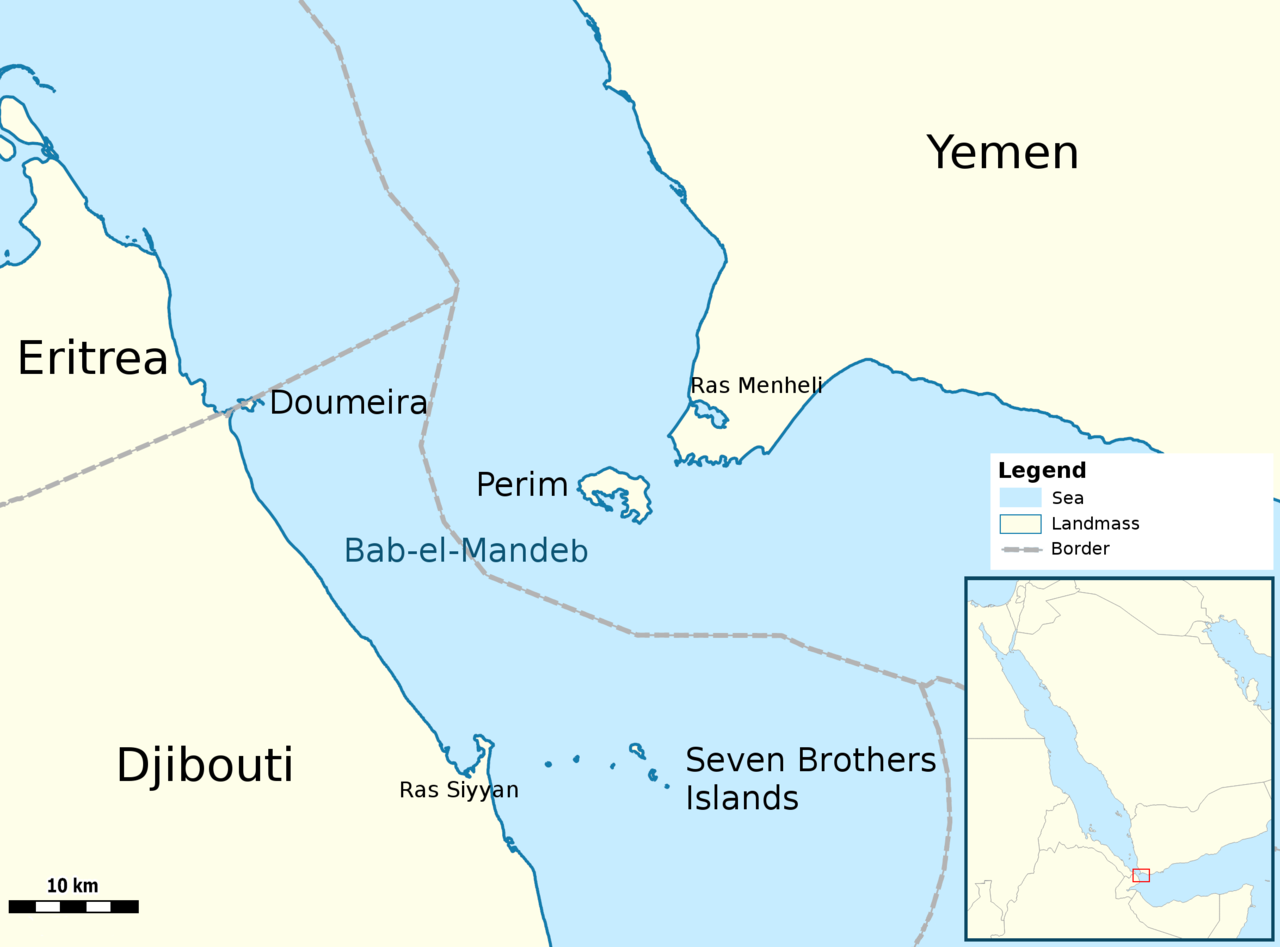
Bab-el-Mandeb is relatively short but complex in form. The strait is divided by the volcanic island of Perim into two channels: an eastern, narrow passage and a wider western passage. Distances across the strait are modest—roughly 20 miles (about 30 km) between prominent headlands on the Yemen and Djibouti/Eritrea coasts—yet depths and currents vary significantly. The narrower eastern channel, sometimes called Alexander's Strait, is only a few kilometres wide and shallow by ocean standards. The western channel is broader and reaches considerably greater depths. Along the African coast a chain of small islands, often grouped as the "Seven Brothers," contributes to navigation complexity.
- Dividing island: Perim, which splits the passage into two channels.
- Eastern channel: narrow, shallower and confined.
- Western channel: wider and deeper, accommodating most large vessels.
- Nearby features: the entry from the Red Sea and connection to the Guardafui Channel and the Gulf of Aden.
History, names and cultural references
The evocative name has multiple traditional explanations. Popular and medieval accounts describe perilous currents, storms and shipwrecks that inspired the title; other local stories refer to a legendary earthquake that separated the continents, an event mentioned in regional lore and sometimes tied to biblical or Qur'anic interpretations. These traditional accounts are part of the strait's cultural footprint and appear in a variety of historical sources and oral histories (legend) that sometimes reference seismic activity (earthquake) and the separation of Asia and Africa.
Strategic and economic importance
Bab-el-Mandeb is a major maritime chokepoint because it links the Red Sea—an artery for trade between Europe and Asia—to the Indian Ocean. Traffic through the strait continues onward via the Suez Canal toward the Mediterranean Sea, making it an essential segment of global shipping routes and energy transport. A significant share of seaborne oil and container traffic transits this route. For example, in the early 21st century several million barrels of oil per day passed through the strait, underscoring its role in global energy logistics and commercial navigation. The presence of busy tanker and cargo traffic places high value on reliable charts, pilotage and maritime security.
- Role in global trade: fast route between Europe and Asia via the Suez Canal (Suez).
- Energy transit: frequent passage of oil and gas shipments bound for international markets.
- Regional economies: main coastal states rely on trade, fishing and services tied to the strait.
Contemporary issues: navigation, security and environment
Because of its strategic value, Bab-el-Mandeb has been the focus of naval patrols, commercial convoy planning and multinational security operations intended to deter piracy, armed boarding and other threats to merchant shipping. Nearby territorial waters and overlapping claims have led to diplomatic attention among littoral states. Environmental concerns include the vulnerability of local marine ecosystems to oil spills, pollution from heavy shipping and the ecological sensitivity of island and coastal habitats. International organizations, regional navies and commercial operators maintain navigational warnings and coordinate to reduce risks to transit.
In navigation practice, maritime authorities emphasize transiting the strait in daylight when possible, using recommended routes, and following traffic separation schemes when they are published. The characteristics of the two channels—one narrow and shallow, the other wider and deeper—shape vessel routing and pilotage decisions. Modern charts and satellite-based services complement traditional local knowledge to keep the passage open for commerce while managing safety and environmental stewardship.
For further reading about regional geography, maritime law, and navigational guidance see resources on the local states and seafaring history, or consult maritime publications and hydrographic offices for up-to-date sailing directions and notices to mariners. Depth and soundings information and historical notes are commonly tabulated in those guides.
Related links: Arabian Peninsula, Red Sea, and practical navigation summaries from international maritime agencies and regional authorities provide current operational detail for mariners and planners.
Questions and answers
Q: What is the Bab-el-Mandeb?
A: The Bab-el-Mandeb is a strait between Yemen on the Arabian Peninsula, Djibouti and Eritrea, north of Somalia, in the Horn of Africa. It connects the Red Sea to the Guardafui Channel and Gulf of Aden.
Q: What does "Bab-el-Mandeb" mean?
A: "Bab-el-Mandeb" means "Gate of Tears" in Arabic.
Q: How did it get its name?
A: The strait gets its name from either the dangers of traveling on it or an Arab legend about those who were drowned by an earthquake that separated Asia and Africa.
Q: What role does Bab el Mandab play?
A: Bab el Mandab acts as an important link between the Indian Ocean and Mediterranean Sea via the Red Sea and Suez Canal.
Q: How much oil passes through it per day?
A: In 2006, about 3.3 million barrels (520,000 m3) of oil passed through the strait per day out of a world total of about 43 million barrels per day (6,800,000 m3/d).
Q: How wide is Bab Iskender (Alexander's Strait)?
A: The eastern channel known as Bab Iskender (Alexander's Strait) is 2 miles (3 km) wide and 16 fathoms (30 m) deep.
Q: What are Seven Brothers?
A: Near the coast of Djibouti is a group of smaller islands known as Seven Brothers.
Tags
Related articles
Author
AlegsaOnline.com Bab-el-Mandeb: the strait linking the Red Sea and the Gulf of Aden Leandro Alegsa
URL: https://en.alegsaonline.com/art/8010
Sources
- eia.doe.gov : World Oil Transit Chokepoints