
Gulf of Aden — Geography, History, and Strategic Importance
The Gulf of Aden is a major waterway between the Arabian Peninsula and the Horn of Africa that links the Red Sea to the Indian Ocean and plays a critical role in global shipping, ecology, and regional history.
Overview
The Gulf of Aden lies between the southern coast of the Arabian Peninsula and the eastern coast of Africa. It forms a seaway that links the Red Sea with the wider Indian Ocean, providing a passage for vessels transiting between Europe and Asia via the Suez Canal. The name is given in several regional languages; in Arabic it is written as Khalīj ʿAdan and in Somali as Khaleejka Cadan. The gulf opens into the Indian Ocean (Indian Ocean) to the east and connects to adjacent seas and channels described below.
Image gallery
5 Images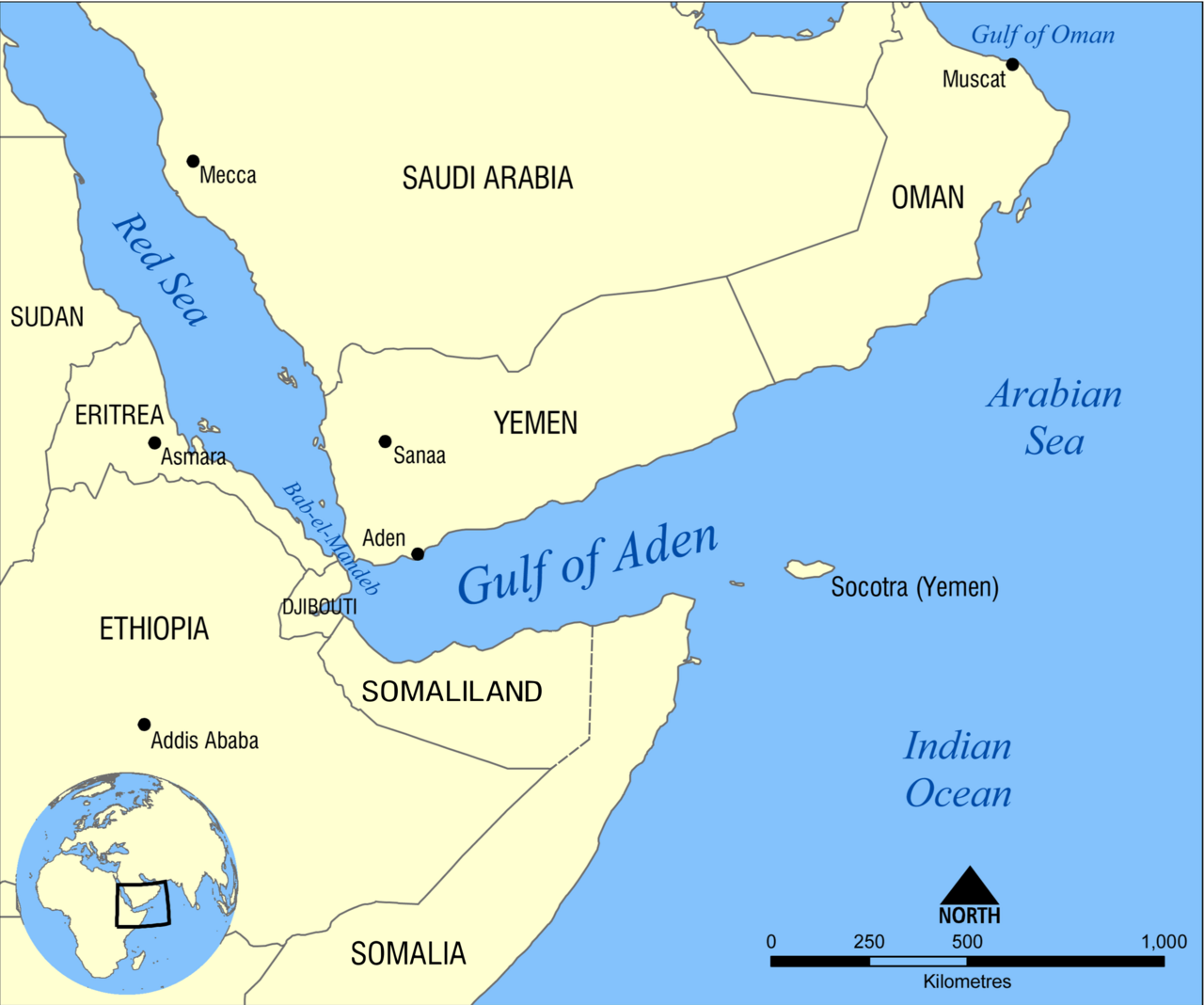



Geography and physical features
Bordered to the north by Yemen and to the south by Somalia, the Gulf of Aden sits at a key junction of continental shelves, deep basins and active ocean currents. Its waters receive seasonal influence from monsoon winds, which can drive coastal upwelling and affect local fisheries. The gulf's shoreline includes rocky promontories, sandy bays and some coral communities that support marine life and local livelihoods.
- Northern shore: Yemen (Yemen).
- Southern shore: Somalia (Somalia) and nearby Horn of Africa coasts.
- Northwest connection: the Red Sea via the Bab el Mandeb strait.
- Southwest connection: the Somali Sea and Guardafui Channel (Somali Sea, Guardafui Channel).
History and navigation
For millennia the gulf has been a corridor for trade, migration and cultural exchange between Africa, Arabia and South Asia. Historically used by sailing dhows and later by steamships, it became a modern strategic artery with the opening of the Suez Canal. Control of the straits and approaches has been important to regional powers and foreign navies. In the early 21st century international efforts concentrated on ensuring safe passage because of threats such as piracy and armed conflict in nearby littoral states.
Economic and strategic importance
The Gulf of Aden carries a substantial share of global commercial shipping, including energy supplies and container traffic. Its waters are patrolled by multinational naval forces when security concerns arise. Fishing, small-scale coastal trade and ports along the gulf contribute to the economies of bordering nations. Mariners and planners often refer to the gulf's geographic coordinates and navigational guides; a representative coordinate near its central area is given as 12°32′45″N, 48°08′44″E.
Environment and conservation
Despite its heavy use as a shipping lane, the gulf supports biologically productive zones where upwelling brings nutrients to the surface. Coral habitats, pelagic fish and marine mammals occur in parts of the region, though they face pressures from overfishing, pollution and coastal development. Cooperation among bordering countries, international organizations and scientific teams aims to better understand and manage environmental risks.
Notable distinctions
The Gulf of Aden is distinct from adjacent bodies of water by function and geography: it is the immediate link between the Red Sea and the Indian Ocean, flanked by named channels and seas such as the Red Sea entrance at the northwest and the neighboring Somali Sea to the south. Its eastern approaches and nearby channels remain central to maritime strategy and trade in the wider region. For more general or navigational references consult regional maritime guides and authoritative oceanographic sources (Arabic name source, Somali name source, Somalia context, Yemen context).
Related articles
Author
AlegsaOnline.com Gulf of Aden — Geography, History, and Strategic Importance Leandro Alegsa
URL: https://en.alegsaonline.com/art/41364