
Florida Keys: geography, ecology, history, and travel
A concise encyclopedia overview of the Florida Keys: an island chain off southern Florida, its geography, climate, ecology, human settlement, and role as a tourism and conservation region.
The Florida Keys are a low-lying archipelago of roughly 1,700 islands extending from the southeastern tip of the United States. They begin near the tip of the Florida peninsula and arc southwest and then westward toward Key West. The chain lies off the coast of the southeast United States and includes both inhabited islands and smaller uninhabited keys such as the Dry Tortugas. Geographically the keys form a rim along the Atlantic Ocean to the east and the Gulf of Mexico to the west, helping define the edge of Florida Bay.
Image gallery
10 Images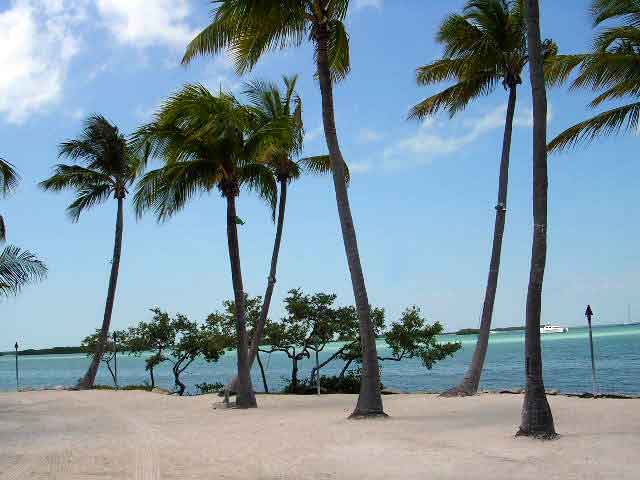


Location, scale, and climate
The southernmost point of the inhabited chain is Key West; from there the Cuban coast lies nearby, a distance commonly stated in nautical and land measures — for example, roughly 98 miles (about 157 km) to Cuba. The keys occupy latitudes between about 23.5° and 25.5° North. Although they are often associated with subtropical settings, climate classifications list much of the area as tropical under the Köppen system; the islands receive warm temperatures year-round and are affected by seasonal tropical storms and hurricanes. The chain also forms part of the ecosystem boundary for Florida Bay, with tidal flows and currents shaping local habitats.
Administration, area and population
Most of the land area of the keys is administered as part of Monroe County, while a small northeastern portion extends into Miami-Dade County, notably within the municipal limit of Islandia. The total land area of the islands is modest compared with mainland Florida. At the 2000 census the population of the keys was recorded as 79,535; population density varies sharply, with the city of Key West concentrating a significant share of residents. Key West also functions as the county seat, while Monroe County includes a mainland portion that lies largely within the Everglades and another section comprised of the island chain from Key Largo to the Dry Tortugas, with the mainland component sometimes described separately from the insular counties near the Everglades mainland.
Island groups and notable keys
The islands are commonly grouped as Upper, Middle and Lower Keys, reflecting their position along the overseas highway and marine channels. Examples of islands in these groups include:
- Upper Keys: Key Biscayne, Key Largo
- Middle Keys: Islamorada, Tavernier, Plantation Key, Long Key, and Marathon
- Lower Keys: Key West and several smaller keys that extend toward the Dry Tortugas
These names are used for administrative, postal and tourism purposes, and many individual keys are home to distinct communities, marinas and conservation areas.
Ecology, economy and human uses
The Keys host a mosaic of habitats—seagrass beds, mangrove shorelines, coral reefs and tidal flats—that support diverse wildlife, including species of fish, sea turtles and birds. The nearby coral reefs are among the northernmost in the continental United States and are important both ecologically and for recreation. Economically, the region depends heavily on tourism, sport fishing, boating and hospitality services, while local communities balance development with conservation efforts, marine protected areas and state and federal regulations aimed at preserving fragile coastal and reef systems.
Transportation and cultural notes
U.S. Route 1, often called the Overseas Highway, links many of the inhabited keys by bridges and causeways and is the principal road access from the mainland. Historically the modern highway follows or replaced 19th- and early 20th-century transport corridors, and the keys have long been a cultural meeting point—mixing maritime, Cuban, Bahamian and mainland American influences—which is reflected in architecture, cuisine and festivals.
Because of their location and low elevation the Florida Keys face environmental pressures, including hurricane risk, sea-level rise, and habitat loss. Management of freshwater resources, wastewater, and coastal development remains central to planning across the island chain as communities and managers work to preserve both the human and natural values of this distinctive region.
archipelago · 1,700 islands · southeast United States · Florida · peninsula · Dry Tortugas · Atlantic Ocean · Gulf of Mexico · Florida Bay · 98 miles · 157 km · Cuba · subtropics · tropical · Köppen · Monroe County · Miami-Dade County · Islandia · Key West · county seat · mainland
Related articles
Author
AlegsaOnline.com Florida Keys: geography, ecology, history, and travel Leandro Alegsa
URL: https://en.alegsaonline.com/art/35211