
Dry Tortugas: islands, Fort Jefferson, and the national park
Remote islands west of Key West notable for Fort Jefferson, coral reefs, seabirds and the Dry Tortugas National Park, accessible by boat or seaplane.
Overview
The Dry Tortugas are a small, remote cluster of islands and reefs off the western end of the Florida Keys. They lie roughly 113 kilometers (113 km / 70 mi) west of Key West and form a distinct, sparsely inhabited outpost within the Dry Tortugas National Park. The archipelago is part of the broader Florida Keys chain and therefore belongs to the United States.
Image gallery
7 Images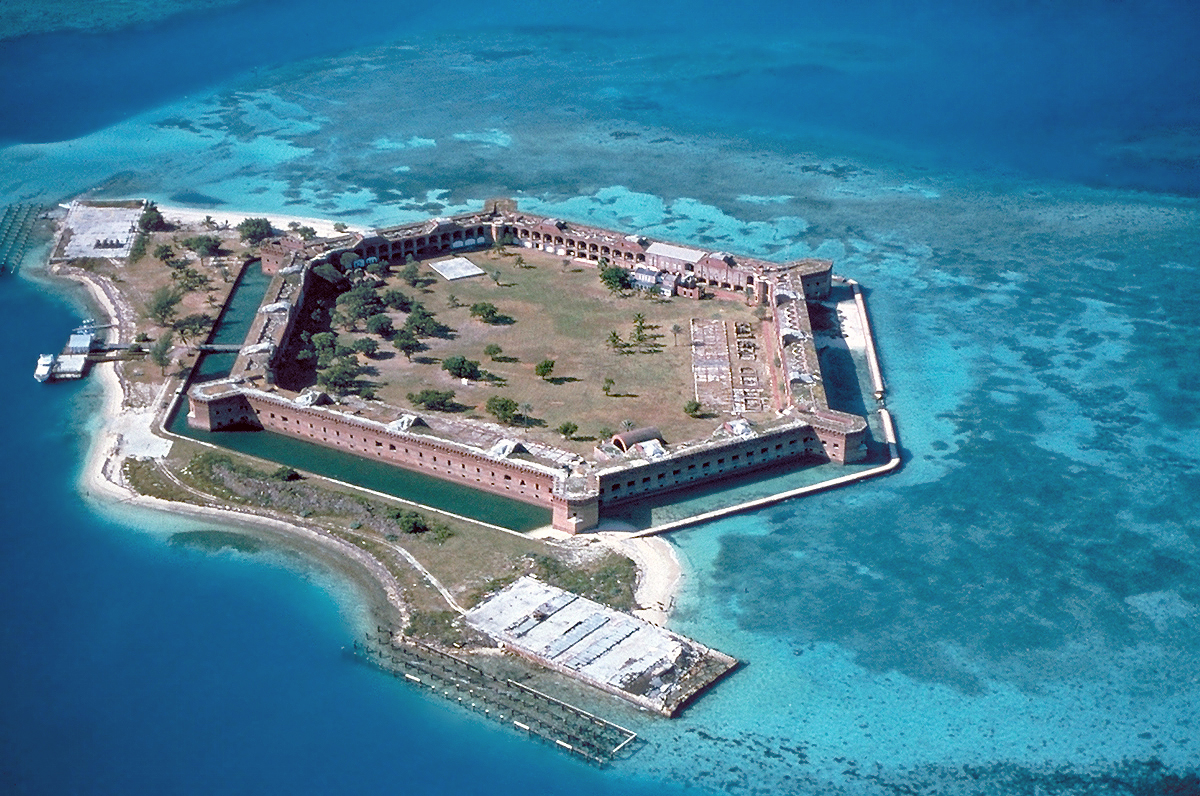


Geography and natural characteristics
The group includes several small islands and surrounding shallow banks and coral reefs. The nearest land features include the Marquesas Keys-area to the east and the submerged Tortugas Bank farther west. The islands rise only a few meters above sea level and are ringed by clear, warm waters that support coral, seagrass, and rich marine life. They provide important habitat for migratory seabirds, nesting terns and frigatebirds, and serve as a stopover for marine species.
History and human use
European awareness of the islands dates to early Spanish exploration: they were sighted during voyages in the early 16th century, often associated in accounts with the year 1513 and explorers such as Juan Ponce de León, reflecting the region's long maritime history and Spanish connections (Spanish navigation and mapping). In the 19th century the United States built Fort Jefferson on one of the larger islands as a coastal fortress and coaling station; the fort later had brief use as a military prison.
Fort Jefferson and cultural significance
Fort Jefferson is a massive, unfinished masonry fortification notable for its size and the extent of its brickwork. It played a role in coastal defense and later became historically notable when it briefly housed prisoners in the post–Civil War era. Today the fort is the central cultural and interpretive feature of the protected area and attracts visitors interested in military architecture and history.
Park status, recreation, and access
Administratively the islands lie within an unincorporated area of Monroe County and are managed as a national park unit. As a protected area they are valued for conservation, research and low-impact recreation. Access to the islands is limited: visitors typically reach the park by ferry, private boat or seaplane from Key West and must follow regulations designed to protect fragile habitats. Popular activities include snorkeling, birdwatching, historic tours of Fort Jefferson, and diving on nearby wrecks and reefs.
Notable facts and distinctions
- The Dry Tortugas are one of the most remote parts of Florida open to the public and are widely appreciated for clear water and abundant marine life.
- The islands combine natural and cultural resources: significant seabird colonies, coral habitats, and a 19th-century masonry fort coexist within the park unit.
- Because of low elevation and sensitive ecosystems, management emphasizes preservation and careful visitor planning; the area illustrates challenges of conserving small island and reef environments.
For more information, maps and park regulations consult official resources and guides: island overview, Florida Keys context, national framework, distance data, imperial distance, Key West services, early sighting, Spanish era, explorer biography, Tortugas Bank, county jurisdiction, and park administration.
Related articles
Author
AlegsaOnline.com Dry Tortugas: islands, Fort Jefferson, and the national park Leandro Alegsa
URL: https://en.alegsaonline.com/art/29054