
Fold mountains: formation, structure, history and significance
Fold mountains are major orogenic belts produced by crustal shortening at convergent margins. This article describes how they form, their structure, historical terminology, examples and their environmental and economic importance.
Overview
Fold mountains are large mountain belts that form where the Earth's outer layers are compressed and deformed, commonly at convergent plate boundaries. Traditionally described as the result of the folding of stratified rock layers, the term has been widely used in physical geography and introductory geology. Modern geoscience, however, treats them as complex orogenic systems in which folding, thrust faulting, crustal thickening and uplift all contribute to building relief.
Image gallery
3 Images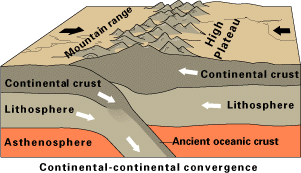


How they form
Fold mountains originate where two tectonic plates move toward one another and compress intervening rock. Sediments that accumulated along continental margins are squeezed, causing layers to buckle into folds, detach along weak horizons (for example, salt layers) and stack as thrust sheets. This process produces zones of intense shortening called fold-and-thrust belts. Along with folding, large-scale thrust faults can transport rock sheets tens to hundreds of kilometres, thickening the crust and driving uplift.
Structure and characteristic features
Typical structural elements include anticlines and synclines (upward and downward folds), thrust faults and nappes—large slabs of rock that have been displaced over other rocks. Metamorphism commonly alters rocks in the deeper parts of the belt, while erosion sculpts sharp ridges and valleys at the surface. Detachment layers such as evaporites can allow rock packages to translate and fold more easily: salt behaviour is often cited as a mechanical facilitator in fold development (salt phenomena).
History of the concept
The label "fold mountain" dates from an era before plate tectonics became the unifying framework for Earth's deformation. Early observers inferred that mountains like the Himalayas were simply folded strata. With the recognition of plate tectonic processes, geologists refined the concept to emphasize crustal shortening, thrusting and plate interactions. Today many specialists prefer terms such as "fold-and-thrust belt" or "orogenic belt" instead of the older phrase fold mountains, though the older name remains common in educational contexts.
Examples and importance
- Well-known belts include the Himalaya–Karakoram system, the Alps, the Appalachians and other continental collision orogens.
- Fold-and-thrust belts often host valuable mineral deposits, structural traps for hydrocarbons, groundwater aquifers and distinctive ecosystems formed by elevational gradients.
- They also concentrate seismic hazard because ongoing plate convergence and slip on faults can produce earthquakes.
Some mountain ranges have mixed origins: for example, parts of the North American Cordillera record both folding and later extensional or compressional events, reflecting a complex tectonic history linked to evolving plate boundaries and terrane accretion. The broader framework of plate tectonics explains why fold-and-thrust belts are concentrated at particular margins of continents and why their architecture varies with time and convergence style.
Distinctions, applications and notable facts
Fold mountains differ from block (fault-block) mountains, which are formed mainly by tensional faulting, and from volcanic ranges created by magma ascent. In many fold belts, a mix of folding and thrust faulting produces nappes and stacked sequences whose study informs understanding of past plate motions and climate evolution. Geologists combine field mapping, seismic imaging and stratigraphic analysis to unravel these histories and to locate resources. For accessible introductions and maps of orogenic belts, consult general geology resources or regional summaries such as those used in Earth's crust studies and educational physical geography materials. For plain-language overviews and further reading see curated educational sites and textbooks (mountain and tectonics pages) and targeted technical reviews (folding and specific orogen summaries).
Understanding fold mountains is important for hazard assessment, resource exploration and reconstructing the geological evolution of continents. Although the phrase "fold mountain" can still be useful in broad descriptions, precise geological work relies on detailed structural and tectonic vocabulary to reflect the many processes that create and modify these prominent features on Earth.
Questions and answers
Q: What are fold mountains?
A: Fold mountains are mountains formed mainly by the effects of folding on layers in the upper part of the Earth's crust.
Q: Why is the term "fold mountains" rather out of date?
A: The term "fold mountains" is rather out of date because it was used before plate tectonics became well understood.
Q: What are mountain belts?
A: Mountain belts are mountain ranges that were previously called fold mountains.
Q: How are mountain belts formed?
A: Mountain belts are not caused by the folding of the earth's crust. The main mechanism causing a thickening of the crust at these sites of continent-continent collision along the boundary is thrust faulting.
Q: How are fold mountains formed?
A: Fold mountains are formed when two tectonic plates move together and are usually formed from sedimentary rocks which accumulated along the margins of continents.
Q: What happens to the accumulated layers of rocks when the plates and continents riding on them collide?
A: When plates and the continents riding on them collide, the accumulated layers of rock may crumple and fold like a tablecloth that is pushed across a table, particularly if there is a mechanically weak basal layer such as salt.
Q: What is the main cause of fold mountains?
A: The main cause of fold mountains is the movement of two tectonic plates towards each other at a convergent plate boundary.
Related articles
Author
AlegsaOnline.com Fold mountains: formation, structure, history and significance Leandro Alegsa
URL: https://en.alegsaonline.com/art/35354
Sources
- ethlife.ethz.ch : "Fold mountains slip on soft areas"