
Yellow-billed magpie (Pica nuttalli)
Overview of the yellow-billed magpie, a California endemic songbird: appearance, behavior, taxonomy, breeding, threats and conservation status.
The yellow-billed magpie (Pica nuttalli) is a distinct, medium-sized member of the crow family known for its glossy black-and-white plumage and a bright yellow bill. Often observed in social groups, this bird has a limited geographic range and a set of behaviors and habitat preferences that set it apart from other magpies. For general context on related species see magpie and on its broader classification as a songbird within the crow family.
Image gallery
2 Images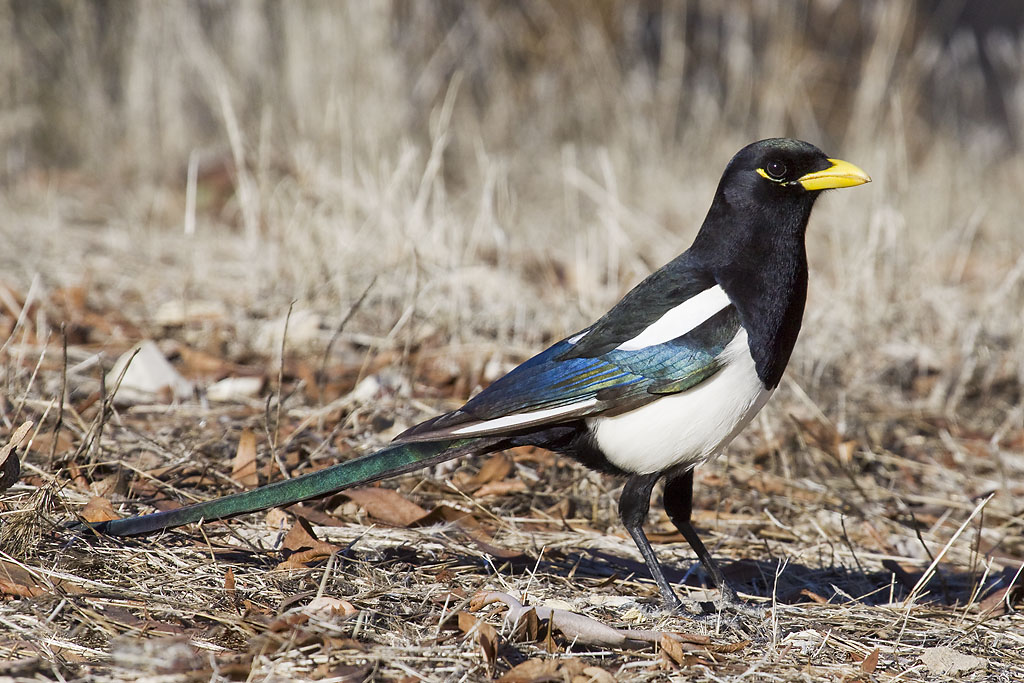

Range and habitat
Unlike many widespread corvids, the yellow-billed magpie is endemic to California. It is most common in the warm, dry oak savannas, riparian corridors and shady valleys of the state's central lowlands, including much of the Central Valley. Within that range it favors open areas with scattered trees for nesting and adjacent fields or pastures for foraging.
Appearance and behaviour
This species has the characteristic long tail and striking black-and-white pattern of magpies, but its pale yellow bill and facial bare skin are immediately diagnostic. Yellow-billed magpies are omnivorous and opportunistic: their diet includes insects, seeds, agricultural grain and fruit, and they will take carrion, small vertebrates and eggs when available. Socially they nest in loose colonies and feed in flocks that can number several dozen birds.
Breeding and life cycle
The breeding season typically begins in spring. Pairs and small colonies start nests in April, and by the end of June many chicks have fledged; the staggered timing of nesting allows groups to raise multiple broods or to buffer against local failures (see timing references at end of June). Nests are commonly built in oak or riparian trees and colonies may include three to thirty nests clustered where food and nesting sites coincide.
Taxonomy and evolutionary history
First formally described by John James Audubon, who initially placed it in the genus Corvus, the species honors the naturalist Thomas Nuttall in its scientific name. Within Pica the yellow-billed magpie is most closely related to the North American black-billed magpie (Pica hudsonia). Genetic and biogeographic evidence suggests that a common ancestor crossed from Kamchatka to Alaska and, during the Pleistocene, populations were split by glaciation and the uplift of ranges such as the Rocky Mountains. The California population became isolated in a comparatively warm climate and developed the yellow bill and other local adaptations.
Conservation and notable threats
The yellow-billed magpie was once abundant across its natural range, but populations declined after the arrival of West Nile virus in North America following 1999 and from ongoing loss and fragmentation of suitable habitat. While not universally classified as endangered, some local populations remain vulnerable and conservationists monitor disease impacts, habitat change, and human-related mortality. Maintaining oak woodland patches, protecting riparian corridors and reducing disease transmission risks are central to efforts that help sustain this California endemic.
Quick facts
- Scientific name: Pica nuttalli.
- Distinctive features: yellow bill, black-and-white plumage, long tail.
- Distribution: restricted to California lowlands and adjacent valleys.
- Diet: omnivorous— insects, seeds, carrion, small vertebrates and eggs.
- Social structure: nests in loose colonies; forages in flocks.
For further reading on related topics or more detailed species accounts, consult regional bird guides and peer-reviewed studies that address its ecology, genetics and conservation status.
Related articles
Author
AlegsaOnline.com Yellow-billed magpie (Pica nuttalli) Leandro Alegsa
URL: https://en.alegsaonline.com/art/109758
Sources
- birdlife.org : Yellow-billed Magpie Pica nuttalli
- bna.birds.cornell.edu : Yellow-billed Magpie (Pica nuttalli)
- bna.birds.cornell.edu : The Birds of North America Online
- dx.doi.org : 10.2173/bna.180