
Yellowfin tuna (Thunnus albacares)
A large, fast-swimming tropical tuna species valued by commercial and sport fisheries; known as ahi in many markets and recognized by its bright yellow fins.
The yellowfin tuna (Thunnus albacares) is a widely distributed pelagic fish found in warm oceanic waters around the world. It is commonly sold and eaten under the Hawaiian name ahi, a term also applied locally to the related bigeye tuna. The species inhabits tropical and subtropical seas and is one of the most important tropical tuna for global fisheries and coastal economies; general information about tuna biology and fisheries can be found via tuna resources and regional guides to ocean regions.
Image gallery
10 Images

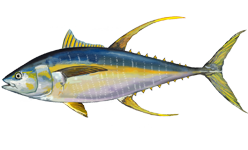


Appearance and identifying features
Yellowfin are streamlined, muscular fish with a metallic dark blue to black back and silvery sides. Their most striking trait is the set of long, bright yellow dorsal and anal fins and a series of yellow finlets toward the tail. Adults commonly reach lengths greater than one meter and develop a slender, powerful body adapted for sustained swimming and surface feeding.
Biology and behavior
These tunas are fast, highly migratory predators. They feed on schooling fish, squid and crustaceans and often associate with floating objects and dolphins when foraging. Spawning occurs in warm offshore waters, with eggs and larvae dispersed in the pelagic zone. Growth is relatively rapid; individuals mature and contribute to fisheries within a few years.
Fisheries, uses and culinary importance
Yellowfin supports a variety of fishing methods including purse seine, longline and pole-and-line. Purse seining around fish aggregating devices (FADs) and unassociated schools yields large catches for canned and fresh markets. It is prized for steaks and sashimi — particularly as ahi — and is also targeted by recreational anglers. Management aims to balance livelihood needs with stock health.
Conservation, management and notable facts
Populations are monitored by regional fisheries management organizations; some stocks face pressure from high fishing effort and bycatch issues. Sustainability programs and selective gear practices are used to reduce impacts. The species name albacares can be misleading: despite that epithet, the albacore is a different species. In European languages this confusion sometimes leads to alternate common names among French and Portuguese fishers. The yellowfin is also culturally significant in parts of the Indian Ocean and is the national fish of the Maldives.
- Key identifiers: yellow dorsal and anal fins; metallic blue back.
- Common uses: fresh steaks, sashimi (ahi), canning.
- Main threats: overfishing, bycatch, and FAD-associated fishing impacts.
Related articles
Author
AlegsaOnline.com Yellowfin tuna (Thunnus albacares) Leandro Alegsa
URL: https://en.alegsaonline.com/art/109779