
Black-billed magpie (Pica hudsonia)
A North American corvid with striking black-and-white plumage and long tail; adaptable omnivore, socially complex, widespread west of the Appalachians and common in open temperate landscapes.
Overview
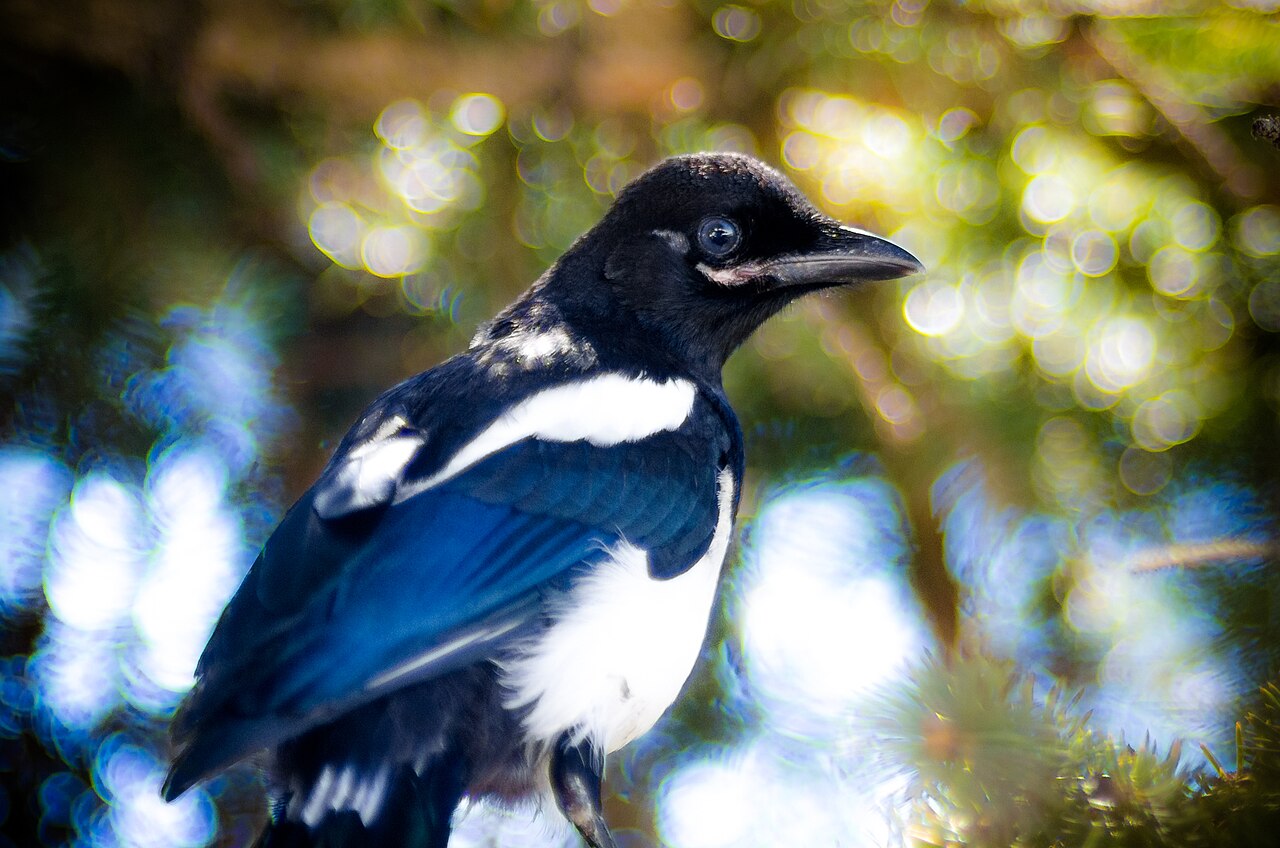
The black-billed magpie (Pica hudsonia) is a medium-sized member of the crow family noted for its glossy black-and-white plumage, long graduated tail and a distinctly black bill. A passerine or songbird in the corvid group, it is widespread across western and northwestern North America where it occupies open, temperate habitats such as grasslands, parkland and agricultural edges. The species is highly adaptable and often lives near people, scavenging and hunting in a range of environments.
Image gallery
9 Images




Identification and notable characteristics
Black-billed magpies are unmistakable in the field because of their contrasting plumage and long tails. Key features include:
- Plumage: white belly and shoulder patches set against iridescent black head, back and tail.
- Bill and legs: entirely black, distinguishing it from the related yellow-billed magpie.
- Size and shape: medium-sized corvid with a long, wedge-shaped tail and a robust, slightly decurved bill.
- Voice and behavior: a variety of harsh calls, gurgles and chattering; bold and curious, often seen perching conspicuously or foraging on the ground.
For general context about magpies as a group, see magpie and their place among songbirds. The black-billed magpie belongs to the broader corvid family (Corvidae), which includes crows, ravens and jays.
Distribution and habitat
Black-billed magpies occur primarily in the western half of North America, broadly west of the Appalachian region and extending into northern areas while avoiding the largest desert regions. Their range favors open country with scattered trees, riparian corridors and human-modified landscapes where perches and nesting sites are available. See regional range summaries at range resources.
Diet and ecological role
Magpies are omnivores with a flexible diet that helps explain their success across varied habitats. Typical food items include:
- Insects and other invertebrates
- Seeds and grains
- Small vertebrates and nestlings
- Carrion and human food scraps
- Eggs and occasional fruit
This opportunistic feeding makes them important as both predator and scavenger, influencing local food webs and occasionally bringing them into conflict with people or poultry producers. For details on prey and foraging behavior see diet studies.
Reproduction and social structure
Black-billed magpies commonly form long-term monogamous pairs that defend a territory during the breeding season. Nests are bulky, domed structures placed in trees or large shrubs. Breeding typically begins in spring, with eggs hatched and chicks fledging over several weeks. They are social outside of the breeding season and may gather in family groups or loose flocks.
Evolution, relatives and taxonomy
Within the genus Pica the black-billed magpie is closely related to the yellow-billed magpie of California (Pica nuttalli). Both species share a common ancestor that dispersed from northeastern Asia into North America during glacial cycles of the Pleistocene. Geological events such as the glaciation of mountain ranges and subsequent isolation led to divergence; for background on this history see Pica relatives, yellow-billed magpie, and migration hypotheses linking Kamchatka to Alaska. Mountain glaciation and climatic shifts, including effects tied to the Rocky Mountains, shaped regional evolution and isolation in warmer refugia such as parts of California and other western valleys (warm-climate refugia).
Conservation and human interactions
The black-billed magpie is currently considered common and its populations are stable across most of its range. It benefits from human-altered landscapes but can be locally persecuted for taking eggs or poultry. In culture and folklore the magpie has a mixed reputation, admired for intelligence and curiosity while sometimes viewed as thievish because of its habit of collecting shiny objects. For conservation status and further reading visit resources such as general magpie information and regional species accounts linked above.
Further notes
Because magpies are intelligent corvids, they are subjects of behavioral research into problem solving, social learning and memory. Their adaptability and conspicuous habits make them familiar birds for many people across western North America.
Questions and answers
Q: What is the black-billed magpie?
A: The black-billed magpie is a type of songbird and member of the crow family with black and white plumage and a black beak.
Q: Where does the black-billed magpie live?
A: The black-billed magpie lives in North America west of the Appalaches and north of the big Deserts.
Q: What kind of landscape can the black-billed magpie be found in?
A: The black-billed magpie can be found in temperate, open landscape.
Q: What is the black-billed magpie's diet?
A: The black-billed magpie is an omnivorous species that feeds on insects, carrion, seeds, small vertebrates, and eggs.
Q: When does the breeding season of the black-billed magpie start?
A: The breeding season of the black-billed magpie starts in May.
Q: How long does it take for all of the black-billed magpie chicks to fledge?
A: It takes until the end of June for all of the black-billed magpie chicks to fledge.
Q: Is the black-billed magpie an endangered species?
A: No, the species' population is stable and it is currently not considered as endangered.
Related articles
Author
AlegsaOnline.com Black-billed magpie (Pica hudsonia) Leandro Alegsa
URL: https://en.alegsaonline.com/art/11890
Sources
- bna.birds.cornell.edu : Black-billed Magpie (Pica hudsonia)
- bna.birds.cornell.edu : The Birds of North America Online
- dx.doi.org : 10.2173/bna.389
- iucnredlist.org : iucnredlist.org/apps/redlist/details/106005745/0/full