
Yutyrannus — large feathered tyrannosauroid of the Early Cretaceous
Yutyrannus huali, a large Early Cretaceous tyrannosauroid from northeastern China, is the largest dinosaur known from direct feather impressions; its fossils illuminate integument, ecology, and evolution of feathers.
Overview
Yutyrannus huali is a genus of tyrannosauroid theropod dinosaur from the Early (Lower) Cretaceous of northeastern China. The name, often rendered as "feathered tyrant," reflects two notable facts: its relationship to later tyrannosaurids and the preservation of filamentous integumentary structures that are interpreted as feathers. Yutyrannus is significant because it is the largest—or among the largest—dinosaurs for which direct evidence of feathers has been described, changing how scientists think about the distribution of feathers among large predatory dinosaurs.
Image gallery
10 Images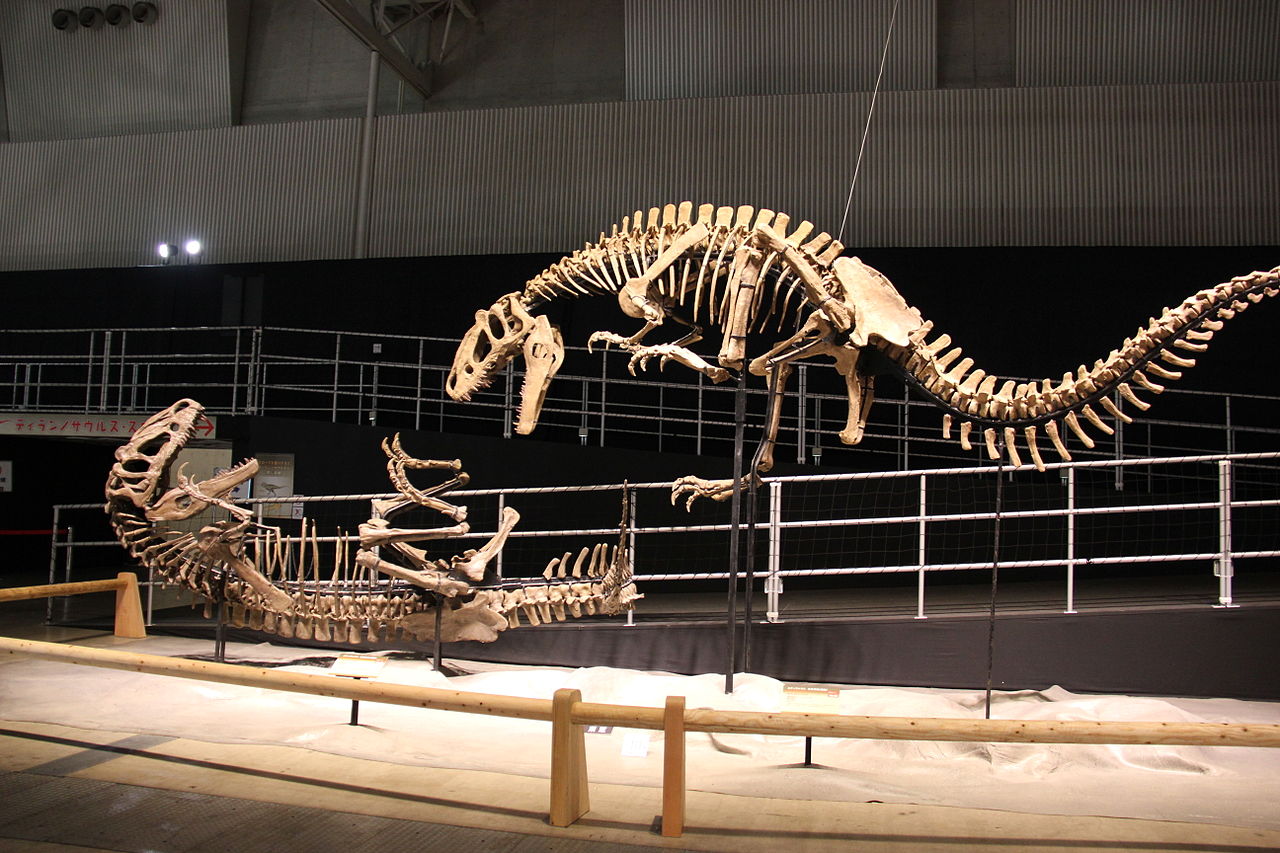


Physical characteristics
Known from three nearly complete specimens representing different life stages (adult, subadult and juvenile), Yutyrannus is estimated to have reached about 10 metres in length and roughly 3 metres in hip height. The skeleton shows the broad skull and robust hindlimbs typical of basal tyrannosauroids, but it retained some primitive features absent in later, larger tyrannosaurids.
- Feathers: Fossils preserve long, filament-like feathers up to about 20 centimetres long on parts of the body. These structures are simple and hairlike rather than the complex, vane-bearing feathers seen on birds.
- Limbs and build: The forelimbs are relatively short compared with the hindlimbs; the pelvis and hindlimb proportions suggest an active, bipedal animal adapted for predation or scavenging.
- Ontogeny: Multiple sized specimens allow comparison of growth stages, showing changes in proportions as individuals matured.
Discovery, age and geology
Specimens of Yutyrannus were recovered from Early Cretaceous deposits in Liaoning Province, a region famous for exceptionally preserved fossils and for the Jehol Biota. The rocks that yielded the specimens are commonly attributed to the Yixian Formation, which preserves a rich assemblage of plants, invertebrates and vertebrates including other feathered dinosaurs. Radiometric and biostratigraphic work places these beds in the Early Cretaceous; many accounts cite an age of roughly 125 million years.
Three articulated skeletons were acquired through collectors and prepared for study; they are interpreted as a small sample from a single locality or closely related exposures. The presence of multiple individuals helps paleontologists infer aspects of behaviour, growth and variation within the species.
Paleobiology and function of feathers
Because Yutyrannus was far too large to fly, its feathers are interpreted as serving non-volant functions. Leading hypotheses include thermal insulation, particularly useful in temperate or seasonal climates; visual display for signalling between individuals; and possibly aiding in brooding or covering young. Simple filamentous feathers in basal coelurosaurs likely preceded the evolution of complex pennaceous feathers used for flight in later theropod lineages.
Comparison with smaller feathered theropods suggests a mosaic of integument types across theropod groups: some large taxa retained filamentous coverings while others show evidence of scales or reduced plumage. These patterns bear on questions about thermoregulation, ecology, and the evolutionary origins of feathers.
Significance and distinctions
Yutyrannus challenged the assumption that large predatory dinosaurs were universally scaly by providing direct evidence that sizeable tyrannosauroids could carry substantial feather coverings. It is often contrasted with smaller feathered taxa such as Beipiaosaurus; some reports note that Yutyrannus is many times heavier than such earlier finds, illustrating how integumentary structures persisted as body size increased.
Phylogenetically, Yutyrannus occupies a position among basal members of the lineage that later produced Tyrannosaurus rex and its kin. Its combination of primitive and derived traits makes it an important taxon for tracing the evolutionary steps that led to classic tyrannosaurid anatomy.
Further reading and resources
For general background on classification you can consult a summary of tyrannosauroid relationships. For the geological context see resources on the Lower Cretaceous and the Yixian Formation. Comparative information about other feathered dinosaurs such as Beipiaosaurus highlights differences in size and integument. Information on the discovery region is available through materials about northeastern China fossil sites; specimen histories and museum records are discussed in accounts of the three recovered fossils. Discussions of non-flight feather functions are summarized in works about feather function and evolution.
Questions and answers
Q: What is Yutyrannus?
A: Yutyrannus is an early forebear of Tyrannosaurus rex and a Tyrannosauroid dinosaur that lived 124.6 million years ago.
Q: What is the size of Yutyrannus?
A: Yutyrannus was about 10 meters long and 3 meters tall, making it one of the largest known dinosaurs with direct evidence of feathers.
Q: What is unique about Yutyrannus' feathers?
A: Yutyrannus' feathers were long, up to 20 centimeters, and filamentous. It is the largest known dinosaur with direct evidence of feathers.
Q: Where were the fossils of Yutyrannus found?
A: The fossils of Yutyrannus were found in Liaoning Province, which is now northeastern China.
Q: What functions did Yutyrannus' feathers have?
A: Yutyrannus' feathers supported other functions such as temperature regulation and visual signaling.
Q: How many fossils of Yutyrannus have been found and where were they found?
A: Three fossils of Yutyrannus, including an adult, a subadult, and a juvenile, were found in the rock beds of Liaoning Province, China.
Q: Could Yutyrannus fly?
A: No, Yutyrannus could not fly due to its size.
Related articles
Author
AlegsaOnline.com Yutyrannus — large feathered tyrannosauroid of the Early Cretaceous Leandro Alegsa
URL: https://en.alegsaonline.com/art/110277
Sources
- nytimes.com : "Bus-size dinosaurs, as fuzzy as chicks"
- youtube.com : "New flying T-Rex discovered!?"
- redorbit.com : "New dinosaur species is largest known feathered animal"
- news.nationalgeographic.com : "One-ton feathered dinosaur found: fluffy and fierce"
- doi.org : 10.1038/nature10906
- pubmed.ncbi.nlm.nih.gov : 22481363
- xinglida.net : xinglida.net/pdf/Xu_et_al_2012_Yutyrannus.pdf
- csmonitor.com : "Humongous fuzzy dinosaur unearthed in China"