
Solar wind
The solar wind is a continuous flow of charged particles and magnetic field from the Sun that shapes the heliosphere, drives space weather, and interacts with planets, comets and spacecraft.
Overview
The solar wind is a persistent outflow of ionized gas from the Sun that fills the region of space dominated by the Sun's magnetic field. It consists primarily of charged particles — mainly protons, electrons and helium nuclei — embedded in a magnetized plasma. Together these particles and fields create the heliosphere, the bubble in which the planets orbit. The wind flows outward through the Solar System and ultimately meets interstellar space beyond the heliopause; its influence extends across many astronomical scales.
Image gallery
10 Images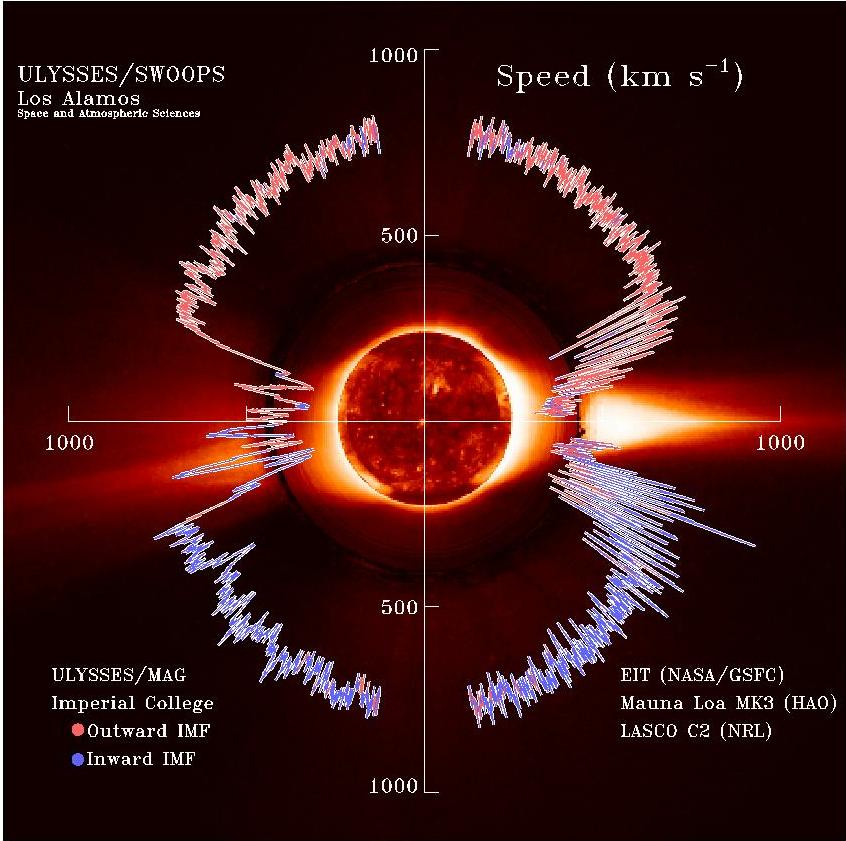




Properties and behavior
Typical solar wind speeds at Earth's orbit range from a few hundred to several hundred kilometres per second. At distances of a few solar radii the flow becomes supersonic and remains so until it encounters the heliospheric termination region. The wind carries the solar magnetic field into space, producing the interplanetary magnetic field and large-scale structures such as streams and shocks. Two common components are the fast wind, emerging from coronal holes, and the slower wind associated with the Sun's equatorial regions and streamers. Transient eruptions known as coronal mass ejections (CMEs) inject denser, faster plasma and strong magnetic fields that can disturb the steady flow.
Origins, cycle and variability
The solar wind originates in the Sun's hot outer atmosphere, the corona. Magnetic processes there heat and accelerate coronal plasma so it can escape the Sun's gravity. Its properties change with the roughly 11‑year solar activity cycle: during solar maximum eruptions and CMEs are more frequent, while during solar minimum the fast wind from persistent coronal holes is more widespread. Localised regions, shocks and interaction regions produce variability on timescales from minutes to years.
Effects on planets, comets and technology
When the solar wind encounters a planet it interacts with any intrinsic magnetic field and atmosphere. Earth's magnetic field deflects much of the flow, channeling energy into the polar regions and generating the aurora. Space weather driven by solar wind disturbances can disrupt satellites, degrade communications, and present radiation hazards to astronauts and spacecraft. Powerful geomagnetic storms have caused electrical outages on Earth, most notably the 1989 Quebec blackout, and historical events such as the 1859 Carrington storm represent benchmarks for potential societal impact. The solar wind also sculpts cometary comae and tails: when a comet's ice sublimates the newly released gases and dust are swept into a tail by the flow, which points away from the Sun rather than trailing the comet's orbit. In addition, tenuous atmospheres of bodies like Mars are eroded by persistent solar wind interaction.
Measurement and exploration
Direct study of the solar wind has been a major focus of space missions and experiments. Instruments measure particle fluxes, composition, speed and magnetic field to characterise plasma conditions. Historical studies include the Apollo-era Solar Wind Composition Experiment, which collected particles for laboratory analysis as part of the Apollo program. More recent probes such as ACE, Wind, Ulysses and the Parker Solar Probe have explored the wind at various distances and latitudes, revealing its three-dimensional structure and the microphysics of particle acceleration and turbulence.
Why the solar wind matters
- It defines the heliospheric environment that shields and shapes near-Earth space and interplanetary travel.
- Solar wind interactions drive space weather with direct consequences for satellites, power grids and human activities in space.
- Studying the wind helps scientists understand fundamental plasma processes and the behavior of other stellar winds across the galaxy.
For introductory background and mission details see resources on solar and heliospheric science: charged particles, protons, electrons, plasma, heliosphere, Solar System, interstellar interaction, astronaut radiation, spacecraft effects, Earth's magnetic field, auroral displays, Quebec blackout, comet tails, sublimation, volatile release, Solar Wind Composition Experiment, and Apollo program.
Related articles
Author
AlegsaOnline.com Solar wind Leandro Alegsa
URL: https://en.alegsaonline.com/art/91650
Sources
- ui.adsabs.harvard.edu : 2003GeoRL..30.1517M
- doi.org : 10.1029/2003GL017136
- worldcat.org : 1944-8007
- doi.org : 10.1029/2019SW002278
- doi.org : 10.1029/2002JA009504