
Plasma (physics): the ionized state of matter and its properties
Plasma is an ionized state of matter whose charged particles respond to electromagnetic fields; it dominates the visible universe and has many natural and technological roles.
Overview
Plasma is a distinct state of matter in which a significant fraction of the constituent atoms or molecules have lost one or more electrons and exist as a mixture of free electrons and positively charged ions. This process, commonly called ionization, gives the medium collective electromagnetic behavior that differs fundamentally from neutral gases, liquids, and solids. Because the particles carry electric charge, plasmas are strongly affected by both electric fields and magnetic fields, producing phenomena such as currents, waves, and filamentary structures that do not appear in ordinary gases.
Image gallery
10 Images
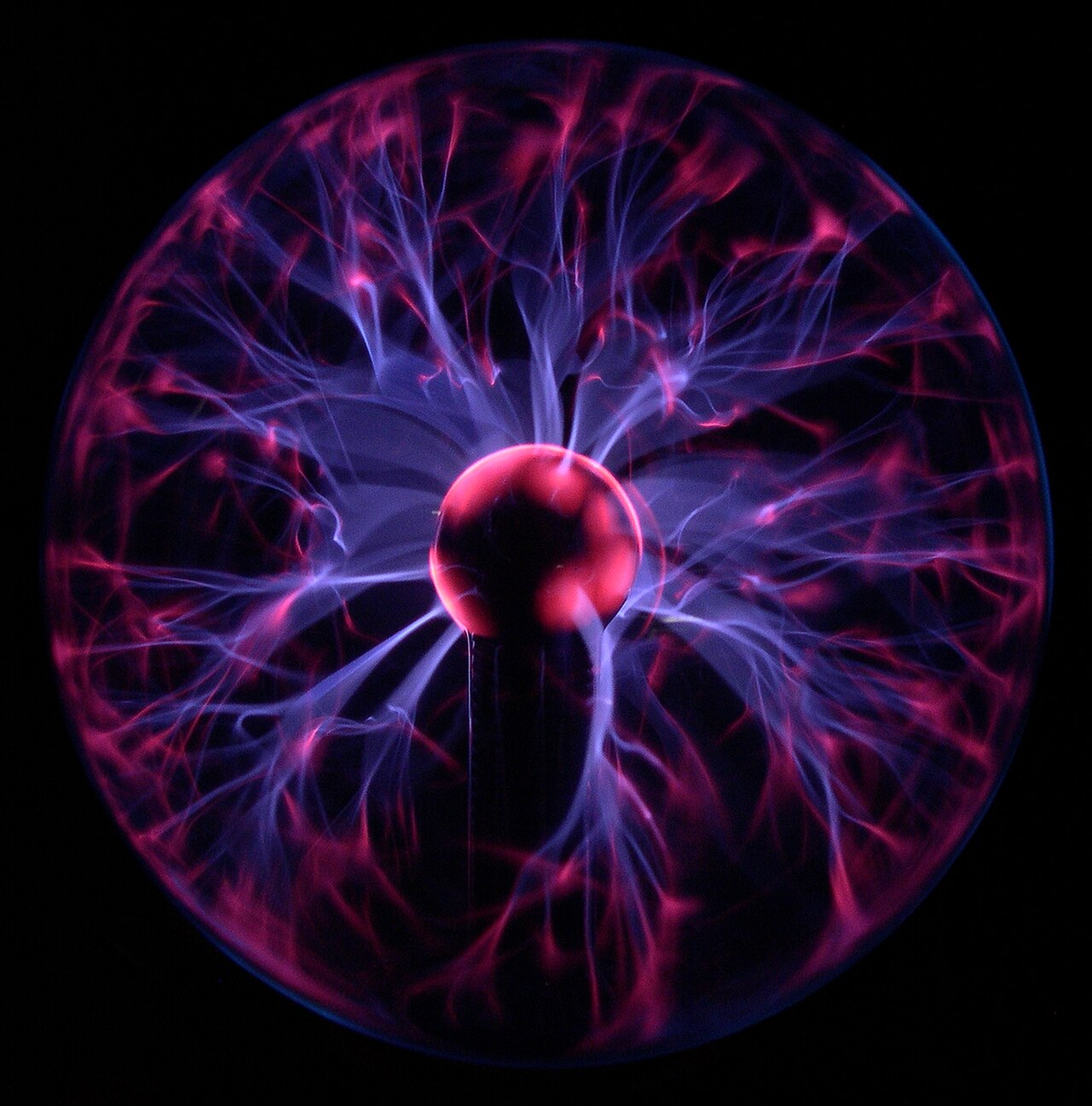





Key characteristics
In a plasma the basic constituents are free electrons and positive ions, arising from the partial or complete removal of electrons from atoms. These charged particles interact via long-range electromagnetic forces, so local disturbances can propagate and organize over distances much larger than the mean free path of neutral particles. Plasmas typically conduct electricity better than many metals, so comparisons sometimes state that plasma is a better electrical conductor than copper under similar conditions. Their temperature and density vary widely: some plasmas are extremely hot, as in the interiors of stars, while others are tenuous and cold, as in the low-density regions of outer space. Changes in heat or particle energy can cause recombination, when electrons reattach to ions and the plasma returns to a neutral gas.
Formation, behavior, and distinctions
Plasma can be produced by supplying enough energy—via heat, electrical discharge, strong radiation, or particle beams—to overcome the binding energy that holds electrons to nuclei, a process that requires high temperatures or intense fields in many cases. Once formed, the charged components permit the medium to support electric currents and a rich variety of collective motions such as oscillations, instabilities, and magnetically guided flows. Magnetic confinement, for example, can control a plasma in ways impossible for neutral gases, enabling devices that trap and steer charged populations using fields.
Natural and technological examples
Plasma is ubiquitous in the cosmos: more than 99% of the visible universe is in a plasma state, including the material composing the Sun and most other stars, where extreme pressures and temperatures exist. On Earth, visible manifestations include lightning and the aurora; in the upper atmosphere and in interplanetary space plasmas occur at low densities. Humans have created and harnessed plasmas for many purposes: gas-discharge lamps such as fluorescent tubes and neon signs, low-pressure industrial plasmas for materials processing, and display technologies like plasma displays used with television-type screens. Other examples include plasma globes and laboratory discharges used for research and education.
Applications, research, and significance
Plasma science underpins important technologies in lighting, electronics fabrication, surface coating, and propulsion. A major research area is controlled thermonuclear fusion, where hot plasmas are being studied and confined with magnetic or inertial methods to achieve conditions for energy-producing fusion reactions. Experimental programs and devices investigate fusion as a potential large-scale energy source that could avoid many drawbacks of conventional nuclear power. In laboratory and space physics, scientists probe plasma instabilities, wave-particle interactions, and magnetic reconnection to understand both practical devices and astrophysical processes. Geophysicists and astronomers study plasmas to explain phenomena from the solar wind to stellar evolution and cosmic structure formation, since most visible cosmic matter exists in this state.
Summary and further reading
Plasma is the ionized state of matter distinguished by its charged particles and responses to electromagnetic forces. It spans a wide range of temperatures and densities and plays central roles in nature and technology. For readers seeking introductory resources or specialized topics, authoritative reviews and textbooks cover atomic processes, magnetohydrodynamics, laboratory techniques, and fusion research. Practical introductions touch on how Earth's environment and human technology make and use plasmas, while advanced studies link plasma behavior to the dynamics of fusion research and astrophysical systems. Additional topical entries can explain how specific examples—such as pressure effects, electric fields, and the role of electrons and ions—influence observed behavior.
- Natural plasmas: Lightning, space plasmas, stellar interiors
- Human-made plasmas: plasma displays, neon and fluorescent lamps, industrial processing
- Research topics: fusion, magnetically confined plasmas, reconnection, waves and instabilities
For a concise starting point, readers often explore introductory courses or summaries that explain how ionization creates charged components, how electromagnetic fields shape their dynamics, and why plasma physics is essential to understanding both everyday devices and cosmic structures.
Questions and answers
Q: What is plasma?
A: Plasma is a 4th state of matter created by adding energy to a gas so that some of its electrons leave their atoms. This process is called ionization, and results in negatively charged electrons and positively charged ions.
Q: How does plasma react to electric and magnetic fields?
A: The charged particles in a plasma react strongly to electric and magnetic fields (i.e. electromagnetic fields).
Q: What happens when a plasma loses heat?
A: When a plasma loses heat, the ions will re-form into a gas, emitting the energy which had caused them to ionize.
Q: What percentage of matter in the visible universe is believed to be plasma?
A: Over 99% of the matter in the visible universe is believed to be plasma.
Q: How can magnetic fields be used with plasmas?
A: Magnetic fields can be used to hold a plasma, but not to hold a gas.
Q: Is plasma better than copper as an electrical conductor?
A: Yes, Plasma is usually better than copper as an electrical conductor.
Q: What are some artificial uses for plasmas on Earth?
A: Artificial (man-made) uses for plasmas on Earth include fluorescent light bulbs, neon signs, and plasma displays used for television or computer screens. Plasma lamps and globes are also popular children's toys and room decorations.
Related articles
Author
AlegsaOnline.com Plasma (physics): the ionized state of matter and its properties Leandro Alegsa
URL: https://en.alegsaonline.com/art/77307