
Earth's magnetic field: origin, structure, and effects
The geomagnetic field surrounding Earth is generated by motions in the metallic core. It shapes the magnetosphere, guides navigation and animals, varies over time, and records geological history.
The Earth’s magnetic field, often called the geomagnetic field, is the magnetic region that surrounds the planet and extends into space. It behaves in many respects as if produced by an internal magnet but is in reality generated by moving electrically conducting fluid in the planet’s interior. The field interacts with the stream of charged particles from the Sun and helps define the magnetosphere, a dynamic space environment that modulates particle entry and produces familiar phenomena such as the auroras. For a basic definition see magnetic field and for context about the planet see Earth.
Image gallery
10 Images


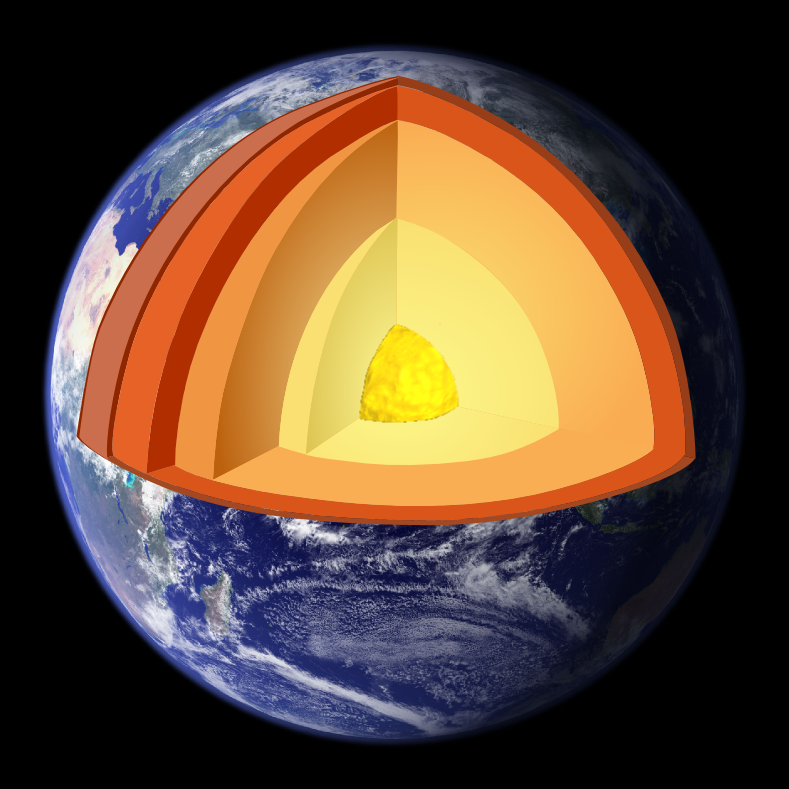
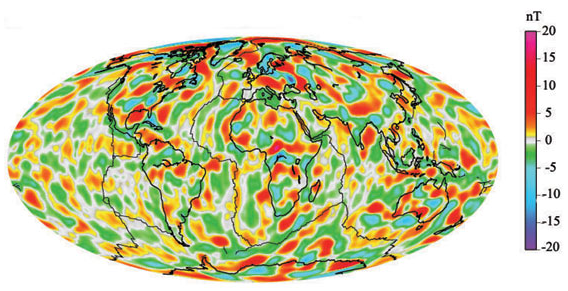
How the field is generated
The leading explanation for the origin of the geomagnetic field is the geodynamo mechanism. In this view, the outer core is a convecting, electrically conducting fluid made mainly of iron and nickel that moves under the influence of heat loss, compositional changes and planetary rotation. Those flows produce electrical currents, and the currents in turn generate and maintain the magnetic field. The layered structure of a solid inner core and a fluid outer core and differences in motion between these regions contribute to the dynamo; see summaries of the deep interior at Earth's core.
Structure and measurable properties
From a distance the main part of the field resembles a dipole roughly aligned with Earth’s rotation axis, but closer inspection reveals non-dipolar regional anomalies and time-dependent changes. Measurable properties include magnetic declination (the angle between geographic and magnetic north), magnetic inclination (the tilt of field lines relative to the surface), and field intensity. Instruments and simple compasses respond to these properties; a magnetic compass is a practical tool that points along field lines and is described at compass. The positions of the magnetic poles differ from the geographic poles; see magnetic poles.
- Main contributors: the internal dynamo field from the core, crustal magnetization stored in rocks, and external currents in the ionosphere and magnetosphere.
- External structures: the magnetosphere, including trapped particle regions (often called radiation belts), and boundary layers where solar wind interactions drive currents.
The magnetosphere acts as a partial shield against charged particles from the Sun and cosmic rays, reducing direct particle flux to much of the atmosphere and surface and enabling phenomena such as auroral displays near high latitudes. The shielding is not absolute; strong solar storms can compress the magnetosphere, induce currents in technology and increase particle radiation risks for satellites and astronauts. The general space environment and shielding topics are discussed at space environment and shielding.
History, reversals and scientific uses
On geological timescales the field changes. Slow drift of the field called secular variation is routinely observed, and over millions of years the field has undergone polarity reversals in which the magnetic north and south swap places. These reversals and other changes are recorded in magnetic minerals in volcanic and sedimentary rocks and form the basis of paleomagnetism and plate-tectonic reconstructions.
Measurements of the field are widely used in navigation (both traditional compass navigation and modern systems), in studies of animal migration where many species use magnetic cues, and in geophysical exploration for minerals and hydrocarbons. Archaeomagnetic dating uses changes in Earth's field recorded by human-made materials to provide archaeological age information. Observatories and satellites continuously monitor the field to support research and practical applications.
Scientific study combines observations, laboratory experiments and numerical models to understand the geodynamo, anticipate space-weather impacts and interpret the magnetic record preserved in rocks. Maps of declination and intensity are updated regularly because the poles and overall field can move and change strength. While polarity reversals have occurred many times in Earth’s past, their detailed effects on climate and life remain subjects of ongoing research and careful study.
Questions and answers
Q: What is the Earth's magnetic field?
A: The Earth's magnetic field is the magnetic field that surrounds the Earth, which is sometimes called the geomagnetic field.
Q: What creates the Earth's magnetic field?
A: The Earth's magnetic field is created by the rotation of the Earth and Earth's core.
Q: What is the function of the Earth's magnetic field?
A: The Earth's magnetic field shields the Earth against harmful particles in space.
Q: How stable is the Earth's magnetic field?
A: The Earth's magnetic field is unstable and has changed often in the history of the Earth.
Q: How is the Earth's magnetic field generated?
A: The Earth's magnetic field is thought to be generated by the different speeds of the two parts of the core as the Earth spins, creating the magnetic field as though it had a large bar magnet inside it.
Q: What do magnetic poles create?
A: Magnetic poles created by the Earth's magnetic field are near to the geographical poles.
Q: What applications does the Earth's magnetic field have?
A: The geomagnetic field is used by compasses to find directions and by many migratory animals when they travel long distances each spring and fall. The magnetic poles will trade places during a magnetic reversal.
Related articles
Author
AlegsaOnline.com Earth's magnetic field: origin, structure, and effects Leandro Alegsa
URL: https://en.alegsaonline.com/art/29589
Sources
- wdc.kugi.kyoto-u.ac.jp : "Magnetic North, Geomagnetic and Magnetic Poles"
- deeptow.whoi.edu : "The Magnetic North Pole"
- cb.iee.unibe.ch : "Delayed Autumn migration in northern european waterfowl"