
Aurora (northern and southern lights)
A natural light display in high-latitude skies produced when charged solar particles interact with Earth's magnetic field and atmosphere, creating curtains, arcs and colors known as aurora borealis/australis.
Overview
An aurora is a natural light display that appears in the night sky, most commonly seen at high latitudes. The phenomenon is known in English as the northern lights (aurora borealis) in the northern hemisphere and the southern lights (aurora australis) in the southern hemisphere. These luminous curtains, arcs and diffuse glows are usually concentrated around polar regions such as the Arctic and the Antarctic, though strong events can carry visible activity far from the poles.
Image gallery
10 Images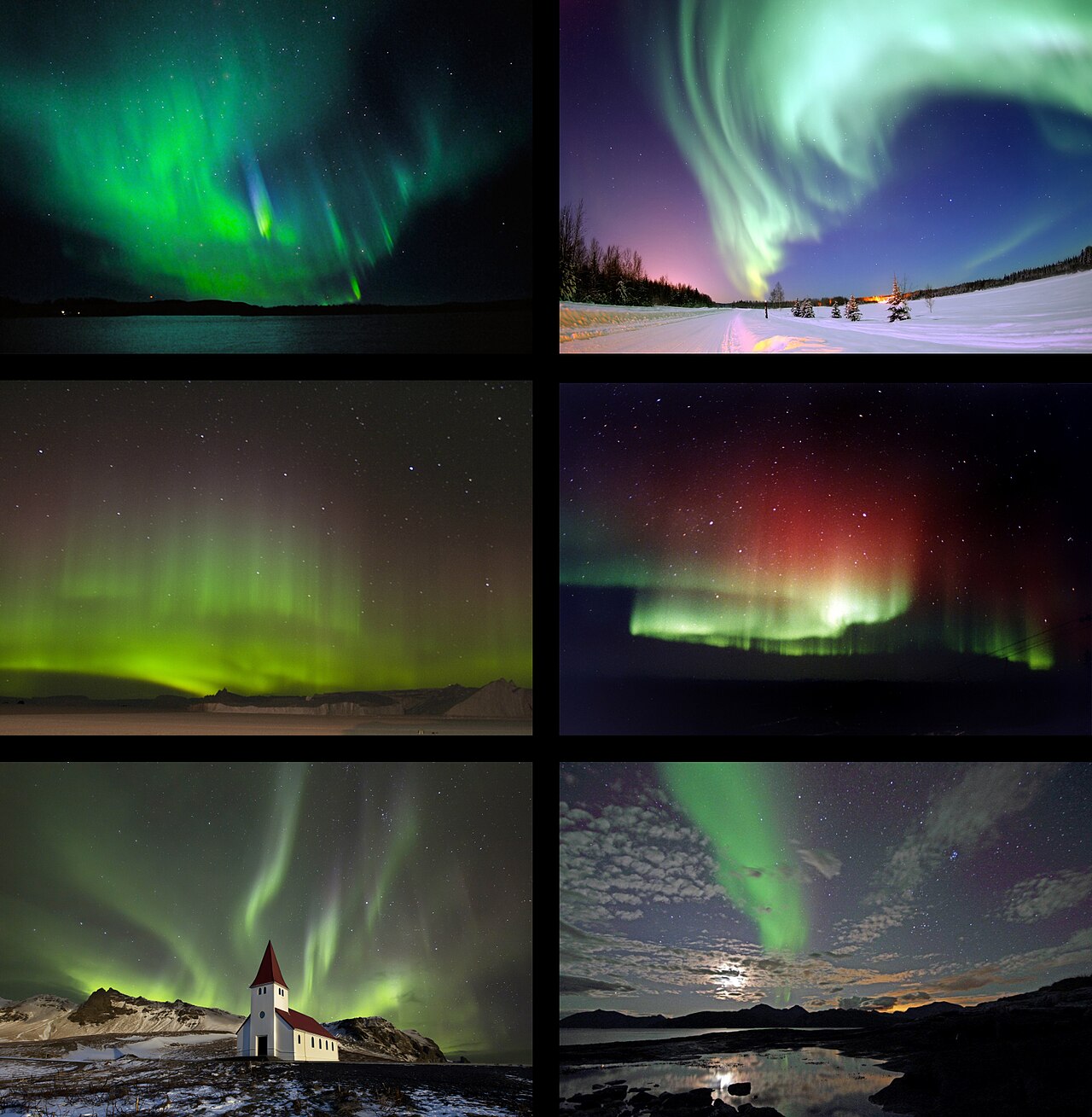



How auroras form
Auroras are produced when streams of energetic charged particles from the Sun interact with the Earth's magnetic environment and upper atmosphere. Variations in the solar wind and in transient solar events disturb the magnetosphere, allowing electrons and ions to travel along magnetic field lines toward the polar regions. When these particles collide with atmospheric gases they transfer energy, which is emitted as light at characteristic wavelengths.
Colors, altitudes and shapes
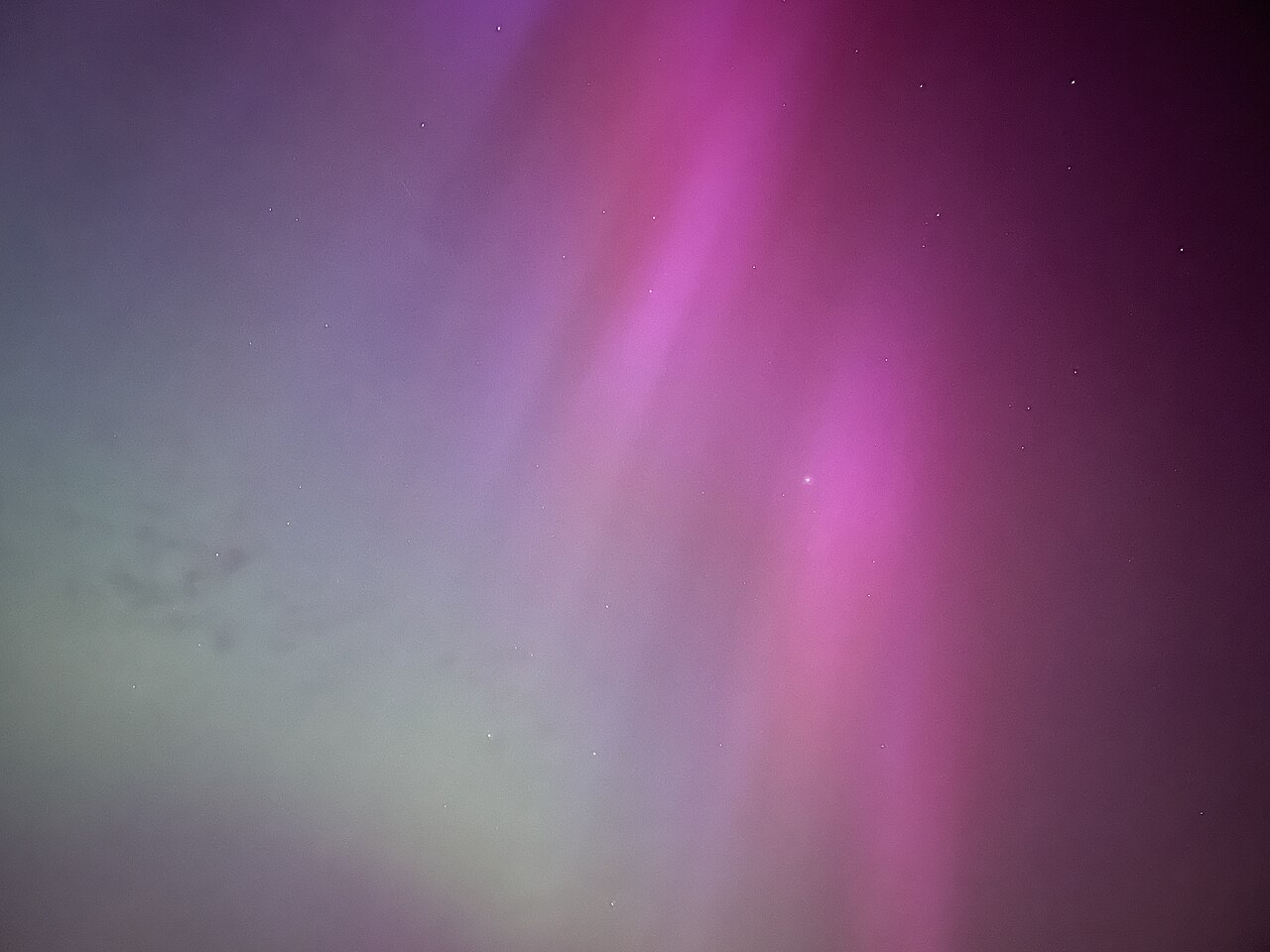
Different atoms and molecules emit different colors when excited. Atomic oxygen frequently produces green or red light, with green near lower thermospheric altitudes and red at higher altitudes. Molecular nitrogen and ionized nitrogen contribute blue, purple and pink hues, especially at lower auroral altitudes or in energetic displays. The apparent color and intensity depend on particle energy, atmospheric composition and viewing conditions.
Auroral shapes vary widely. Common forms include steady arcs, waving curtains with vertical rays, patches, and bright coronas seen overhead. Displays can extend across hundreds of miles of sky and sometimes appear to stretch from horizon to horizon, creating dramatic moving panoramas.
Occurrence and variability
Auroras are most frequent and intense near the geomagnetic poles, often forming an ‘auroral oval’ that surrounds each pole. Their occurrence is driven by solar activity: the approximate 11-year solar cycle, solar flares and coronal mass ejections all affect how often and how brightly auroras appear. Powerful geomagnetic storms may push visible auroras to mid-latitudes for a time.
Observation and forecasting
Because auroral light is faint compared with daylight, observations require darkness and clear skies. Winter months and long nights in polar regions typically offer the best viewing opportunities. Observers use geomagnetic indices, real-time space-weather reports and local cloud forecasts to assess visibility. Many research groups and tourist services publish forecasts and alerts to help people plan viewing trips near the North Pole or South Pole.
Cultural significance and history
Auroras have been noticed and interpreted by human societies for millennia. In cultures that experience frequent displays, auroras appear in folklore, oral histories and traditional beliefs, often connected to omens, spirits, or ancestral beings. Scientific study advanced from early natural philosophers’ observations to modern measurements that combine ground-based networks and spacecraft instruments.
Scientific importance and terrestrial effects
Auroras are a visible manifestation of space-weather processes that can affect technology. Strong geomagnetic activity associated with auroras has been linked to disruptions of radio communications, satellite operations, navigation signals and electrical power systems. Studying auroras helps researchers understand plasma physics, magnetospheric dynamics and Sun–Earth coupling.
Auroras elsewhere in the solar system
Similar auroral phenomena occur on other planets that possess magnetic fields and atmospheres. Jupiter and Saturn show powerful auroral emissions produced by interactions with the solar wind and, in Jupiter’s case, with material from its moons. These planetary auroras provide comparative insights into magnetospheric physics under very different conditions.
Practical notes and resources
- Terminology: aurora borealis (northern) and aurora australis (southern) are the standard names in many languages.
- Viewing tips: dark sites, clear skies and forecasts increase the chance of seeing detailed structure and color.
- Further reading and forecasts: consult official space-weather services for solar wind and geomagnetic conditions (solar wind, magnetosphere), and regional observatories for local guidance.
- Geographical context: general information about polar regions and extremes can be found via resources connected with the Arctic, the Antarctic, the North Pole and the South Pole.
- Extent: descriptions of how far auroras can reach and their apparent horizon-to-horizon extent are discussed in observational accounts and forecasting summaries (extent and visibility).
Questions and answers
Q: What is an aurora?
A: An aurora is a natural light display in the sky, also known as polar light, northern light, or southern light.
Q: Where are auroras usually seen?
A: Auroras are usually seen in the high latitudes, particularly in the Arctic and Antarctic regions.
Q: What causes auroras?
A: Auroras are produced when the Earth's magnetosphere is disturbed by the solar wind.
Q: What is the Aurora borealis?
A: The Aurora borealis is an aurora that appears around the North Pole, commonly referred to as the northern lights.
Q: What is the Aurora australis?
A: The Aurora australis is an aurora that appears around the South Pole, also known as the dawn of the south or southern lights.
Q: When can auroras happen and when can they be seen?
A: Auroras can happen at any time, but they can only be seen at night because their light is not as strong as the light of day.
Q: What legends are associated with the aurora?
A: Many legends are associated with the aurora in all countries where this phenomenon regularly occurs.
Related articles
Author
AlegsaOnline.com Aurora (northern and southern lights) Leandro Alegsa
URL: https://en.alegsaonline.com/art/7420
Sources
- onlinelibrary.wiley.com : onlinelibrary.wiley.com/doi/10.1029/JZ065i009p02727/abstract;jsessionid=C121DB9B2BD1AB7DE…