
Apollo program: United States crewed effort to land humans on the Moon
Apollo was NASA's 1960s–70s program to land humans on the Moon and return them safely. It produced the first lunar landings, important scientific return, hardware innovations, and a major Cold War-era legacy.

The Apollo program was a United States national effort, led by NASA, to land a crewed spacecraft on the Moon and bring its crew safely back to Earth. The name came from the Greek god Apollo. Announced and accelerated after a 1961 presidential pledge by John F. Kennedy, Apollo set the specific goal of achieving a lunar landing before the end of the decade. Kennedy's challenge framed the program as a bold national undertaking in the larger context of human exploration and technological competition.
Image gallery
10 Images




Context and motivation
Apollo took place during the Cold War and the broader "space race" between the United States and the Soviet Union. Soviet successes, including sending the first person into orbit, helped spur U.S. political leaders to commit large resources to regain leadership in crewed spaceflight. Beyond geopolitics, supporters argued that Apollo would yield scientific discoveries, inspire education and engineering, and produce technology useful on Earth.
Design and main components
The core vehicles for lunar missions were collectively known as the Apollo spacecraft. The stack included three primary elements: the Command Module (CM), the Service Module (SM) and the Lunar Module (LM). The Command Module was a bell-shaped capsule that housed the crew and returned to Earth; the Service Module carried propulsion, power and consumables for transit; and the Lunar Module was a two-stage lander designed to descend to and ascend from the lunar surface. To reach lunar orbit Apollo used the powerful Saturn V rocket, a three-stage vehicle that remains one of the largest rockets ever flown.
- Command Module: crew cabin and reentry vehicle.
- Service Module: support systems and main engine for translunar and transearth maneuvers.
- Lunar Module: dedicated lander with descent and ascent stages.
Major missions and milestones
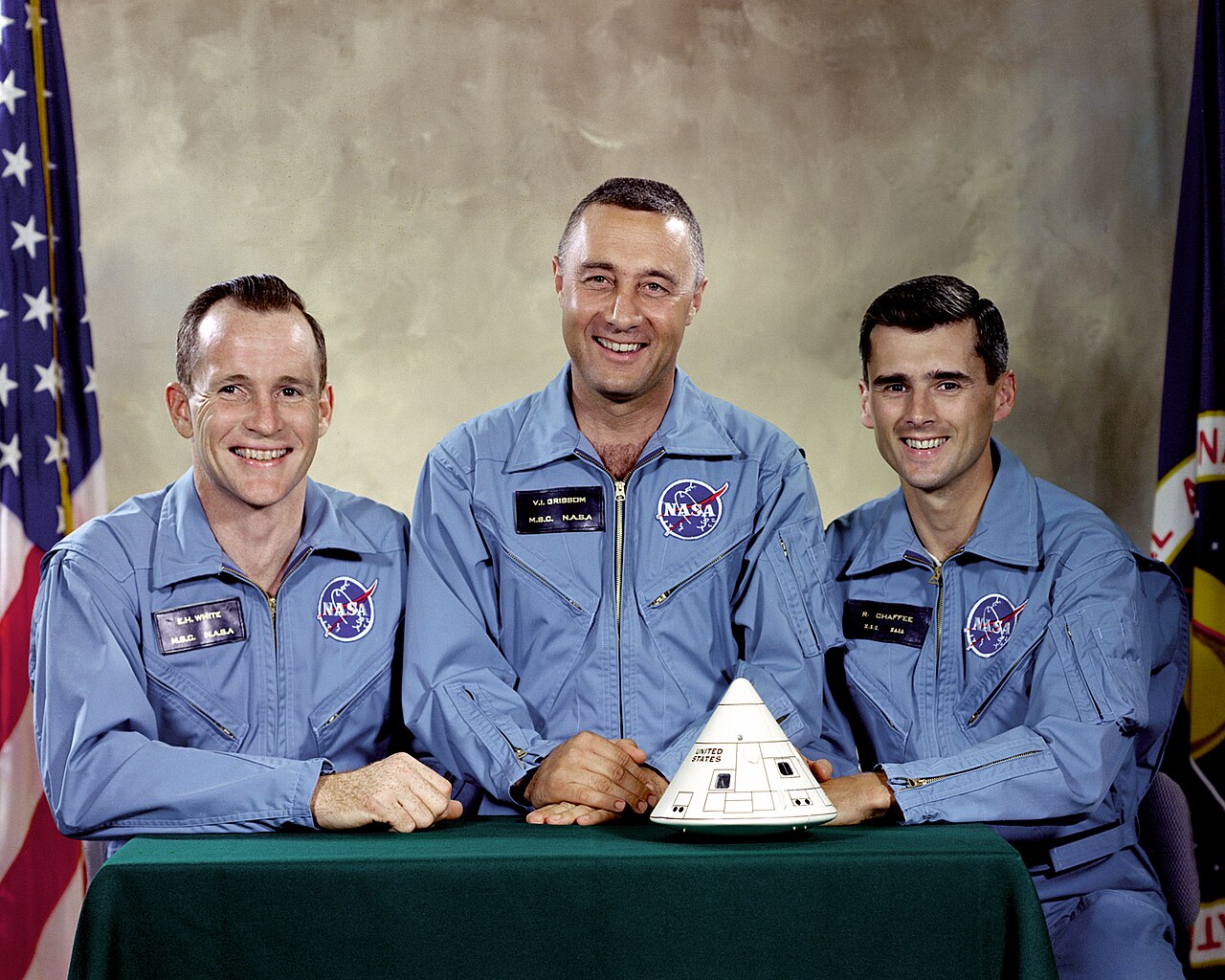
Apollo included many test flights, setbacks and triumphs. A 1967 cabin fire during a ground test killed three astronauts and led to a major redesign and safety overhaul. In 1968 Apollo 8 performed the first crewed orbit of the Moon and sent home iconic Earthrise photographs. On July 20, 1969, Apollo 11 achieved the first human landing on the lunar surface, a mission that made Neil Armstrong and Buzz Aldrin household names while Michael Collins remained in lunar orbit. The program later carried out additional successful landings and scientific expeditions on the surface; the last crewed Moon landing was Apollo 17 in 1972. One mission, Apollo 13, experienced a dramatic in-flight accident but returned its crew safely — its story became widely known through the film Apollo 13.
- Apollo 1 (AS-204): fatal 1967 fire during testing.
- Apollo 8: first crewed lunar orbit (1968).
- Apollo 11: first lunar landing (1969).
- Apollo 13: in-flight emergency and safe return (1970).
- Apollo 17: final crewed lunar mission (1972).
Scientific returns and legacy
Apollo crews collected hundreds of kilograms of lunar rock and soil, installed experiments on the surface, and performed geological fieldwork that reshaped understanding of the Moon's origin and history. Instruments left on the surface returned seismic, heat-flow and other long-term data. The program pushed advances in rocketry, materials, avionics, computing and life-support systems; many technologies and management practices developed for Apollo influenced later civilian and military programs.
Beyond the technical results, Apollo had broad cultural and educational effects. It raised public interest in science and engineering, created iconic images and moments of human achievement, and continues to inspire artists, educators and scientists. It also prompted debate over government spending priorities and the long-term direction of human spaceflight.
Transition and later developments
After the lunar missions concluded, NASA redirected effort toward reusable spacecraft and long-duration programs. Work that followed Apollo included the development of the Space Shuttle and later participation in the International Space Station, along with numerous robotic missions. The Apollo era remains one of the most intensively studied and celebrated chapters in human spaceflight history and a frequent point of reference for contemporary plans to return humans to the Moon and travel beyond it.
For further reading and archival materials consult institutional histories and primary sources from agencies and museums that preserve Apollo-era records and artifacts.
Relevant links: NASA, Apollo (name), human spaceflight, Moon, John F. Kennedy, decade, this decade, exploration, Soviet Union, outer space, Cold War, Apollo spacecraft, Space Shuttle, International Space Station, Apollo 13.
Questions and answers
Q: What was the Apollo program?
A: The Apollo program (or Project Apollo) was a project by the United States' National Aeronautics and Space Administration (NASA). The goal was to send a human to explore the Moon and bring him home to earth safely.
Q: Who started the Apollo program?
A: The Apollo program was started by US President John F. Kennedy in 1961.
Q: Why did the US start the Apollo program?
A: One reason the US started the Apollo program was that the Soviet Union was the first country to send a person into outer space, so many in the US thought that they needed to stay ahead of them in space exploration during the Cold War.
Q: What were some components of an Apollo spacecraft?
A: An Apollo spacecraft consisted of a Command and Service Module, and a Lunar Module. The Command Module was a space capsule and Lunar Module was a lander which docked on their way to Moon.
Q: How big were Mercury and Gemini spaceships compared with an Apollo capsule?
A: Mercury and Gemini spaceships were very small and cramped, but an Apollo capsule was much bigger allowing astronauts to move around instead of having to stay in their seats.
Q: What happened after 1975 when NASA ended its work on Project Apollos?
A: After 1975 when NASA ended its work on Project Apollos, they began working on other projects such as Space Shuttle Program, International Space Station, and many unmanned space exploration projects.
Q: Was there any movie made about one mission from this project?
A: Yes, there is movie made about problems that happened during one mission from this project called "Apollo 13".
Related articles
Author
AlegsaOnline.com Apollo program: United States crewed effort to land humans on the Moon Leandro Alegsa
URL: https://en.alegsaonline.com/art/4920
Sources
- jfklibrary.org : Special Message to Congress on Urgent National Needs
- hq.nasa.gov : "Part 2(D) - July through September 1967"
- hq.nasa.gov : The Apollo Spacecraft — A Chronology. Volume IV
- burro.astr.cwru.edu : "Apollo Program"
- wikidata.org : wikidata.org/wiki/Q46611
- d-nb.info : 4232143-8
- id.loc.gov : n85308634
- id.ndl.go.jp : 00956386
- snaccooperative.org : w6wf1szt
- viaf.org : 158349825
- worldcat.org : lccn-n85308634