
Light year — the astronomical unit of distance
A light year is the distance light travels in a vacuum in one year. It is a unit of length used to express vast astronomical distances and conveys both spatial scale and look-back time.
Overview
A light year is a unit of length used in astronomy to express very large distances by reference to the speed of light. It equals the distance that light travels in empty space during the interval of one year. Because light moves extremely fast, a single light year corresponds to a distance far larger than everyday measures such as kilometres or miles.
Image gallery
3 Images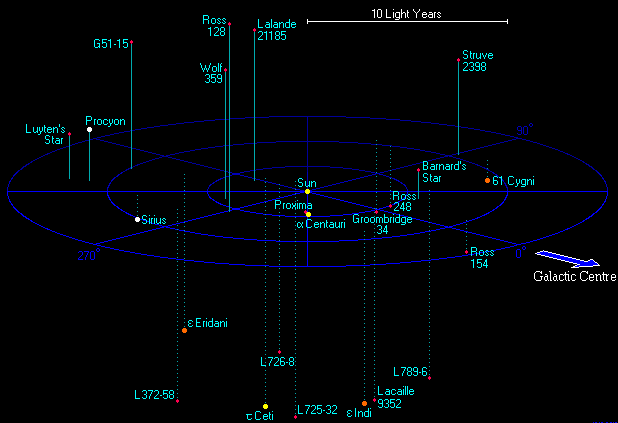

Definition and approximate value
Formally, one light year is the product of the speed of light and the duration of a chosen year. Using the commonly employed Julian year of 365.25 days and the defined speed of light, a light year is about 9.46 trillion kilometres (roughly 5.88 trillion miles). In less precise contexts it is often rounded to about 10 trillion kilometres or about 6 trillion miles.
Units and comparisons
A light year is a unit of length, not time. In professional astronomy other units are also used: the parsec, which equals about 3.26 light years, is convenient when working with parallax and angular measurements, while the astronomical unit (AU) is used for solar-system distances. Choice of unit depends on scale — from AUs within planetary systems to light years or galaxies-scale measures for extragalactic work.
Examples and cosmic scale
- Proxima Centauri, the nearest star to the Sun, lies a little over four light years away.
- The visible diameter of the Milky Way is measured in tens of thousands to around a hundred thousand light years across.
- The Andromeda object is separated from us by a few million light years, illustrating intergalactic distances within the universe.
Observational meaning
Using light years connects distance with the time taken by light to travel. Observing an object a million light years away means seeing it as it was a million years ago; light carries information about earlier states across space. This "look-back" aspect is central to studies of cosmic history and evolution.
History and usage notes
The term "light year" became common as astronomers and educators needed an intuitive way to communicate immense distances. It remains popular in public communication because it ties together an easily grasped interval (a year) with the finite speed of light. When precision is required, scientists specify the exact definition of the year used and may prefer parsecs or SI metres for calculations.
Related articles
Author
AlegsaOnline.com Light year — the astronomical unit of distance Leandro Alegsa
URL: https://en.alegsaonline.com/art/57947
Sources
- iau.org : The IAU and astronomical units