
Santa Cruz, California — coastal city on Monterey Bay
Coastal city on the northern shore of Monterey Bay known for beaches, redwood forests, UC Santa Cruz, surf culture, tourism, and a layered history from Ohlone settlement through the Spanish mission era to a modern mixed economy.
Overview
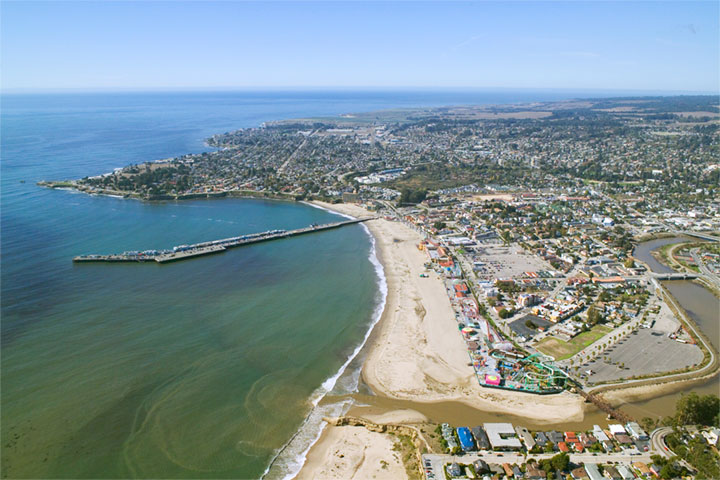
Santa Cruz is a coastal city on the northern shore of Monterey Bay in California's Central Coast region. It is widely recognized for its shoreline, surf culture, year-round outdoor recreation, and the University of California, Santa Cruz (UCSC). The city blends residential neighborhoods, a compact downtown, and extensive natural areas including coastal bluffs and nearby redwood forests.
Image gallery
10 Images





History
The Santa Cruz area was first inhabited for thousands of years by Indigenous peoples of the Ohlone cultural group, who lived by hunting, gathering and fishing along the coast. European presence began with Spanish exploration and the establishment of a mission outpost in the late 18th century. The mission period, and later Mexican and American eras, brought dramatic social and economic change: Indigenous populations declined from disease and forced labor associated with colonial systems, while new settlers developed ranching, timber, and agricultural enterprises.
Geography and climate
Located at the northern end of Monterey Bay, Santa Cruz sits where coastal terraces meet steep hills and redwood canyons. The city experiences a Mediterranean-style climate: mild, often foggy summers with cooler ocean temperatures and wetter winters with most annual rainfall. Microclimates are common, with warmer inland pockets and cooler, windier coastal zones. The nearby marine environment is part of the Monterey Bay National Marine Sanctuary, an ecologically important stretch of coastline and ocean.
Economy, culture and institutions
Historically, local industries included timber, commercial fishing and agriculture—strawberries and other specialty crops remain important in the surrounding county. Today the economy combines tourism, higher education, small-scale agriculture, and technology- and service-sector employers linked to the broader Silicon Valley corridor. UCSC, founded in the 1960s, is a major cultural and economic anchor and contributes research, arts, and a youthful demographic to the city.
Landmarks, recreation and notable facts
- Santa Cruz Beach Boardwalk: a seaside amusement park with a classic wooden roller coaster along the shore.
- Steamer Lane and other surf breaks: among California's well-known surfing spots, drawing local and visiting surfers.
- Redwood parks and trails: nearby state parks and preserves protect old-growth and second-growth redwood groves.
- Wharf and local fisheries: the long wharf provides recreation, fishing, and waterfront activity.
Santa Cruz has faced several challenges typical of coastal California cities, including earthquake risk and periodic droughts. The 1989 Loma Prieta earthquake caused significant damage in the region and affected parts of the city. Preservation of natural areas, adaptation to climate variability, and balancing tourism with local quality of life are ongoing concerns.
External links and references
Further information and resources:
- City of Santa Cruz official site
- Monterey Bay and regional coastal information
- Ohlone cultural and historical resources
- Indigenous lifeways and archaeology
- History of Spanish colonization in California
- Spanish mission era overview
- Disease and demographic change in colonial California
- Immigrant communities and local history
- Chinese and Asian American history in California
- Portuguese and other immigrant influences
- Timber and forestry history of the region
- Commercial fishing and maritime economy
- Dairy and agricultural development in Santa Cruz County
- Loma Prieta earthquake: regional impacts and recovery
- Tourism and coastal recreation resources
- Climate summaries for coastal Central California
- Mediterranean climate zones
- Marine fog and coastal weather phenomena
- Drought, water management, and conservation in California
This article summarizes broadly known aspects of Santa Cruz: its coastal setting, layered history from Indigenous habitation through colonial and American periods, a mixed economy anchored by education and tourism, and prominent natural and cultural landmarks that draw visitors and support local life.
Related articles
Author
AlegsaOnline.com Santa Cruz, California — coastal city on Monterey Bay Leandro Alegsa
URL: https://en.alegsaonline.com/art/87110
Sources
- calafco.org : "California Cities by Incorporation Date" · web.archive.org
- cityofsantacruz.com : "A Guide to Your City Government"
- santacruzsentinel.com : "Santa Cruz can't do it on its own"
- statewidedatabase.org : "Statewide Database"
- wedrawthelines.ca.gov : "Communities of Interest – City"
- www2.census.gov : "2016 U.S. Gazetteer Files"
- geonames.usgs.gov : "Santa Cruz"
- factfinder2.census.gov : "American FactFinder"
- www2.census.gov : "Census Urban Area List"
- factfinder.census.gov : "American FactFinder"
- tools.usps.com : "ZIP Code(tm) Lookup"