
Azerbaijan Railways (Azərbaycan Dəmir Yolları)
State-owned national railway operator of Azerbaijan: network, technical profile, history from imperial and Soviet eras, stations and services, international links and modernization.
Azerbaijan Railways is the national, state-owned railway company of the Republic of Azerbaijan, operating the country’s common-carrier rail network. Its Azerbaijani name is recorded as Azərbaycan Dəmir Yolları, and it functions as a closed joint-stock company under state ownership (state rail operator). The administrative headquarters are based in the capital city, the company headquarters in Baku. The system is an important part of Azerbaijan’s transport infrastructure, serving both passengers and freight across internal corridors and international links.
Image gallery
10 Images


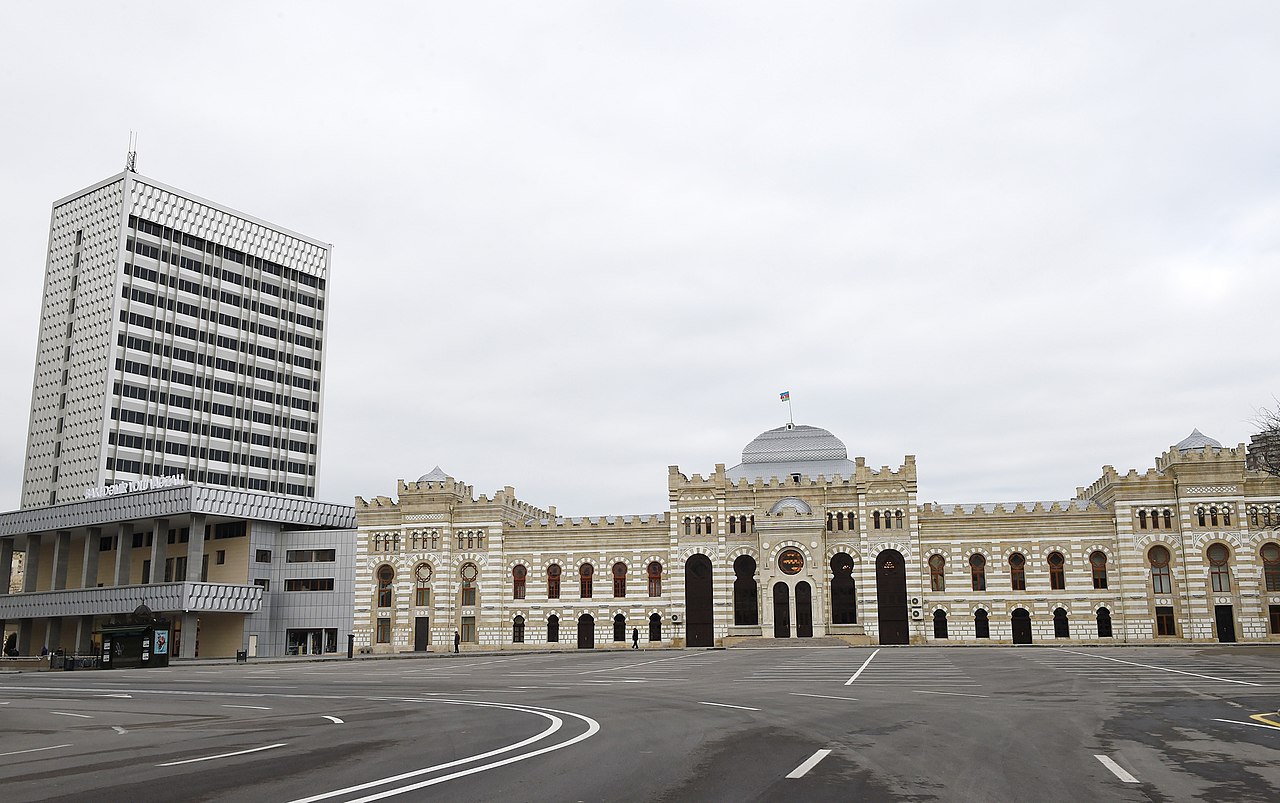
Network and technical profile
The national network totals approximately 2,932 km of track, measured on the principal routes. The infrastructure uses the broad 1,520 mm track standard that is common across the countries of the former Russian Empire and the Soviet Union; the gauge is often referenced as 1520 mm. Portions of the network are electrified: around 1,272 km (about 43% of route length) have overhead electrification systems. The primary electrification system employs a 3 kV supply, typically described as 3,000 V and implemented in direct current form (DC), which is consistent with regional practice for many main lines (electrified routes).
- Total route length: ~2,932 km (route statistics).
- Single-track portion and double-track sections across the network.
- Electrified route length: ~1,272 km (electrification).
- Signalling and automatic systems are in use on selected stretches (automatic signalling).
- Public passenger lines form a major part of the network (public transport routes).
History and institutional development
Rail transport in the territory of modern Azerbaijan has roots in the late 19th century: the first line was laid in the late 1870s and opened by 1880, initially serving suburbs and industrial areas around Baku (early line). During the imperial and then Soviet periods the railways were integrated into wider regional systems. After the collapse of the Soviet Union in 1991 (dissolution of the USSR), the network in Azerbaijan became the responsibility of a national operator. That transition converted the local component of the former Soviet Railways into the present Azerbaijani company and its modern legal form. Key regional cities such as Gəncə (Ganja) have long been important nodes on the network.
Stations, terminals and operational systems
The network includes roughly 176 stations of varying size and function. A small number of stations are fitted with fully automatic operation; examples include Biləcəri and Şirvan. Several stations are equipped to handle containerized cargo and have dedicated storage areas for intermodal operations. For instance, a few terminals are designed to accept standard cargo containers and have handling equipment and adapted machinery to support loading and unloading activities (storage areas, cargo handling, container facilities, terminal mechanisms, specialized machines).
Safety and operational control combine wayside signalling with communications systems and maintenance teams. Approximately one-third to nearly half of the network uses automated signalling on key corridors, and communications staff and repair crews maintain message flows between control centres, stations and drivers (signalling, communications, maintenance personnel, train crews).
International connections and modernization
As a country bridging Europe and Asia, Azerbaijan has invested in international rail links to improve regional connectivity and trade flows. A major recent project is the Kars–Tbilisi–Baku corridor, a trilateral rail link completed in the late 2010s that directly links Azerbaijan with its neighbours; the route connects to Turkey via Georgia, creating a continuous overland corridor to the west (Turkey, Georgia, Azerbaijan). That project, together with targeted upgrades, has encouraged investment in newer rolling stock and signalling technology. Modernization efforts have aimed at raising speeds, improving reliability and increasing freight capacity through the network using contemporary engineering and control technologies (modern technology).
Services, role and challenges
Azerbaijan Railways carries both passenger and freight traffic. Passenger services include regional and intercity trains that serve urban centres and smaller communities. Freight activity encompasses bulk commodities, containerized goods and transit cargo moving through Azerbaijani territory. The company and national authorities continue to prioritize rehabilitation of ageing track and equipment; many sections and vehicles require renewal or overhaul to meet contemporary standards.
While the railway’s total route length places it outside the very largest national systems globally, it occupies a significant position in the country’s transport mix and in regional logistics. Continued investment in terminals, electrification and cross-border corridors is expected to shape the railway’s development and its contribution to trade and mobility in the Caucasus and beyond.
Further information and technical references may be sought from official sources and published infrastructure reports (Azerbaijani title, company form, gauge, electrification data, voltage note, current type, headquarters, capital city, political context, early history, network statistics, signalling systems, communications, repairs, operations, terminals, freight, containers, handling equipment, machinery, regional hubs, passenger network, Turkey link, Georgia link, Kars–Tbilisi–Baku project, modernization).
Questions and answers
Q: What is the name of Azerbaijan's national state-owned rail transport company?
A: The national state-owned rail transport company in the Republic of Azerbaijan is called "Azerbaijan Railways" Closed Joint-Stock Company.
Q: How long is the total length of the railway network in Azerbaijan?
A: The total length of the railway network in Azerbaijan is 2,932 km (1,822 mi).
Q: What type of gauge does the railway use?
A: The railway uses a 1520 rail gauge which is electrified at 3 kV (3,000 V) DC.
Q: When was the first railway line laid in Azerbaijan?
A: The first railway line was laid in 1878 and opened in 1880 outside Baku.
Q: How much of the total length of routes are electrified?
A: 43% or 1,272 km (790 mi) are electrified.
Q: How many stations does Azerbaijan Railways have?
A: There are 176 stations on Azerbaijan Railways.
Q: What year did Kars–Tbilisi–Baku Railway open and what effect has it had on railways in Azerbaijan?
A: Kars–Tbilisi–Baku Railway opened and was completed in 2017 and has had a positive effect on railways in Azerbaijan with new technology being implemented as well as new and faster trains replacing old ones. It has also increased freight market share for railways quickly since its completion.
Tags
Related articles
Author
AlegsaOnline.com Azerbaijan Railways (Azərbaycan Dəmir Yolları) Leandro Alegsa
URL: https://en.alegsaonline.com/art/7918
Sources
- indexmundi.com : "Azerbaijan Railways"