
Perseus (constellation)
Perseus is a northern constellation notable for the variable star Algol, the bright star Mirfak, the Double Cluster and the radiant of the Perseids meteor shower.
Overview
Perseus is a constellation in the northern sky traditionally associated with the Greek hero Perseus. It occupies a region of the Milky Way rich in bright stars and open clusters, and it is best seen from the Northern Hemisphere during autumn and winter months. The pattern of its notable stars has been recorded since antiquity and remains a familiar feature of the night sky.
Image gallery
6 Images




Characteristics and principal stars
The constellation contains several prominent stars that serve as visual anchors. Alpha Persei, commonly called Mirfak, is the brightest star in Perseus. Beta Persei, better known as Algol, is a famous eclipsing binary whose regular dimming was noticed by observers in ancient times. Perseus also hosts numerous open clusters and nebulae that are accessible with small telescopes or binoculars.
Deep-sky objects and regions
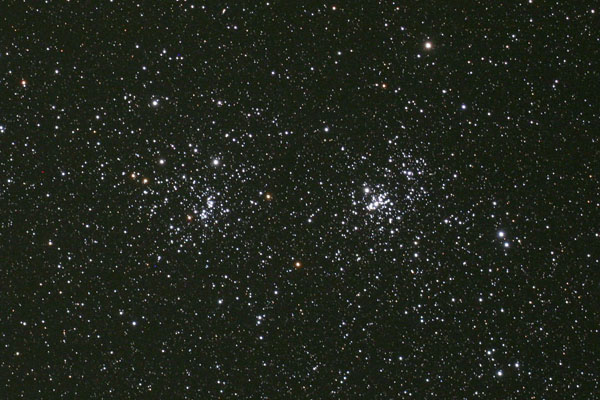
Among the deep-sky highlights are the Double Cluster (h and Chi Persei), a striking pair of open clusters visible to the naked eye under dark skies, and the open cluster M34. The constellation overlaps rich star-forming regions such as parts of the Perseus molecular cloud, and on larger scales it gives its name to structures like the Perseus Arm of the Galaxy and the Perseus Cluster of galaxies studied by professional astronomers.
History and mythology
Perseus derives from Greek mythology: the hero who rescued Andromeda from a sea monster. The figure was catalogued by ancient astronomers and included among the 48 constellations listed by Ptolemy. Modern astronomy retains the name and boundaries standardized by the International Astronomical Union, but the mythic associations remain part of its cultural identity.
Observing Perseus
Perseus offers targets for observers of all levels. Algol provides an easy example of an eclipsing binary whose brightness changes can be tracked visually over hours. Open clusters such as the Double Cluster and M34 are rewarding through binoculars. Perseus also marks the radiant of the annual Perseids meteor shower, a dependable late-summer display whose particles originate from comet Swift–Tuttle.
Notable facts
- Algol is one of the earliest known periodic variable stars and played a role in understanding binary star systems.
- The Double Cluster is a striking pair of young clusters often shown in wide-field astrophotography.
- For practical information on positions and observing, see Perseus constellation resources.
Related articles
Author
AlegsaOnline.com Perseus (constellation) Leandro Alegsa
URL: https://en.alegsaonline.com/art/75938