
Moss: non-vascular bryophytes, life cycle, habitats and ecological importance
Concise encyclopedia entry on mosses: non-vascular bryophytes that absorb water, reproduce by spores, shape soils and peatlands, and serve ecological and horticultural roles.
Overview
Mosses are small, green plants belonging to the group of non-vascular land plants known as bryophytes. They lack specialized water-conducting tissues found in vascular plants and so absorb moisture directly across their leaves and stems rather than distributing it through internal veins or vessels (vascular tissues). Because of this basic constraint, mosses typically form low, dense mats that hold water and protect individual plants from drying.
Image gallery
10 Images




Structure and physiology
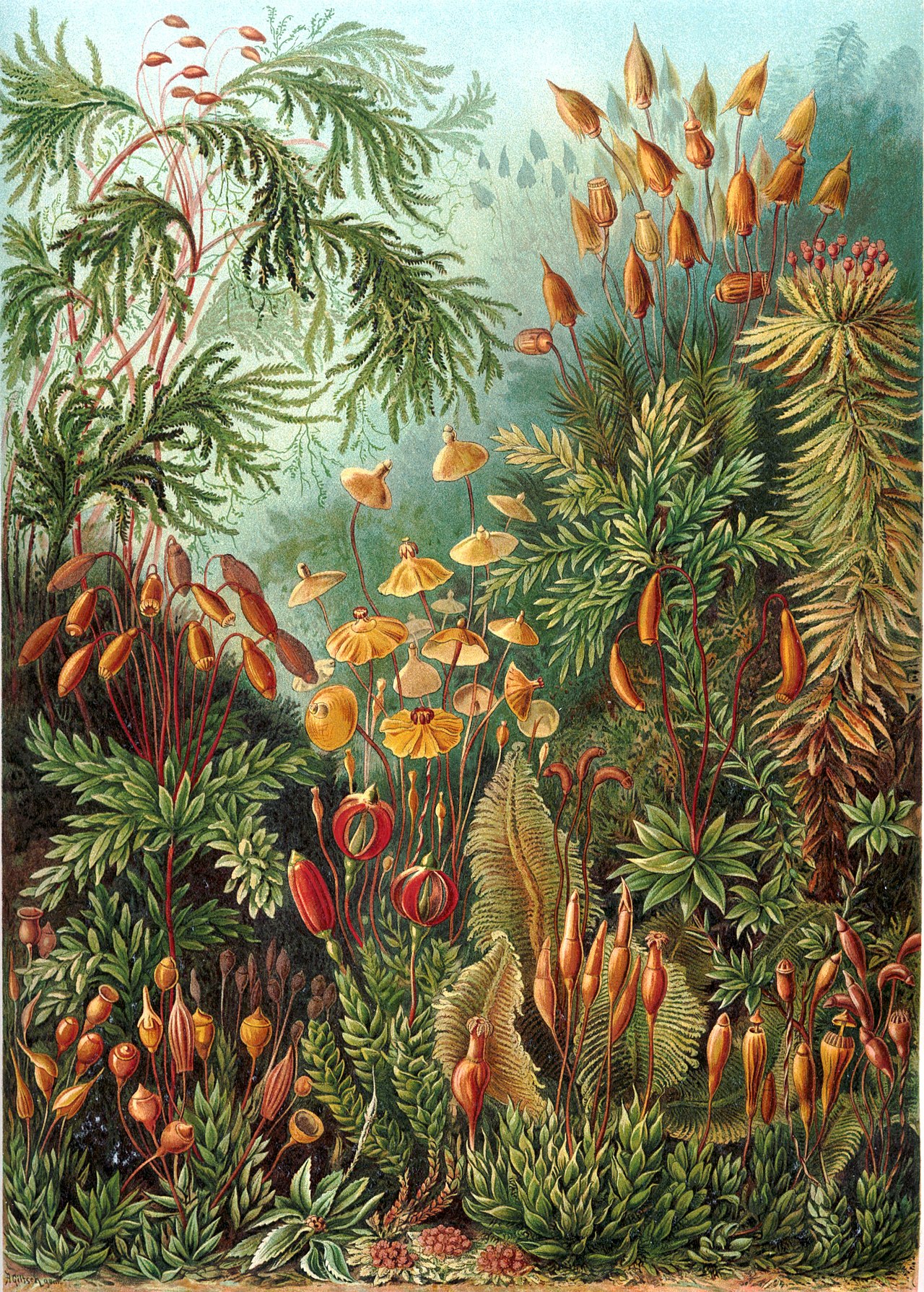
Mosses do not have true roots as seen in flowering plants; instead they have rhizoids, simple hair-like filaments that anchor the plant and help with uptake of water and minerals. Their body plan is relatively simple: the familiar green cushion or carpet is the gametophyte, the stage of the life cycle that is dominant and carries a single set of chromosomes (haploid). Without internal plumbing they rely on external moisture: water soaks into their tissues in a sponge-like way, and thinness of the plant keeps every cell close to a wet surface.
Reproduction and life cycle
Mosses reproduce using spores rather than seeds or fruit. Their life cycle exemplifies alternation of generations: the green, long-lived gametophyte produces sex organs that generate sperm on male plants and eggs on female plants. Because sperm are flagellated and require a film of water to reach eggs, mosses are tied to moist conditions for fertilization. When fertilization occurs the resulting diploid cell develops into a sporophyte, a usually small stalk and capsule that remains attached to and nutritionally dependent on the gametophyte; the capsule later releases spores that disperse to form new gametophytes.
Habitats, ecology and limits to growth
Mosses occupy a wide range of habitats where moisture is sufficient for their water-dependent processes: stream banks, damp rock faces, forest floors, and fog-laden coastal zones. They are unable to survive in very dry deserts for long periods because they cannot transport water internally; instead many species survive intermittent drought by entering a dormant, desiccated state and resuming activity when water returns. Although generally small, some moss species such as those in the genus Dawsonia can reach notable heights (approaching the size of small shrubs in exceptional cases).
- Ecological roles: Mosses stabilize soil, reduce erosion, retain moisture, and create microhabitats for invertebrates and microbes.
- Peat-forming species: Sphagnum mosses can accumulate into thick peat layers that store carbon and shape acidic bog ecosystems.
- Indicators: Many mosses are sensitive to pollution and moisture changes, so they are used as indicators of environmental conditions.
Human uses and significance
People have used mosses in horticulture (for moisture retention and soil conditioning), in traditional packing or insulation, and in restoration projects to stabilize disturbed soils. Peat derived from mosses has historically been used as fuel and soil amendment, though peat harvesting raises conservation concerns because it releases stored carbon and damages bog habitats.
Classification and notable facts
Biologists classify mosses within several orders and classes; a large majority fall into the class often referenced as Bryopsida, while other groups contain fewer species. Globally there are thousands of moss species, exhibiting a variety of growth forms from cushion-like clumps to feathery mats. Mosses are thought to have diverged early among land plants, with some research indicating an evolutionary relationship with liverworts. Their dependence on surface water means that they are commonly found near springs (springs), rivers (rivers), and in areas with frequent fog (fog), but they are generally absent from extremely arid environments such as many deserts.
For further introductory resources, consult basic botanical guides and field keys to bryophytes; specialized literature treats spore biology, rhizoid structure and the ecological importance of peat-forming mosses in greater detail. Basic summaries and outreach materials are commonly available from academic and conservation organizations (bryophyte overviews, spore dispersal, life cycle references).
Related articles
Author
AlegsaOnline.com Moss: non-vascular bryophytes, life cycle, habitats and ecological importance Leandro Alegsa
URL: https://en.alegsaonline.com/art/66859
Sources
- doi.org : 10.1130/G33122.1