
Magma: molten rock beneath Earth's surface
Magma is molten rock beneath the Earth's crust. This article explains its composition, types (felsic, mafic, intermediate), formation at tectonic settings, emplacement as intrusions or lava, and its scientific importance.
Overview
Magma is a naturally occurring mixture of molten rock, suspended crystals and dissolved volatile components that exists beneath the Earth's surface. Unlike surface lava, magma remains at depth and can collect, evolve and either cool slowly to form coarse-grained igneous rocks or be erupted as lava during volcanic activity. For a concise definition and basic background see melted rock.
Image gallery
4 Images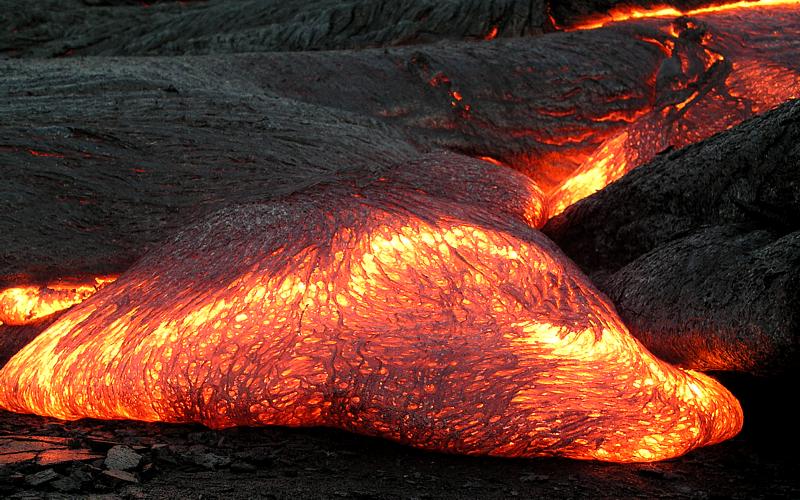


Composition and physical properties
The chemical makeup of magma is dominated by silica (SiO2) together with varying amounts of iron, magnesium, calcium, sodium, potassium and other elements. Silica content influences viscosity: high-silica magmas (rich in quartz and feldspar-forming components) are more viscous and tend to trap gases, while low-silica magmas are less viscous and flow more readily. Geologists distinguish compositional end-members such as felsic magmas (silica-rich) and mafic magmas (silica-poor). Temperature, crystal content and gas concentration also determine how a magma behaves—hotter, crystal-poor melts move more easily than cool, crystal-laden ones.
Major magma types and the rocks they form
- Felsic: high silica, high viscosity, commonly produce light-coloured plutonic rocks such as granite and explosive volcanic products.
- Mafic: lower silica, more fluid, typically yield dark volcanic rocks like basalt and dense intrusive rocks.
- Intermediate: compositions between felsic and mafic; commonly associated with convergent margins and composite volcanoes.
How magma is generated
Magma forms where solid rock partially melts. This melting can occur for three principal reasons: addition of heat, decompression melting as pressure falls, or the introduction of volatiles (water and carbon dioxide) that lower the melting temperature of minerals. These processes are common at specific tectonic settings: mid-ocean ridges, subduction zones, continental rifts and mantle plumes. Typical settings include:
- Mid-ocean ridges where upwelling mantle undergoes decompression melting.
- Subduction zones where fluids released from the subducting slab induce melting in the overlying mantle wedge.
- Continental rift zones where thinning crust and mantle upwelling produce melts.
- Hotspots and plume-related melting that can occur beneath oceans or continents.
These are often grouped under the broader term tectonic settings that control where and how magma is produced.
Pathways, emplacement and volcanic activity
Once produced, magma rises because it is less dense than the surrounding solid rock. It may stall and accumulate in sub-surface reservoirs called magma chambers, where processes such as crystallization, mixing and assimilation of surrounding rock change its composition. Magma that cools and solidifies below the surface forms intrusive bodies or intrusions, which later appear as dikes, sills and plutons. Smaller planar intrusions are known as dikes or sills. If magma reaches the surface it erupts as lava from a volcano, building volcanic landforms and producing a range of lava types and pyroclastic materials.
Scientific importance and notable observations
Studying magma is crucial for understanding volcanic hazards, crustal growth and the thermal and chemical evolution of the planet. Because direct sampling of subsurface magma is difficult, scientists use erupted lavas, experimental petrology, geophysical imaging and geochemistry to infer magma properties. There are rare instances where drilling has encountered active molten rock; notable geothermal and research boreholes have reported direct access to magma, for example in Iceland and Hawaii, illustrating the practical and scientific challenges of working near molten reservoirs (drilling findings). For further reading on magma processes and rock types see introductory resources such as general overviews and specialized pages on felsic magmas, mafic magmas and tectonic settings like subduction and continental rifts.
Magma remains a dynamic subject across geology, linking deep Earth processes to surface landscapes and hazards. Its study combines field observations, laboratory experimentation and geophysical techniques to reconstruct how melts form, travel and solidify within the planet.
Related articles
Author
AlegsaOnline.com Magma: molten rock beneath Earth's surface Leandro Alegsa
URL: https://en.alegsaonline.com/art/60609