
Hotspot (geology)
A geological hotspot is a localized volcanic source often fed by a deep mantle plume or other processes. Hotspots produce island chains, plateaus and geothermal areas and help trace plate motions; origins are debated.
In geology a hotspot is a localized area of persistent volcanic activity that can occur within a tectonic plate rather than only at plate margins. The term appears in discussions of geology and is used to describe places where volcanism is unusually strong or long-lived relative to surrounding regions. Hotspots can generate individual volcanoes, long chains of islands and seamounts, and large volcanic plateaus.
Image gallery
10 Images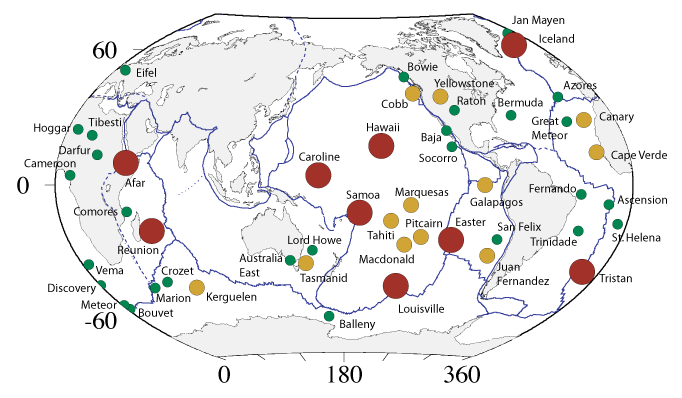


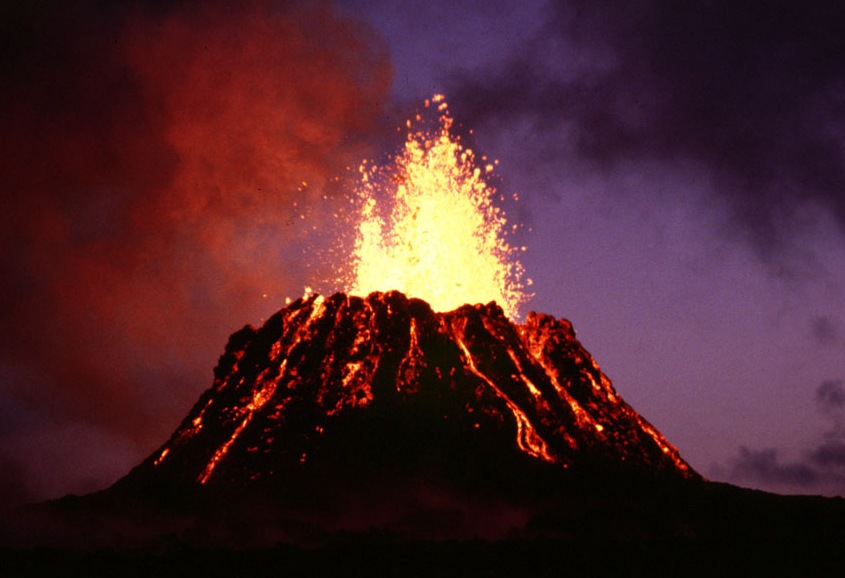

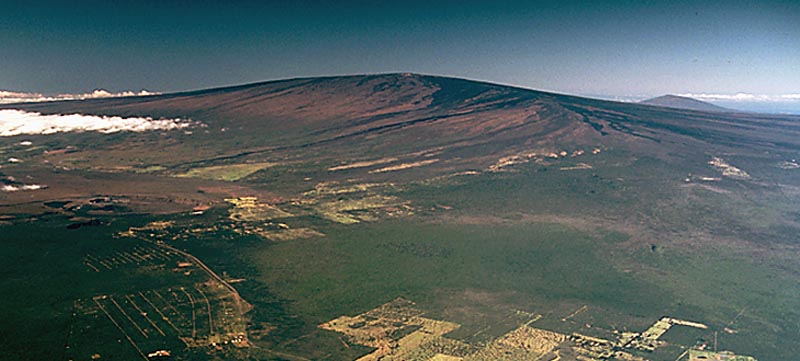
How hotspots form
Two broad classes of explanation exist. The traditional mantle-plume model envisions hot, buoyant material rising from deep in the mantle — possibly from near the core–mantle boundary — to form a narrow upwelling that supplies melt to the surface. In this view a plume often has an initial broad head that can produce extensive flood basalts, followed by a narrower, long-lived tail that sustains a volcanic center. Alternative hypotheses attribute hotspot volcanism to shallower processes, such as lithospheric extension, small-scale convection, or fertile compositional anomalies in the upper mantle. No single mechanism explains every hotspot, and multiple processes may coexist.
Typical features and signatures
- Age-progressive volcanism: chains of volcanoes or seamounts whose ages increase away from the active center, formed as a plate moves over a stationary or slowly moving source.
- Hotspot tracks: linear arrangements of islands, seamounts and extinct volcanic edifices recording past plate motion.
- Geochemical and isotopic anomalies in erupted lavas that can differ from mid-ocean-ridge basalt chemistry.
- Association with intraplate volcanic centers far from plate boundaries, though some hotspots interact with ridges or subduction zones.
Uses, examples and significance
Hotspot tracks are valuable tools for reconstructing past plate motions and testing models of plate tectonics. They create notable landscapes and hazards: volcanic island chains such as the Hawaiian islands, continental geothermal systems like Yellowstone, and volcanic plateaus linked to large igneous events. Examples frequently cited in literature include Hawaii, Iceland (where a hotspot interacts with a mid-ocean ridge), the Galápagos, Reunion, and Yellowstone. The distribution and chemistry of hotspot lavas also inform our understanding of mantle structure and dynamics.
History of the idea and scientific debate
The mantle-plume hypothesis became prominent in the late 20th century as a way to explain intraplate volcanism and certain flood-basalt provinces. Since then, observations from seismology, petrology and geochemistry have both supported and challenged aspects of the plume model. Some studies find evidence for deep-rooted upwellings, while others emphasize shallower, lithosphere-controlled explanations. The question of whether hotspots form a fixed reference frame for plate reconstructions remains contested among researchers.
Practical implications and hazards
Hotspots influence regional topography, provide geothermal energy resources, and pose volcanic hazards that include explosive caldera events, lava flows and long-lived steam and gas emissions. Understanding whether a volcanic center is plume-fed, lithospherically driven, or a hybrid helps specialists assess eruption history, magma supply and long-term risk.
For a general overview of how hotspots are discussed in earth sciences see volcanic literature and for the role of subsurface melts consult sources on magma dynamics. Additional regional examples and case studies may be found through referenced geologic reviews and syntheses using the placeholder links provided here.
Questions and answers
Q: What is a hotspot in geology?
A: A hotspot in geology is a portion of the Earth's surface that experiences volcanism.
Q: What causes a hotspot?
A: A hotspot may be caused by a rising mantle plume or some other cause.
Q: Are hotspots always located near tectonic plate boundaries?
A: No, hotspots may be far from tectonic plate boundaries.
Q: What is a volcanic hotspot?
A: A volcanic hotspot is where magma pushes up from deep in the Earth's crust or mantle and creates a volcano.
Q: How are chains of volcanoes created?
A: Chains of volcanoes are created when the Earth's plates move along, creating a new volcano above the hotspot while moving the older volcanoes away.
Q: Can you give an example of a chain of volcanoes?
A: Yes, a chain of volcanoes can be found in Hawaii.
Q: What can cause the movement of Earth's plates?
A: The movement of Earth's plates can be caused by tectonic activity or other geological events.
Related articles
Author
AlegsaOnline.com Hotspot (geology) Leandro Alegsa
URL: https://en.alegsaonline.com/art/45259
Sources
- ui.adsabs.harvard.edu : 2003E&PSL.205..295C
- doi.org : 10.1016/S0012-821X(02)01048-8
- mantleplumes.org : "Do plumes exist?"
- mantleplumes.org : mantleplumes.org/WebDocuments/Wilson1963.pdf
- pubs.usgs.gov : "Hotspots: mantle thermal plumes"
- wiley.com : Plates vs plumes: a geological controversy
- geotimes.org : geotimes.org/nov00/hotspot.html
- doi.org : 10.1130/0016-7606(2002)114<1245:UMOOTY>2.0.CO;2
- dur.ac.uk : dur.ac.uk/g.r.foulger/Offprints/Yellowstone.pdf