
Sill (geology): sheet-like igneous intrusions
A sill is a concordant, sheet-like igneous intrusion formed when magma intrudes between layers of older rock. This article explains formation, characteristics, examples, and how sills differ from related bodies.
Overview
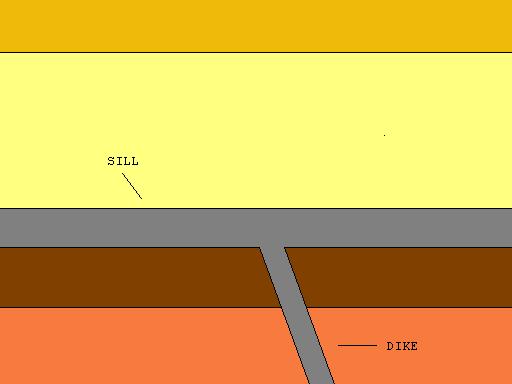
In geology, a sill is a tabular, sheet-like body of igneous rock that has been emplaced parallel to preexisting layers. It forms when molten magma is injected laterally between beds of older rock such as sedimentary rock, beds of volcanic lava, tuff or metamorphic rock. After emplacement the magma cools and crystallises, producing a concordant intrusive sheet that often preserves the original layering of the host.
Image gallery
4 Images


Formation and emplacement
Sills form when magma exploits weaknesses between layers rather than cutting across them. Injection commonly occurs along bedding planes or other zones of mechanical contrast, so the intrusion lies paralleling the surrounding strata. Many sills are supplied by vertical or inclined feeder dykes that transfer melt from deeper sources. Emplacement mechanisms include hydraulic pressurisation, thermal weakening of the host, and inflation of the sill body during repeated injections.
Characteristics
- Geometry: typically tabular, concordant, and laterally extensive; thickness ranges from centimeters to hundreds of metres.
- Textures: chilled margins, contact metamorphism of host rocks, and columnar jointing are common.
- Composition: often mafic (basaltic) but can be intermediate or felsic depending on source magma.
Exposure of sills at the surface is often the result of long-term erosion. Because many sills are more resistant to weathering than surrounding sediments, they can form prominent ridges or escarpments.
Examples and significance
Well-known examples include regional sill complexes and isolated sheets associated with large magmatic provinces. Sills are important records of subsurface magmatic processes, influence local metamorphism and groundwater flow, and can host mineralisation. Distinguishing sills from related intrusions—such as discordant dykes or uplifted laccoliths—relies on their concordant geometry and relationship to surrounding layers.
Understanding sills helps reconstruct volcanic plumbing systems and past tectonic conditions, and it informs engineering, resource exploration, and landscape evolution studies.
Questions and answers
Q: What is a sill in geology?
A: A sill is a flat sheet-like intrusion in geology.
Q: How is a sill formed?
A: A sill is formed by molten magma pushing between older layers of rock, following planes or weakened areas in the existing rocks.
Q: Does a sill cut across preexisting rocks?
A: No, a sill does not cut across preexisting rocks, unlike dykes.
Q: What kind of existing rocks can a sill be found in?
A: A sill can be found in sedimentary rock, beds of volcanic lava or tuff, or metamorphic rock.
Q: How are sills fed?
A: Sills are fed by dykes as they form from a lower magma source.
Q: What does it mean when a sill cools and crystallises?
A: When a sill cools and crystallises, it becomes a solid rock formation.
Q: Does a sill have a similar shape to a dyke?
A: No, a sill has a flat sheet-like shape, while dykes are more cylindrical.
Related articles
Author
AlegsaOnline.com Sill (geology): sheet-like igneous intrusions Leandro Alegsa
URL: https://en.alegsaonline.com/art/90421