
Massif: Geologic mountain block formed by crustal uplift
A massif is a coherent block of the Earth's crust uplifted by tectonic forces and bounded by faults; this article explains its formation, features, examples, and how it differs from linear mountain chains.
Overview
A massif is a relatively large, coherent section of the Earth's crust that has been uplifted as a single block by tectonic forces. Massifs are typically bounded by faults or steep structural boundaries and behave as a unit during deformation, rather than breaking into many small folds. In landscape terms they often form compact groups of peaks or a stable elevated block within a larger mountain system.
Image gallery
5 Images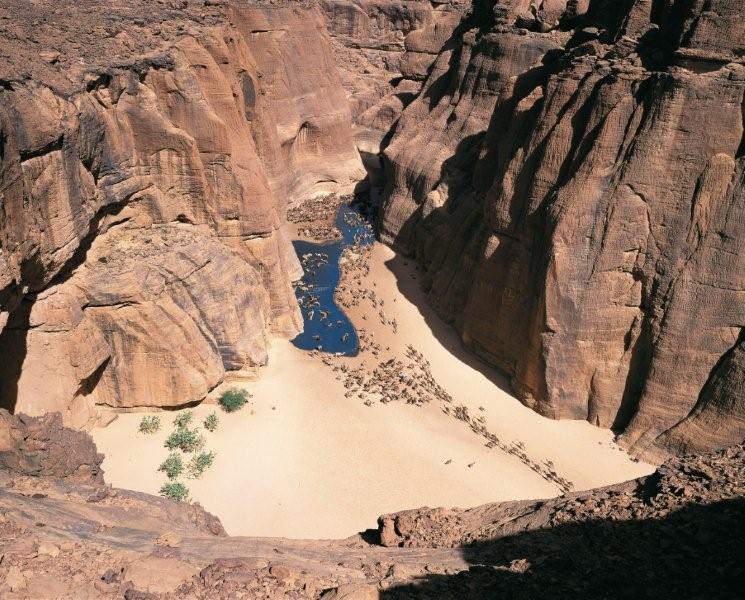


Formation and characteristics
Massifs commonly develop where continental plates converge or where crustal blocks are squeezed and thrust upward while adjacent rocks move down toward the mantle. The result is an uplifted block — a block of rock — that can include igneous, metamorphic and sedimentary units. Key features include strong internal coherence, clear fault-bounded edges, and a pattern of peaks and ridges that are concentrated rather than stretched out.
Historical use of the term
The word "massif" has been used by geologists and mountaineers to describe compact mountain groups. It is widely applied in European geology and cartography to name specific elevated blocks or complexes. The term emphasizes the block-like nature of the structure, rather than implying any single mode of origin.
Examples and significance
Well-known massifs appear in many parts of the world. Some massifs form the core of larger ranges; for example, compact groups in the Himalaya are often described as massifs. The Karakoram contains multi-peak complexes such as Saser Kangri in the Karakoram region. By contrast, long linear belts of mountains along the western edge of the Americas are usually treated as chains rather than massifs — that contrast helps clarify regional tectonics and erosion patterns.
Common characteristics (quick list)
- Fault-bounded margins rather than continuous fold belts
- Concentrated clusters of peaks or a single elevated block
- Relative structural coherence across the unit
- Often a distinct geological history from surrounding terrain
Distinctions and practical importance
Massifs are distinct from linear mountain chains formed by long continuous subduction zones or fold-and-thrust belts. For instance, the western Americas produce elongated orogenic belts, while many European and Asian mountain cores are described as massifs. Understanding whether an area is a massif helps geologists interpret regional tectonic history, map fault systems, assess natural resources, and plan mountaineering routes.
For further reading on tectonic blocks and mountain classification consult introductory geological resources or regional studies: mountain terminology, fault systems, and comparative tectonics between the Americas.
Related articles
Author
AlegsaOnline.com Massif: Geologic mountain block formed by crustal uplift Leandro Alegsa
URL: https://en.alegsaonline.com/art/62704
Sources
- worldatlas.com : "What is a massif?"
- unabridged.merriam-webster.com : "massif"
- nationalgeographic.com : "Mountains Information and Facts"
- smh.com.au : "The Sydney Morning Herald, November 6, 2009"