
Manicouagan impact structure (Manicouagan Reservoir)
Large, multi-ring impact structure in Québec, Canada: a 100 km crater with a 70 km annular lake and central island, formed by an asteroid in the Late Triassic and studied for geology and planetary science.
Overview
The Manicouagan impact structure, often referred to by the name of its annular water body, the Manicouagan Reservoir, is a prominent multi-ring impact feature in the Côte-Nord region of Québec, Canada. The roughly 100 km diameter structure is one of the largest and best-preserved impact basins on Earth and is readily visible in satellite imagery. The most striking element is a near-circular, 70 km wide annular lake that surrounds a central plateau island.
Image gallery
8 Images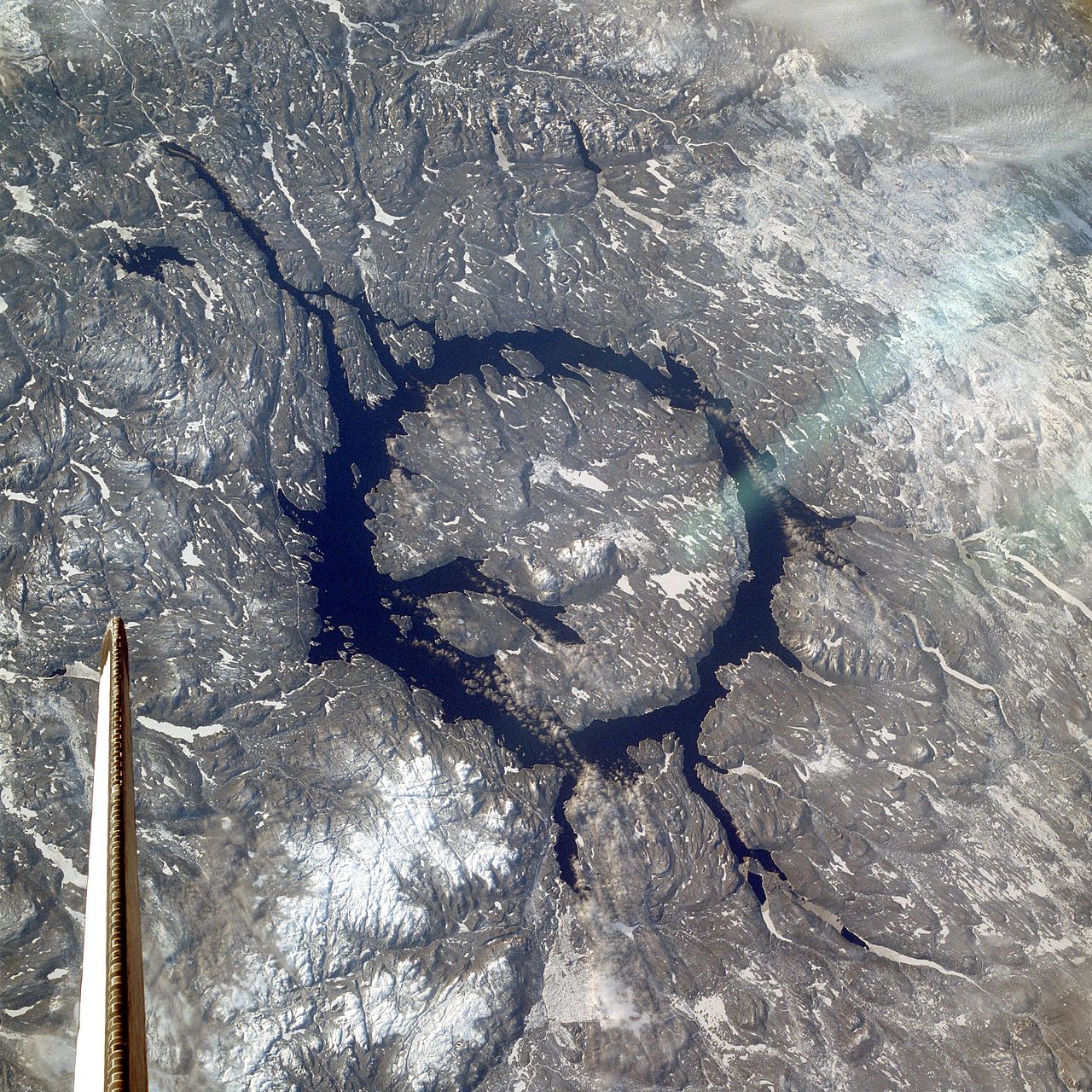


Structure and geology
Manicouagan is a complex, multiple-ring crater that preserves a clear concentric pattern: an outer rim, an inner ring now occupied by the reservoir, and a central uplift forming René-Levasseur Island at the core. Impact-related rocks include breccias and melt rocks; field studies have documented shock features such as shatter cones and crystalline deformation indicative of high-pressure impact processes. Geophysical surveys show gravity and magnetic anomalies consistent with a buried, disrupted target beneath the visible rings.
Age and origin
The crater formed when an asteroid estimated at a few kilometres across struck the region during the Late Triassic, about 214–216 million years ago. Radiometric dating of impact melt rocks and related materials has been used to establish this age. Scientists have proposed and tested hypotheses about whether Manicouagan was part of a cluster of near-simultaneous impacts, but no definitive, widely accepted multi-crater event has been established.
Human use, protection and significance
The annular lake was enlarged and regulated by hydroelectric developments in the 20th century, creating a large reservoir used for power generation. The central island, René-Levasseur, remains sparsely populated and largely natural, with the island and surrounding waters valued for their scenic and ecological qualities. The structure is studied for its scientific importance as a well-preserved natural laboratory for impact processes and post-impact modification.
Scientific and public interest
- Planetary analog: Manicouagan serves as a terrestrial analogue for understanding impact mechanics on the Moon and Mars.
- Geochronology: Precise dates from impact melts help calibrate Late Triassic timelines.
- Education and imagery: Its striking appearance makes it a frequent subject of astronaut photography and educational materials.
For an overview of location and basic facts see Manicouagan crater information. Geological descriptions and field guides are available through regional resources such as Côte-Nord geological summaries and provincial archives. Radiometric dating and technical reports can be found via scientific repositories referenced at impact studies and geochronology summaries. Further public-oriented background and imagery are available at general science portals and educational collections listed at additional resources.
Manicouagan remains an important site for researchers and a striking example of how catastrophic events have shaped Earth's surface and informed our understanding of planetary impact processes.
Related articles
Author
AlegsaOnline.com Manicouagan impact structure (Manicouagan Reservoir) Leandro Alegsa
URL: https://en.alegsaonline.com/art/61328
Sources
- passc.net : Earth Impact Database. University of New Brunswick
- dx.doi.org : dx.doi.org/10.1130/G22967A.1
- unb.ca : "Impact structures listed by diameter (increasing)"
- nature.com : Abstract
- chronicle.uchicago.edu : "Crater chain points to impact of fragmented comet"