
Loanword: words adopted from one language into another
A loanword is a word taken from one language and incorporated into another. This article explains how loanwords arise, common types and adaptations, historical examples, and their cultural importance.
Overview
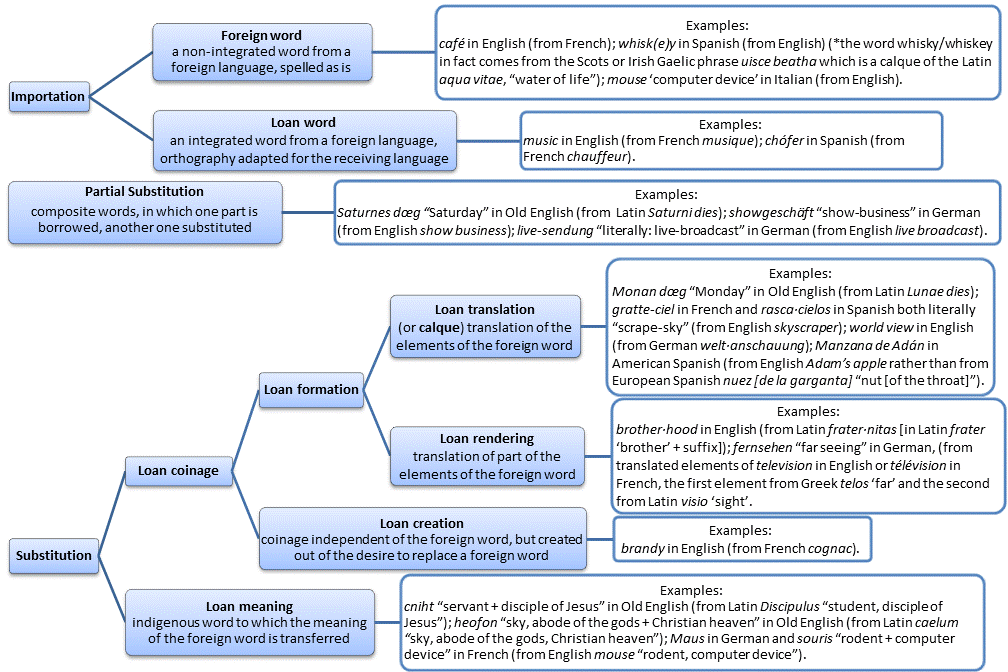
A loanword is a lexical item that a community borrows from another language and integrates into its own vocabulary. Borrowing occurs whenever speakers of different languages interact through trade, conquest, migration, technology, religion, or cultural exchange. The receiving or host language adapts the borrowed form to its sounds, grammar, and writing system; the degree of change varies from almost identical to heavily modified.
Image gallery
3 Images
Characteristics and processes
Loanwords enter a language by several mechanisms. Direct borrowings bring a foreign form with a similar meaning; calques (loan translations) render a foreign expression literally in native words; and loanblends combine native and foreign elements. After entry, phonological adaptation (to fit native pronunciation), morphological integration (adding native endings), and semantic shift (a change in meaning) are common. For example, in English the phonology of many borrowed words was altered to fit native patterns.
History and common sources
Major historical events often produce waves of borrowing. The Norman Conquest introduced a large number of words from French into English after French became the official language of medieval England. That contact created distinctions in English vocabulary such as native animal names (e.g. cow, swine, chicken, sheep) versus French-derived culinary terms for their meat (beef, pork, poultry, mutton) — a familiar illustration of social and semantic layering after contact.
Uses, examples and cultural pathways
Loanwords often reflect cultural items that travel with people: foods, technologies, religious concepts, administrative terms, and fashions. Colonial expansion such as the British Empire spread many foreign words into English, while trade routes and scholarship brought Arabic scientific terms, Latin ecclesiastical vocabulary, and later technical vocabulary from French, Italian, and German. Words for some foods (e.g., spaghetti, sushi, tacos) retain their original names in many languages because the items and their names arrived together. The English word "jungle" is commonly traced to South Asian languages such as Hindi.
Specialized borrowing and domains
Certain domains show strong patterns: culinary and wine vocabulary often comes from French or regional languages (wines), musical terminology is dominated by Italian (musical terms), and technical or philosophical terms have come from German and other scholarly languages (German, philosophical vocabulary). New inventions and concepts are frequently named in the language of the innovators or intermediaries involved in their spread (inventions); sometimes a concept enters a language indirectly through a third language or culture, for example when terms travel via Japan to other regions.
Types, distinctions and notable facts
Not all borrowed forms are treated the same. Borrowings that fill a lexical gap are more likely to be retained; others can coexist alongside native synonyms with subtle differences in register or meaning. Linguists distinguish recent loans from long-established ones that have become part of the core lexicon. Political, social, and historical forces also shape borrowing: prestige languages, trade power, religious authority, or migration patterns determine which languages act as donors. For instance, contact with global powers such as colonial administrations or modern media can accelerate the adoption of new terms in languages around the world, including influences involving communist states or interactions with countries such as America, depending on the era and context.
- Common mechanisms: loanword, calque, loanblend, semantic loan.
- Integration steps: phonological adaptation, morphological fitting, semantic narrowing or broadening.
- Why borrow? new concepts, prestige, colonization, trade, migration.
Understanding loanwords helps illuminate historical contacts between peoples, patterns of cultural influence, and the continuing evolution of languages. For further reading on specific examples and detailed mechanisms, follow general reference guides or linguistic surveys that examine borrowing across families and regions.
Definition reference | Host language concept | English examples | Historical events | French influence | Official language role | England context | Beef example | Pork example | Poultry example | Mutton example | Cow | Swine | Chicken | Sheep | Empire-era borrowing | Hindi example | Inventions and loans | Wines | Musical vocabulary | Italian role | Philosophical vocabulary | German influence | Japan as intermediary | Political influence | International contacts
Related articles
Author
AlegsaOnline.com Loanword: words adopted from one language into another Leandro Alegsa
URL: https://en.alegsaonline.com/art/58724