
Luxembourgish language
A West Germanic language of the Moselle Franconian group, Luxembourgish is the national tongue of Luxembourg and a living vernacular used in speech, media and local culture.
Overview
Luxembourgish is a West Germanic language closely related to the Moselle Franconian dialects of German. It is the national language of Luxembourg and is used widely in everyday speech there, alongside French and German in official and administrative contexts. Although its speakers are concentrated in a small country, the language functions as an important marker of national identity.
Image gallery
5 Images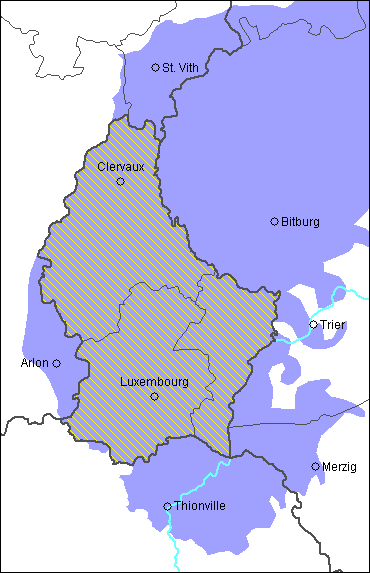


Characteristics and writing
Luxembourgish employs the Latin alphabet with a few diacritics and a standardized orthography used in schools and publications. Its grammar and word order resemble other Germanic languages: nouns have gender, articles distinguish definiteness, and verb placement shows a verb‑second tendency in main clauses. Vocabulary draws from native Germanic roots but also includes many borrowings from French and, to a lesser extent, Dutch and English.
History and development
The language developed from Moselle Franconian dialects spoken in the border regions between what are now Germany, France and Luxembourg. During the 19th and 20th centuries it acquired a stronger written form and greater social prestige. It was legally recognized as the national language of Luxembourg in the late 20th century, and subsequent standardization made it more visible in print, broadcasting and education.
Uses and social context
Luxembourgish is used primarily in informal and family settings, local media, cultural events and politics. In schools and administration, French and German remain important, so most residents are multilingual and frequently switch between languages depending on context. This multilingual environment means Luxembourgish coexists with other tongues rather than replacing them.
Relations and notable facts
Though Luxembourgish shares many features with Standard German and can be mutually intelligible in simple conversation, it is recognized as a separate language with its own norms and literature. Small communities of speakers also live in neighboring regions of Belgium, France and Germany. For further general reference on the country's languages see Standard German.
- Common greetings: Moien (hello), Äddi (goodbye)
- Context: spoken daily in homes and local media; used in cultural expression and political discourse
- Note: many speakers are fluent in several languages and practice frequent code‑switching)
Questions and answers
Q: What is the Luxembourgish language?
A: The Luxembourgish language is a West Germanic language spoken by a lot of people in Luxembourg.
Q: How similar is Luxembourgish to German?
A: Luxembourgish is quite similar to German.
Q: Do many people outside of Luxembourg speak Luxembourgish?
A: No, not many people outside of Luxembourg speak Luxembourgish.
Q: Do many people in Luxembourg speak languages other than Luxembourgish?
A: Yes, many people in Luxembourg speak languages other than Luxembourgish.
Q: What language family does Luxembourgish belong to?
A: Luxembourgish belongs to the West Germanic language family.
Q: Is Luxembourgish a widely spoken language?
A: No, Luxembourgish is not widely spoken outside of Luxembourg.
Q: What is the status of Luxembourgish in Luxembourg?
A: Despite being popular in Luxembourg, other languages are also widely spoken.
Related articles
Author
AlegsaOnline.com Luxembourgish language Leandro Alegsa
URL: https://en.alegsaonline.com/art/60046