
Liquid crystal: properties, phases, history and uses
An overview of liquid crystals: what they are, common phases, how they are observed and controlled, historical background, and principal applications such as displays and sensors.
Overview
Liquid crystals are materials that combine properties of liquids and crystalline solids. They can flow like ordinary liquids yet retain some degree of molecular order typical of crystals. This intermediate state gives rise to directional optical and mechanical behavior that is not present in simple isotropic liquids. For a concise definition see liquid crystals, and note their similarity to a liquid and contrast with a solid crystal.
Image gallery
8 Images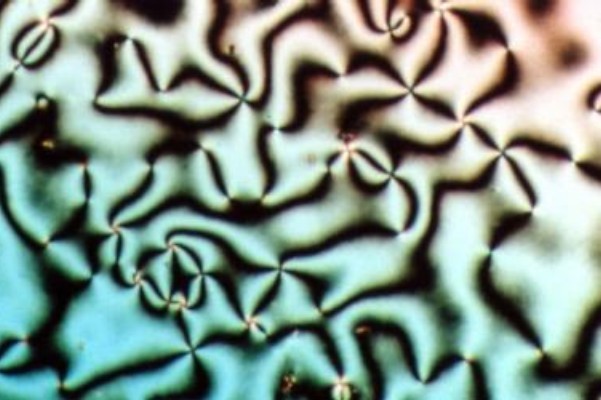



Characteristic structure and phases
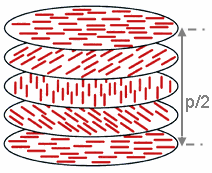
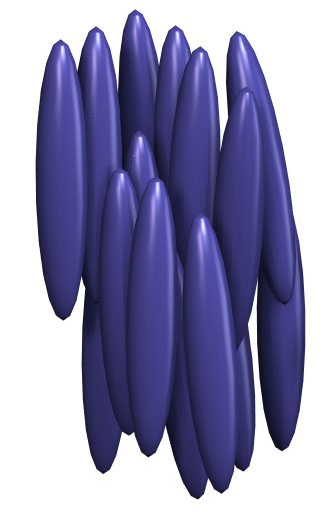
Liquid crystalline phases differ by the way their constituent molecules are arranged and how much positional or orientational order they maintain. Major thermotropic categories include nematic, where molecules share a common orientation but have no layered order; smectic, which form layers with varying degrees of tilt or internal order; and cholesteric (also called chiral nematic), where the preferred orientation twists periodically through the sample. Another important distinction is between thermotropic behavior (driven by temperature) and lyotropic behavior (driven by concentration in a solvent).
Optical and physical properties
Because the molecules are anisotropic and partly ordered, liquid crystals show directional dependence of refractive index and related optical effects. Their optical properties include birefringence and selective reflection in some chiral phases. Under a microscope equipped for polarized microscopy, using polarized light, different phases produce distinctive textures and contrast patterns. These textures represent regions in which the molecular director is aligned differently; within each domain the molecules remain well ordered.
Observation and measurement
Common laboratory methods to study liquid crystals combine optical microscopy, polarization analysis and methods sensitive to molecular order such as X-ray diffraction, nuclear magnetic resonance, and rheology. Polarized-light imaging reveals how domains reorient under external fields or flow. Controlling variables such as temperature, concentration or applied electric fields allows transitions between ordered and isotropic states in much the same way that heating can melt a crystalline solid into a liquid; for contrast, compare with the familiar example of water changing phase and its gaseous phase counterpart.
History and development
Liquid crystals were first reported in the late 19th century when certain organic compounds showed intermediate optical behavior on heating. Early researchers documented these unusual phases, and since the mid-20th century their properties have been understood well enough to enable engineered materials and devices. Progress in synthesis, alignment techniques and electrical control led to practical exploitation of their optical anisotropy.
Applications and importance
The most widely recognized application of liquid crystals is the liquid crystal display (LCD), which uses voltage-driven reorientation of molecules to modulate light and form images. Beyond displays, liquid crystalline materials are used in tunable optical elements, temperature-sensitive indicators, sensors and research tools for studying soft-matter ordering. Their combination of fluidity and anisotropic response makes them valuable for both fundamental studies of phase behavior and numerous technological applications.
Distinguishing features and notable facts
- Liquid crystals are anisotropic fluids: properties depend on direction.
- The same chemical substance can exist in different phases depending on temperature or concentration.
- Their visible textures under polarized light are diagnostic and useful for identification; see resources on microscopy and polarized light.
- Research continues on new liquid crystalline polymers, biological liquid crystals (for example certain cell membranes and DNA assemblies), and fast-switching materials for optics.
For further technical background and practical guidance on observing phases, consult specialized texts and reviews that cover molecular architecture, phase diagrams and methods of alignment and control (light-matter interaction, optical properties and experimental techniques referenced above).
Additional introductory and applied resources can be found through general science collections and technical summaries that explain phase behavior, measurement techniques and device implementations (definition, fluid behavior, crystalline order, observed textures, analogies with simple fluids, and practical notes on phase transitions and display technology).
Related articles
Author
AlegsaOnline.com Liquid crystal: properties, phases, history and uses Leandro Alegsa
URL: https://en.alegsaonline.com/art/58376