
Liquid nitrogen
Cryogenic liquid form of atmospheric nitrogen used for cooling, preservation, and industrial processes. Produced by air liquefaction; boils at −196 °C. Requires careful handling due to extreme cold and asphyxiation risk.
Overview
Liquid nitrogen is the cryogenic, liquid state of the chemical element nitrogen, obtained by cooling and compressing air until nitrogen condenses. It is a colorless, odorless fluid widely used where very low temperatures are required. At standard atmospheric conditions (atmospheric pressure) it boils at about −196 °C (77 K; −321 °F), so it readily vaporizes when exposed to ambient air.
Image gallery
5 Images


Properties and production
Industrial liquid nitrogen is commonly produced from air by cryogenic separation. Air is cooled and pressurized until components liquefy; nitrogen is isolated in a process often called production by fractional distillation of liquefied air. Other methods include gas refrigeration cycles and Joule–Thomson expansion steps in liquefiers. The resulting liquid is very cold, has low viscosity, and vaporizes into inert nitrogen gas. Because the liquid evaporates quickly at room temperature, storage uses insulated vessels called dewars or vacuum-jacketed containers to slow heat transfer.
History and development
The liquefaction of atmospheric gases was a major achievement of 19th-century physics and chemistry. Early experiments led to the first successful liquefaction of nitrogen and other common gases; historical records note the first liquefaction events for several gases, including nitrogen, by researchers such as Wróblewski and Olszewski. Advances in cryogenic engineering and large-scale gas separation during the 20th century, including around World War II, expanded production and lowered costs. Improved industrial methods created a stable supply for many scientific and commercial applications.
Common uses and examples
- Cryopreservation of biological samples, cells, and reproductive material.
- Cryosurgery and dermatological treatments where extreme cold destroys tissue.
- Cooling in laboratories and industry, for example superconducting components that operate at liquid-nitrogen temperatures or precooling before liquid oxygen and other cryogen use.
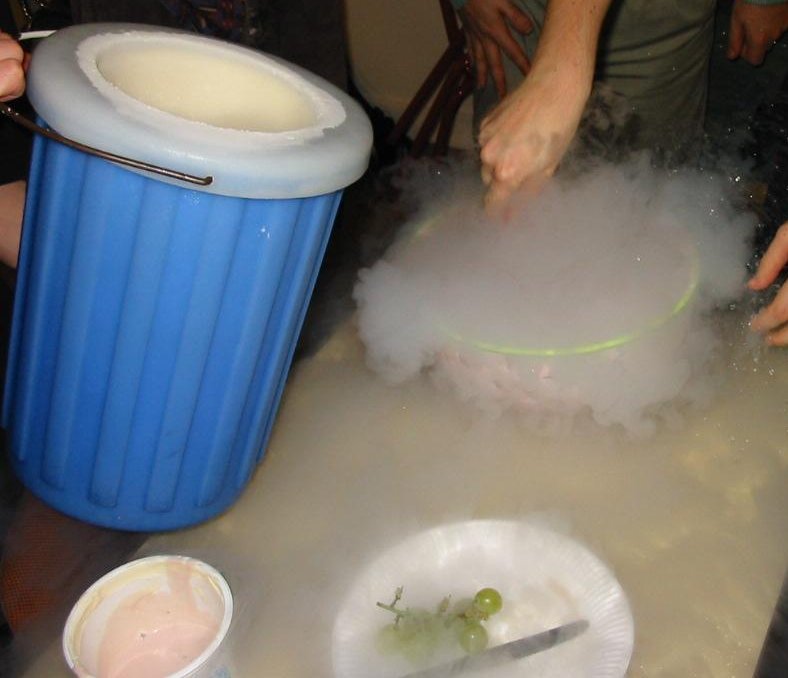
- Food processing and flash freezing, including rapid ice cream production and texture-preserving freezing.
- Theatrical fog and visual effects created by condensing moisture in air; also popular in classroom demonstrations (freezing flowers, making brittle rubber).
Safety, handling and distinctions
Despite being chemically inert under normal conditions, liquid nitrogen presents several hazards. Direct contact causes severe cold burns and frostbite; splashes of the liquid or cold gas can damage skin and eyes. When liquid nitrogen vaporizes in an enclosed area it can displace oxygen and create an asphyxiation hazard—ventilation and oxygen monitoring are important in confined spaces. Because it expands roughly 700-fold on vaporization, sealed containers can rupture from pressure buildup if not fitted with proper relief devices. Special protective equipment—insulated gloves, face shields, and appropriate containers such as vacuum-insulated dewars—are standard practice.
Notable facts and distinctions
Liquid nitrogen is often compared with other cryogens. Unlike liquid oxygen, nitrogen is not a strong oxidizer and does not support combustion, which makes it safer for many applications. It also has a higher boiling point than helium, so helium is used for applications needing temperatures below ~4 K. The widespread availability of liquid nitrogen and its relative low cost have made it a staple in research, medicine, and industry.
For more technical details about production, safety guidelines and historical sources see industrial publications and safety datasheets; introductory resources include summaries of extremely low temperature phenomena, cryogenic engineering texts, and practical handling guides linked from authoritative suppliers and organizations (boiling point references, liquefaction milestones, temperature scales, and accounts of early experiments fractional distillation and production methods). Additional materials on equipment and contemporary applications can be found through manufacturer and academic pages (temperature data, pressure considerations, and comparison with other gases).
Proper training, awareness of the risks, and adherence to handling protocols allow liquid nitrogen to be used safely and effectively across many fields, from routine laboratory cooling to advanced industrial processes.
Related articles
Author
AlegsaOnline.com Liquid nitrogen Leandro Alegsa
URL: https://en.alegsaonline.com/art/58377