
Lithium hydroxide (LiOH): properties, production, and uses
Lithium hydroxide is an inorganic base used in industry and aerospace. This article summarizes its chemical behavior, physical forms, production methods, major applications, and safety considerations.
Lithium hydroxide is an inorganic compound with the formula LiOH. It consists of lithium cations and hydroxide anions and appears commonly as a white, crystalline, hygroscopic solid. Chemically it behaves as a strong base in water and readily reacts with carbon dioxide to form lithium carbonate, a feature that underlies several of its practical applications. For a basic chemical overview see compound data.
Image gallery
4 Images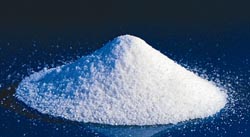


Characteristics and physical forms
- Chemical identity: LiOH; typically available as anhydrous or as the monohydrate.
- Appearance and behavior: white crystalline powder, hygroscopic and corrosive; soluble in water and alkaline in solution.
- Chemical behavior: neutralizes acids, reacts with CO2 to yield lithium carbonate, and participates in common base-catalyzed reactions.
- Relation to elements and ions: contains lithium metal ions and hydroxide ions—see element information at lithium and ionic chemistry at hydroxide.
Production and historical notes
Commercial lithium hydroxide is usually manufactured from lithium carbonate by conversion and purification steps that remove insoluble byproducts; a common route precipitates calcium carbonate when lithium carbonate is treated with calcium hydroxide. The monohydrate form is frequently produced because it is easier to handle, while the anhydrous form is required where water would interfere with downstream processes.
Major uses and applications
LiOH has several important applications across industries. It is used to produce other lithium chemicals, as a precursor for some battery materials, and in lubricating greases. In aerospace and submarine life‑support it serves as an efficient carbon‑dioxide absorbent in canisters and scrubbers because of its ability to form lithium carbonate on contact with CO2. In nuclear power plants small concentrations of lithium hydroxide are employed to help control coolant pH. In organic and industrial chemistry it functions as a strong base for saponification and other base‑catalyzed transformations.
Safety and handling
Lithium hydroxide is caustic: it can irritate or burn skin and eyes and must be handled with appropriate protective equipment. It absorbs moisture and CO2 from air, so storage in dry, well‑sealed containers is advised. Disposal and environmental handling follow regulations for alkali metal hydroxides and lithium compounds; consult material safety resources or supplier information such as technical datasheets.
Distinguishing LiOH from related lithium salts (for example lithium carbonate) is important: lithium hydroxide is more reactive as a base and is often selected when direct alkalinity or rapid CO2 capture is required. For further reading and technical specifications consult manufacturer literature or trusted chemical databases.
Related articles
Author
AlegsaOnline.com Lithium hydroxide (LiOH): properties, production, and uses Leandro Alegsa
URL: https://en.alegsaonline.com/art/58438
Sources
- dx.doi.org : 10.1002/14356007.a15_393