
International Monetary Fund (IMF)
The IMF is a global organization of 189 member countries that promotes monetary cooperation, financial stability, lending, economic surveillance, and capacity development worldwide.
Overview
The International Monetary Fund is an international organization established after the 1944 Bretton Woods conference to promote global monetary cooperation and financial stability. It comprises 189 member countries and is headquartered in Washington, D.C., in the United States. The Fund monitors economic and financial developments, provides policy advice, offers temporary financial assistance to members facing balance-of-payments problems, and supports capacity development.
Image gallery
9 Images



Structure and governance
The IMF is governed by its members through the Board of Governors and an Executive Board that oversees operations. A Managing Director heads the staff and daily work. A quota system, based on members' relative size in the global economy, determines financial contributions, voting power, and access to financing. The institution also manages international reserve assets, notably Special Drawing Rights (SDRs).
Main functions and instruments
Core activities include surveillance of the global and national economies, lending to countries with external financing needs, and technical assistance to strengthen public finance, central banking, and statistical systems. Lending instruments and facilities vary in purpose and duration; their terms are designed to restore macroeconomic stability and sustainable external positions.
History and role
Originally created to support fixed exchange rates and postwar reconstruction, the IMF's role evolved after the early 1970s to address a broader range of macroeconomic and financial issues. It plays a central role in international crisis response, policy coordination among countries, and the provision of economic research and data used by governments, markets, and researchers.
Criticism and reform
The Fund has faced critiques concerning the design and social effects of program conditions, the adequacy of representation for emerging economies, and the balance between fiscal adjustment and social protection. In response, it has implemented governance and policy changes aimed at improving transparency, tailoring programs to social needs, and strengthening collaboration with other international institutions and creditors.
Importance and resources
Governments turn to the IMF for short- and medium-term financing, policy advice, and technical training. Its analyses, forecasts, and data—together with staff reports and public communications—are widely referenced in global economic discussions. For official information and publications see the institution's resources linked above.

History
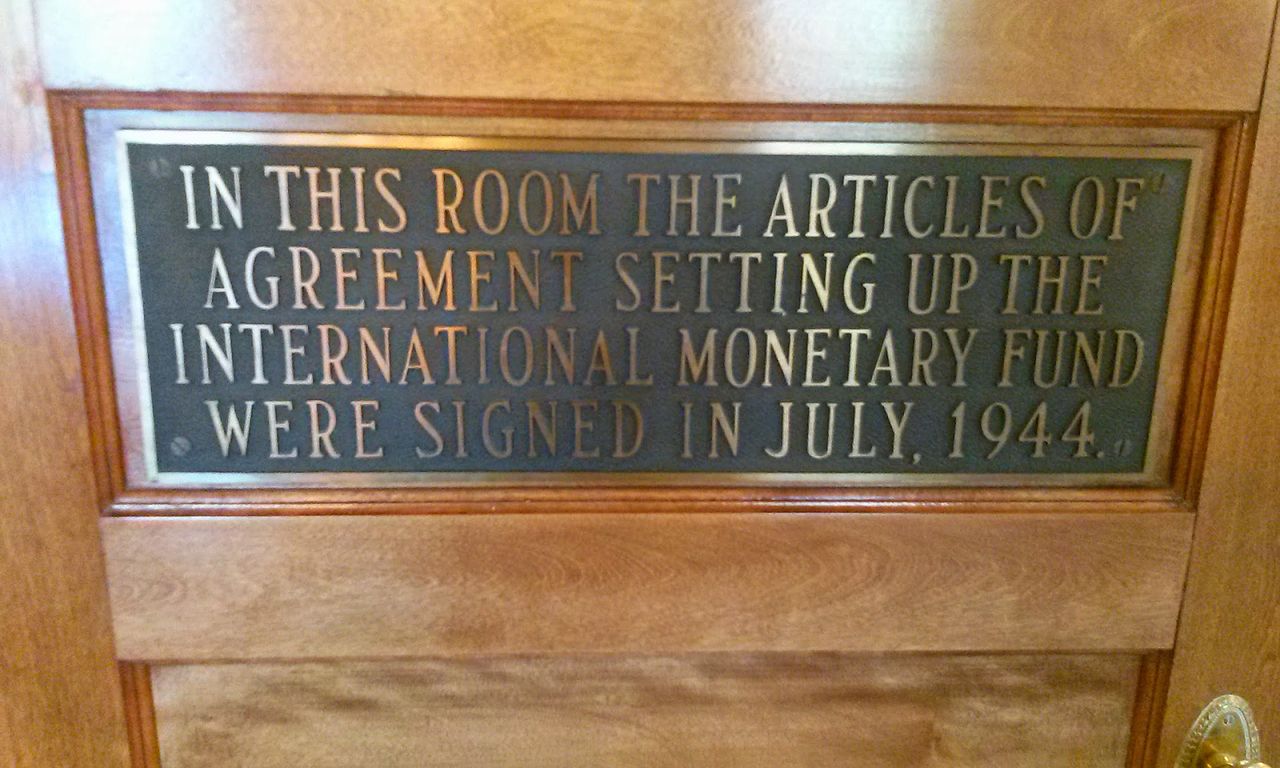
Against the background of the negative monetary experiences in the 1930s, Great Britain (Keynes Plan) and the USA (White Plan) in particular negotiated a new international monetary system, which was finally successfully concluded with the conference in Bretton Woods, a small town in the US state of New Hampshire. These negotiations, which were decisive for the reconstruction of the world economic system, lasted from July 1, 1944 to July 22, 1944, where John Maynard Keynes, with the Keynes Plan he had developed, was unable to prevail against the White Plan preferred by the USA.
As the institutional center of the new system, the IMF was established by international agreement in December 1945. Some previously exclusive national decision-making rights were transferred to it. It began its initial work in May 1946. Its actual operational activities began on 1 March 1947.
Following a resolution of the Bundestag on 28 July 1952, the Federal Republic of Germany joined the IMF on 14 August 1952.
Member States
189 countries are members of the IMF, including all United Nations member states except Andorra, Cuba, Liechtenstein, Monaco, and North Korea. Kosovo, which is not a member of the UN, joined the IMF in 2009. The island nation of Nauru became the 189th member state on April 12, 2016.
Shares and voting rights of Member States
In October 2010, the G20 finance ministers decided that the voting shares of the 187 member states at the time should be redistributed in favor of developing countries and emerging markets, and that the Fund's flexibly available financial resources should be doubled. This was "the most important reform of IMF governance since its inception," according to then Managing Director Dominique Strauss-Kahn. The reforms took effect in January 2016.
According to the IMF's Articles of Agreement, its headquarters must be maintained in the country with the most voting rights.
The share of votes of the 18 euro states is 22.53 percent. The European Commission has proposed that the euro states combine their votes.
Shares and voting rights and governors of the member states with the twenty largest voting shares (as of April 2020):
| IMF Member State | Capital share: | Capital share: | Governor | deputy | Votes: | Votes: |
| United States | 82.994,2 | 17,45 | Steven Mnuchin | vacant | 831.408 | 16,51 |
| 30.820,5 | 6,48 | Taro Aso | Haruhiko Kuroda | 309.671 | 6,15 | |
| China People's Republic of | 30.482,9 | 6,41 | Yi Gang | Yulu Chen | 306.295 | 6,08 |
| Germany | 26.634,4 | 5,60 | Jens Weidmann | Olaf Scholz | 267.810 | 5,32 |
| United Kingdom | 20.155,1 | 4,24 | Rishi Sunak | Andrew Bailey | 203.017 | 4,03 |
| France | 20.155,1 | 4,24 | Bruno Le Maire | François Villeroy de Galhau | 203.017 | 4,03 |
| Italy | 15.070,0 | 3,17 | Roberto Gualtieri | Ignazio Visco | 152.166 | 3,02 |
| India | 13.114,4 | 2,76 | Nirmala Sitharaman | Shaktikanta Das | 132.610 | 2,63 |
| Russia | 12.903,7 | 2,71 | Anton Siluanov | Elvira Nabiullina | 130.503 | 2,59 |
| Brazil | 11.042,0 | 2,32 | Paulo Guedes | Roberto de Oliveira Campos Neto | 111.886 | 2,22 |
| Canada | 11.023,9 | 2,32 | Bill Morneau | Stephen Poloz | 111.705 | 2,22 |
| Saudi Arabia | 9.992,6 | 2,10 | Mohammed Aljadaan | Ahmed A. Alkholifey | 101.392 | 2,01 |
| Spain | 9.535,5 | 2,00 | Nadia Calviño | Pablo Hernández de Cos | 96.821 | 1,92 |
| Mexico | 8.912,7 | 1,87 | Arturo Herrera | Alejandro Diaz de Leon | 90.593 | 1,80 |
| Netherlands | 8.736,5 | 1,84 | Klaas Knot | Christiaan Rebergen | 88.831 | 1,76 |
| Korea Sud South Korea | 8.582,7 | 1,80 | Nam-Ki Hong | Juyeol Lee | 87.293 | 1,73 |
| Australia | 6.572,4 | 1,38 | Joshua Frydenberg | Steven Kennedy | 67.190 | 1,33 |
| Belgium | 6.410,7 | 1,35 | Pierre wish | Alexander De Croo | 65.573 | 1,30 |
| Switzerland | 5.771,1 | 1,21 | Thomas Jordan | Ueli Maurer | 59.177 | 1,18 |
| Turkey | 4.658,6 | 0,98 | Berat Albayrak | Murat Uysal | 48.052 | 0,95 |
| Other German-speaking countries: | ||||||
| Austria | 3.932,0 | 0,83 | Robert Holzmann | Gottfried Haber | 40.786 | 0,81 |
| Luxembourg | 1.321,8 | 0,28 | Pierre Gramegna | Gaston Reinesch | 14.684 | 0,29 |




Related articles
Author
AlegsaOnline.com International Monetary Fund (IMF) Leandro Alegsa
URL: https://en.alegsaonline.com/art/47670
Sources
- people-press.org : people-press.org