
Mexico (United Mexican States): geography, history, people, and culture
Mexico is a federal country in North America with a rich pre-Columbian heritage, Spanish colonial legacy, diverse landscapes and cultures, and a modern mixed economy and society.
Mexico, officially the United Mexican States, is a federal republic located in North America. It stretches from the border with the United States in the north to the borders with Guatemala and Belize in the southeast, and is bounded by the Pacific Ocean to the west and the Gulf of Mexico and Caribbean Sea to the east. The nation's capital is Mexico City.

Image gallery
10 Images


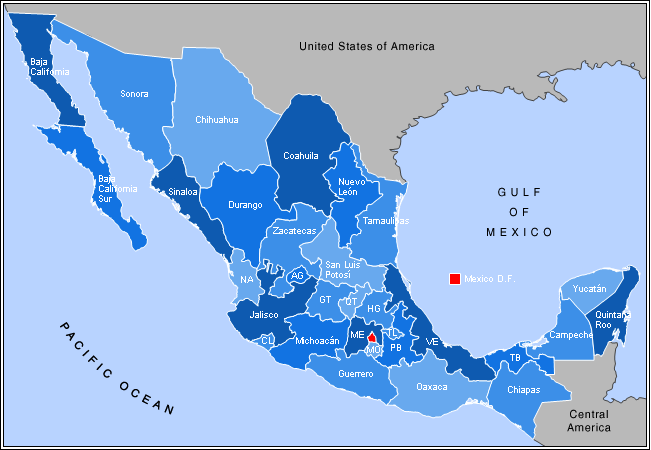


Geography and environment
Mexico's landscape includes arid deserts, high mountain chains (notably the Sierra Madre ranges and a volcanic axis), tropical lowlands and extensive coastlines. The country's position between two oceans and its varied elevation give rise to many climates and ecological regions, from temperate highlands to humid tropical forests. These environments support rich biodiversity and a range of agricultural zones.
Population, languages and religion
People from Mexico are commonly called Mexicans. The majority speak Spanish, and Mexico is often identified as the largest Spanish-speaking country by population. In addition, a large number of communities preserve indigenous languages and cultures; prominent indigenous language families and tongues include Nahuatl, various Mayan languages, and Zapotec among many others. Mexican society is diverse: many citizens have mixed indigenous and European ancestry (often described as mestizo), alongside distinct indigenous peoples and communities. Historically, most Mexicans identify with Roman Catholic traditions, though religious practice today is plural and varied.
History and development
Human societies in the territory now known as Mexico developed some of the Americas' most influential pre-Columbian civilizations, including the Olmec, the Aztecs and the Maya. In the 16th century Spanish conquest transformed political and cultural life, leading to three centuries as the viceroyalty of New Spain. Mexico achieved independence in the early 19th century and experienced a complex 19th and 20th century marked by territorial change, internal conflict and the Mexican Revolution, which shaped modern institutions and the 1917 constitution that underpins the contemporary federal republic.
Government, economy and international role
Mexico is a federation of states with a presidential system. It operates a mixed economy that blends manufacturing, petroleum production, agriculture, services and tourism. The country is integrated into regional and global trade networks and participates in international agreements and organizations. Remittances, tourism, and exports of manufactured goods and energy are important components of national income.
Culture, cuisine and notable facts
Mexican culture is widely recognized for its music (including mariachi), visual arts, literature, and rich culinary traditions such as tacos, mole sauces and regional specialties that reflect indigenous and Spanish influences. Public celebrations like Día de los Muertos enjoy global recognition. Mexico's combination of archaeological sites, colonial cities and living cultural practices makes it a focal point for historians, travelers and scholars. For introductions to Mexico's language, geography, history and institutions see resources on Texas and cross-border relations, cultural overviews at California links, and regional studies involving Nahuatl and Mayan traditions.
- Official name: United Mexican States
- Capital: Mexico City
- Borders: United States, Guatemala, Belize
- Oceans: Pacific Ocean, Gulf of Mexico
For further reading and maps, consult specialized sources and official publications which provide updated demographic, economic and geographic data. General overviews and cultural guides are available through academic and governmental sites listed under focused entries and travel resources.
Questions and answers
Q: What is the official name of Mexico?
A: The official name of Mexico is Estados Unidos Mexicanos.
Q: What countries are south of Mexico?
A: Guatemala and Belize are south of Mexico.
Q: What two bodies of water border Mexico?
A: Mexico is bordered by the Pacific Ocean and the Gulf of Mexico.
Q: Who are Mexicans?
A: Mexicans are people living in or from Mexico.
Q: What language do most Mexicans speak?
A: Most Mexicans speak Spanish.
Q: Are there any other languages spoken in Mexico?
A: Yes, some Mexicans also speak Native American languages such as Nahuatl, Mayan, and Zapotec.
Q: What religion do most modern Mexicans practice? A:Most modern Mexicans practice Catholicism.
Related articles
Author
AlegsaOnline.com Mexico (United Mexican States): geography, history, people, and culture Leandro Alegsa
URL: https://en.alegsaonline.com/art/64346
Sources
- commons.wikimedia.org : Mexico
- presidencia.gob.mx : "Official Name of the Country"
- sre.gob.mx : "General Information about Mexico"
- britannica.com : "Encyclopædia Britannica – Mexico Languages"
- cdi.gob.mx : "Comisión Nacional para el Desarrollo de los Pueblos Indígenas"
- convergencia.uaemex.mx : "Composición Étnica de las Tres Áreas Culturales del Continente Americano al Comienzo del Siglo XXI"
- worldcat.org : 1405-1435
- cdi.gob.mx : "Síntesis de Resultados"
- scjn.gob.mx : "Political Constitution of the United Mexican States Title 2 Article 40"
- inegi.org.mx : "INEGI 2010 Census Statistics"
- imf.org : "World Economic Outlook Database, October 2010"
- imf.org : "IMF"
- data.worldbank.org : "Gini Index"
- hdr.undp.org : "Human Development Report 2011 - Human development statistical annex"
- embamex.sre.gob.mx : "About Mexico"