
Gas giant
A gas giant is a very large planet dominated by a thick gaseous envelope over a dense core. This article describes structure, formation, Solar System examples, exoplanets and key distinctions.
A gas giant is a type of large planet whose bulk mass is composed of a deep, massive atmosphere of light gases above a denser interior. Although many gas giants are believed to have a compact, mostly solid or metallic core, most of their volume is taken up by hydrogen, helium and other volatile materials rather than a rocky surface. The term emphasizes the dominance of gaseous layers and contrasts these worlds with smaller, predominantly rocky planets.
Image gallery
9 Images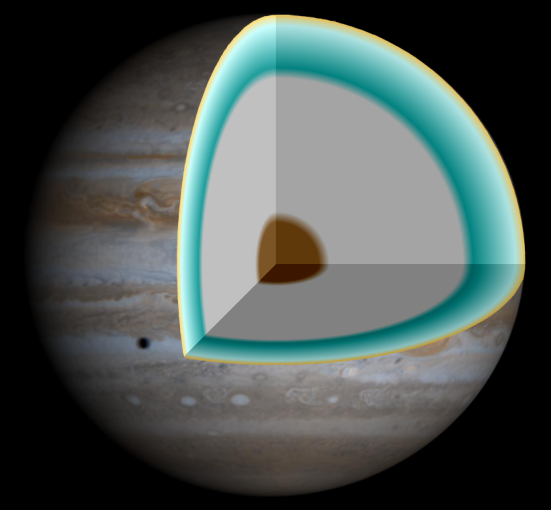





Characteristics and structure
Gas giants are distinguished by very large radii and masses compared with terrestrial planets. Their visible appearance is determined by thick cloud layers and banded atmospheres; internally they show steep changes in composition and state with depth, including molecular gas, metallic fluid hydrogen, and sometimes a compact central material. Typical components include molecular hydrogen and helium, plus trace amounts of methane, ammonia and water vapor. In some planets the deeper layers transition into high-pressure ices or supercritical fluids rather than conventional solids.
- Atmosphere: multi-layered, often with clouds and storms driven by rapid rotation and heat transport.
- Interior: a dense inner region (core) overlain by mantles of hydrogen/helium or volatile-rich mixtures.
- Magnetosphere: many gas giants generate strong magnetic fields through dynamo action in conductive layers.
- Scale: sizes and masses can span a wide range from sub-Saturn to several times Jupiter's mass.
Formation and origin
Two main ideas are used to describe how gas giants form in a protoplanetary disk. The core accretion model envisions the gradual buildup of a heavy-element core that, once massive enough, accretes a large gaseous envelope from the surrounding disk. An alternative, the disk instability model, proposes that portions of the disk can become gravitationally unstable and collapse directly into massive gaseous protoplanets. Both pathways depend on local conditions such as disk mass, temperature and lifetime, and both are subjects of active research and observation.
Examples in the Solar System and beyond
In our Solar System the four largest planets are commonly classified as gas or giant planets: Jupiter and Saturn are the archetypal gas giants, dominated by hydrogen and helium. Uranus and Neptune are often described as "ice giants" because a larger fraction of their mass is water, ammonia and methane ices or high-pressure volatile materials mixed with rock. All four are thought to have more compact inner regions that may include rocky or metallic material comparable in mass to Earth-sized bodies.
Outside our system, astronomers have discovered many giant exoplanets. Some are found at wide separations, more like the classical giants, while a notable class called "hot giants" or "hot Jupiters" orbit very close to their stars and experience intense stellar heating. Detection methods such as radial velocity and transit photometry have revealed a population with diverse masses, radii and orbital properties, expanding our understanding of giant-planet formation and evolution.
Importance and distinguishing facts
Gas giants influence planetary systems strongly: their mass can sculpt debris disks, affect the migration and survival of smaller planets, and deliver or deflect material during system evolution. They host complex atmospheres with weather systems, strong winds, and sometimes long-lived vortices. Observations across wavelengths, from reflected light to radio emissions, probe their cloud structure, composition and magnetic environments. For accessible summaries and observational datasets see resources on planetary composition and general overviews at educational sites such as exoplanet catalogs and mission pages like those associated with space telescopes.
When comparing gas giants to other classes, remember that terminology can vary: some definitions reserve "gas giant" for hydrogen–helium dominated planets and use "ice giant" for Neptune‑class worlds with larger volatile fractions, while others use "giant planet" as the broader category. For further reading on formation theories, interior models, and observed examples see summary articles and databases at planetary science portals, technical reviews at academic repositories, observational catalogs at exoplanet archives, and mission-specific pages such as those for probes and telescopes listed on research sites and outreach portals like public science pages.
Note: this article provides a concise overview; readers seeking detailed models of interiors, magnetic dynamos or atmospheric chemistry should consult specialized literature and mission data archives referenced above.
Related articles
Author
AlegsaOnline.com Gas giant Leandro Alegsa
URL: https://en.alegsaonline.com/art/37664