
Geocentrism
Geocentrism is the historical model that places the Earth at the centre of the cosmos. This article explains its main features, development, decline, and lasting cultural significance.
Geocentrism is the view that the Earth occupies the central, immobile position in the universe and that the Sun, Moon, planets and stars move around it. That concept dominated much of human cosmology for many centuries because, from the surface of Earth, celestial bodies appear to travel across the sky. Geocentric ideas were developed into detailed mathematical systems that sought to match observation with a stable, Earth‑centred framework.
Image gallery
8 Images





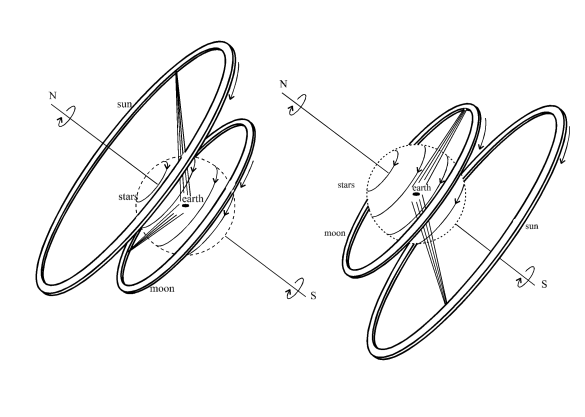
Classical formulation and Ptolemaic system
The most influential classical statement of geocentrism is associated with the astronomer Ptolemy, who compiled observational rules and geometrical constructions in works that guided astronomers for over a millennium. Ptolemaic astronomy modelled planetary motion by combining large circular paths (deferents) with smaller circles (epicycles) to account for changes in speed and direction as seen from Earth. This approach preserved the idea of a spherical, central Earth while producing predictions of positions of the Sun, Moon and planets against the fixed background of stars and the wider Universe.
Key characteristics
- Earth considered stationary and central to cosmic order.
- Celestial spheres or circular motions used to explain apparent movement.
- Complex mechanisms such as epicycles allowed close agreement with observation.
Geocentric thinking was common in many ancient cultures and particularly elaborated by Greek thinkers. Scholars and astronomers refined models over centuries to reconcile theory and measured positions of heavenly bodies.
Transition to heliocentrism
From the late medieval period into the Renaissance, empirical and theoretical developments challenged a fixed Earth. Figures such as Copernicus, Galileo and Kepler proposed and tested alternatives that placed the Sun near the centre and gave Earth an orbital motion — the system known as heliocentrism. Observations of planetary phases, more accurate positional data and improved physical reasoning led to widespread scientific acceptance that Earth is not the universe's centre. The debate also produced intermediate models such as the Tychonic system, which attempted to reconcile data with some geocentric intuition.
Today geocentrism is not supported by mainstream astronomy because a large body of evidence — including spacecraft navigation, stellar parallax, and physical laws — matches a heliocentric and non‑central cosmology. Nevertheless, the geocentric tradition is historically important: it shaped early scientific methods, influenced philosophical and theological thought, and provides an instructive example of how observations, models and assumptions interact in the development of science. For further general context see resources on the history of astronomy and notable transitions in cosmological models, such as works discussing the Sun and its role in changing cosmic perspectives: Sun and observational records from the 16th century.
Major distinctions remain useful for study: geocentrism as an explanatory framework, the Ptolemaic computational system, the Tychonic compromise, and the modern heliocentric view that underpins contemporary astronomy. Each represents a stage in the evolving human attempt to describe the motions of celestial bodies accurately and coherently.
For introductions or primary source translations consult scholarly overviews and historical commentaries available through educational and archival collections: Earth-centred models, planetary motion studies via cosmology, and historical surveys of astronomers' work here.
Related articles
Author
AlegsaOnline.com Geocentrism Leandro Alegsa
URL: https://en.alegsaonline.com/art/38088