
Gegenschein (Counterglow): Faint Antisolar Sky Glow
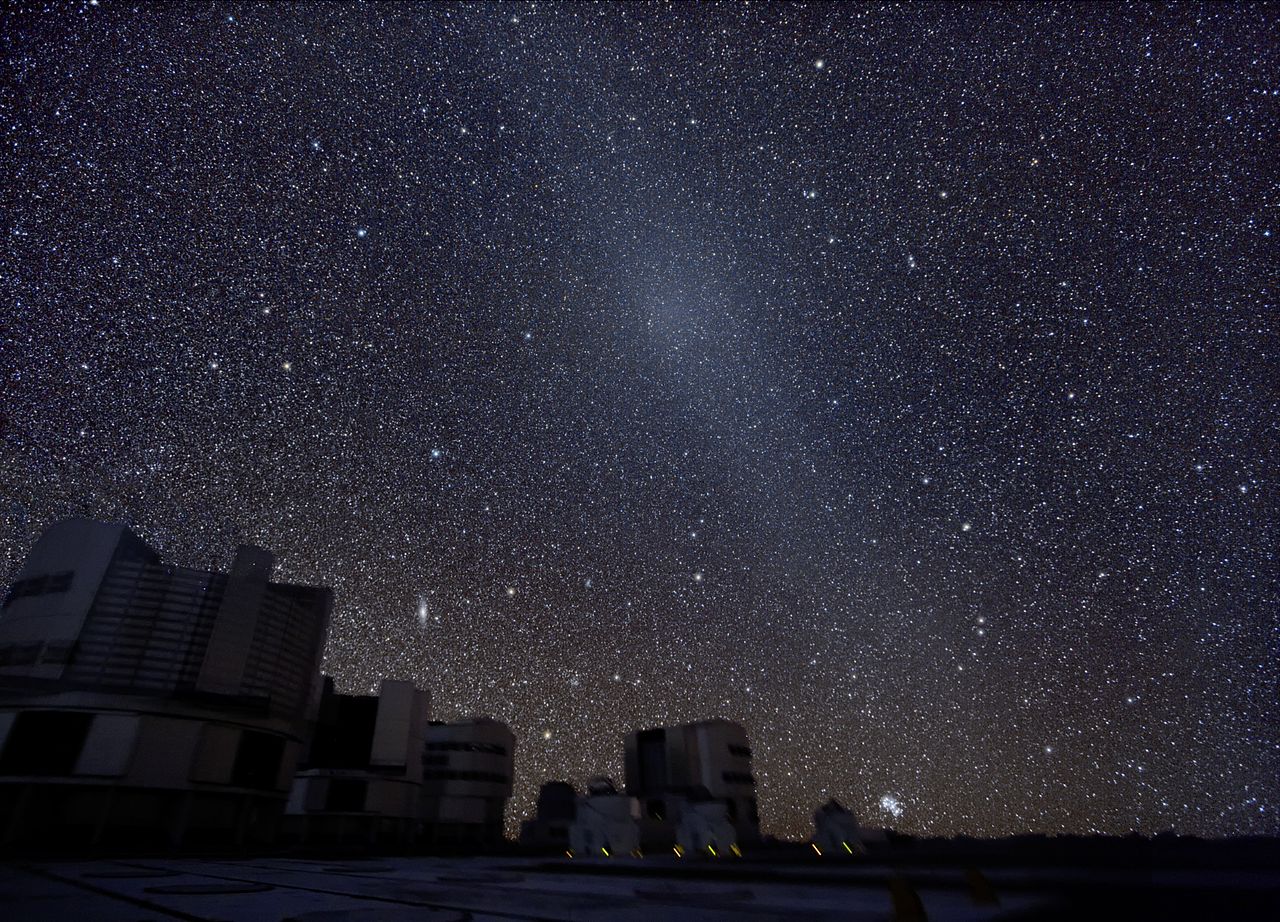
The Gegenschein is a very faint sky glow seen at the point opposite the Sun, produced by sunlight scattering from interplanetary dust. It is visible only under very dark, moonless skies and is related to zodiacal light.
Overview
The Gegenschein, often called the counterglow, is a subtle, diffuse patch of light that appears in the night sky at the point exactly opposite the Sun. Unlike bright celestial objects, it is extremely faint and requires careful observing conditions to detect. The phenomenon is closely linked to the zodiacal light and to the distribution of dust particles in the inner Solar System. For a brief introduction, see faint light and for its antisolar location see exactly opposite the Sun.
Image gallery
2 Images
Appearance and viewing conditions
To the eye, the Gegenschein appears as a small, oval or rounded brightening of the sky centered on the antisolar point. It is much subtler than the broad zodiacal cone that extends along the ecliptic; the Gegenschein is concentrated near the antisolar point where backscattering is strongest. Successful observation typically requires locations free of artificial illumination and a dark, moonless sky — for practical advice on site selection consult away from cities and night timing such as a no moon phase.
- Best conditions: very dark skies, no Moon, low atmospheric dust or haze.
- Where to look: on the ecliptic, at the antisolar point a few hours after local midnight or before dawn.
- Appearance: faint, diffuse, roughly circular enhancement superposed on the zodiacal glow.
Cause and scientific importance
The Gegenschein is produced when sunlight is scattered back toward the observer by dust grains that occupy the plane of the Solar System. These particles — part of the interplanetary dust cloud — reflect sunlight; see a general description of the responsible matter and how particles can reflect light. The localized brightening at opposition is often attributed to a combination of higher dust concentration near Earth's orbital plane and enhanced backscattering (the so-called opposition effect). Astronomers study the Gegenschein and the zodiacal light to learn about the size, composition and spatial distribution of interplanetary dust, which in turn informs models of cometary and asteroidal debris and of how planetary systems evolve.
History, observations and distinctions
Observers have noted antisolar glows for centuries, with increasingly detailed descriptions and photographic records emerging after telescopic and photographic techniques improved. Modern observations use ground-based photometry and spaceborne infrared instruments to map the dust cloud more precisely. The Gegenschein is distinct from other night-sky phenomena such as airglow, the Milky Way, aurorae, and man-made light pollution; its association with the antisolar point and the zodiacal band is a key identifying feature.
Although the Gegenschein is not a practical navigational aid, it remains important in planetary science and in understanding the faint optical backgrounds that affect astronomical observations. Careful study of this counterglow helps astronomers interpret observations of diffuse light in our own and in extrasolar planetary systems.
Related articles
Author
AlegsaOnline.com Gegenschein (Counterglow): Faint Antisolar Sky Glow Leandro Alegsa
URL: https://en.alegsaonline.com/art/37840