
Gemini (constellation)
Gemini, the Twins, is a zodiac constellation notable for the stars Castor and Pollux, the Geminids meteor shower, and a long astronomical history from Ptolemy to modern stargazing.
Gemini is a well-known northern constellation traditionally identified with a pair of twins. It is one of the twelve constellations of the zodiac and has been recognized since antiquity as a distinct constellation. The familiar twin figures are represented by two bright stars and a pattern of fainter stars; an image placeholder appears here:

Image gallery
10 Images


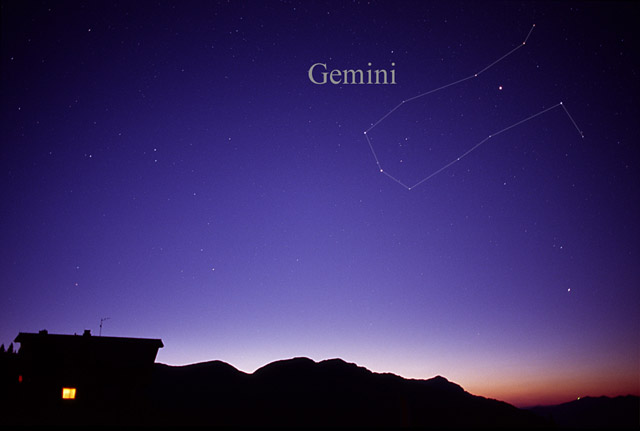





Characteristics and notable objects
Gemini is most conspicuous in the winter sky of the Northern Hemisphere, lying between the constellations Taurus and Cancer along the path of the Sun. Its two brightest stars are Pollux and Castor. Pollux is the brighter and orange-hued star that stands for one twin; it is also known to host at least one planet. Castor is a visually bright star that is in fact a complex multiple-star system. The constellation also contains the open cluster M35 and several fainter clusters and double stars that are popular targets for amateur telescopes.
History and mythology
Gemini was catalogued among the 48 constellations described by the 2nd-century astronomer Ptolemy, and it remains one of the 88 modern constellations recognized today. The Latin name comes from Latin for the twins. In classical lore the figures represent the brothers Castor and Pollux, a pair of heroic twins from Greek mythology whose story has many variations linking them to seafaring, brotherhood and immortality.
Significance and observation
As a zodiac constellation, Gemini lies close to the ecliptic and is crossed by the Sun each year. That position also makes it the radiant region for the annual Geminids meteor shower, one of the most active and reliable winter showers, which peaks in December and is unusual for originating from an asteroid-like parent body rather than a typical comet. The constellation is useful for celestial navigation and seasonal skyfinding because its bright twin stars form a recognizable pattern that helps locate surrounding constellations and deep-sky objects.
Distinguishing facts
- Gemini’s two principal stars are often called the "twin pillars" of the sky; their physical properties (color and multiplicity) contrast with one another.
- It occupies a region of the sky along the zodiac, making it important both in astronomy and historical astrology.
- The Geminids meteor shower highlights Gemini’s modern observational relevance for skywatchers each year.
Whether approached as a cultural symbol, a guidepost for finding other celestial objects, or a locus for an impressive meteor shower, Gemini remains an enduring and accessible feature of the winter sky.
Questions and answers
Q: What is the name of the constellation?
A: The name of the constellation is Gemini.
Q: Who described it?
A: It was described by the 2nd century AD astronomer Ptolemy.
Q: How many constellations are there today?
A: There are 88 modern constellations today.
Q: What does its name mean in Latin?
A: Its name means "twins" in Latin.
Q: Who are Castor and Pollux from Greek mythology?
A: Castor and Pollux are twins from Greek mythology.
Q: What symbol represents Gemini?
A: The symbol for Gemini is (Unicode ♊).
Related articles
Author
AlegsaOnline.com Gemini (constellation) Leandro Alegsa
URL: https://en.alegsaonline.com/art/37877
Sources
- coldwater.k12.mi.us : K12.mi.us