
Dordrecht — Historic River Port City in South Holland
Dordrecht is a historic Dutch city in South Holland, known for its medieval centre, river confluence, inland port and the Synod of Dordrecht. It has a long maritime and industrial tradition and about 120,000 residents.
Dordrecht is a city in the western Netherlands, located in the province of South Holland within the country commonly called the Netherlands. It lies at a strategic confluence of rivers and has developed as an inland river port with a historic inner city on an island. The municipality is home to roughly 120,000 people and combines protected medieval neighbourhoods with active industrial areas.
Image gallery
10 Images
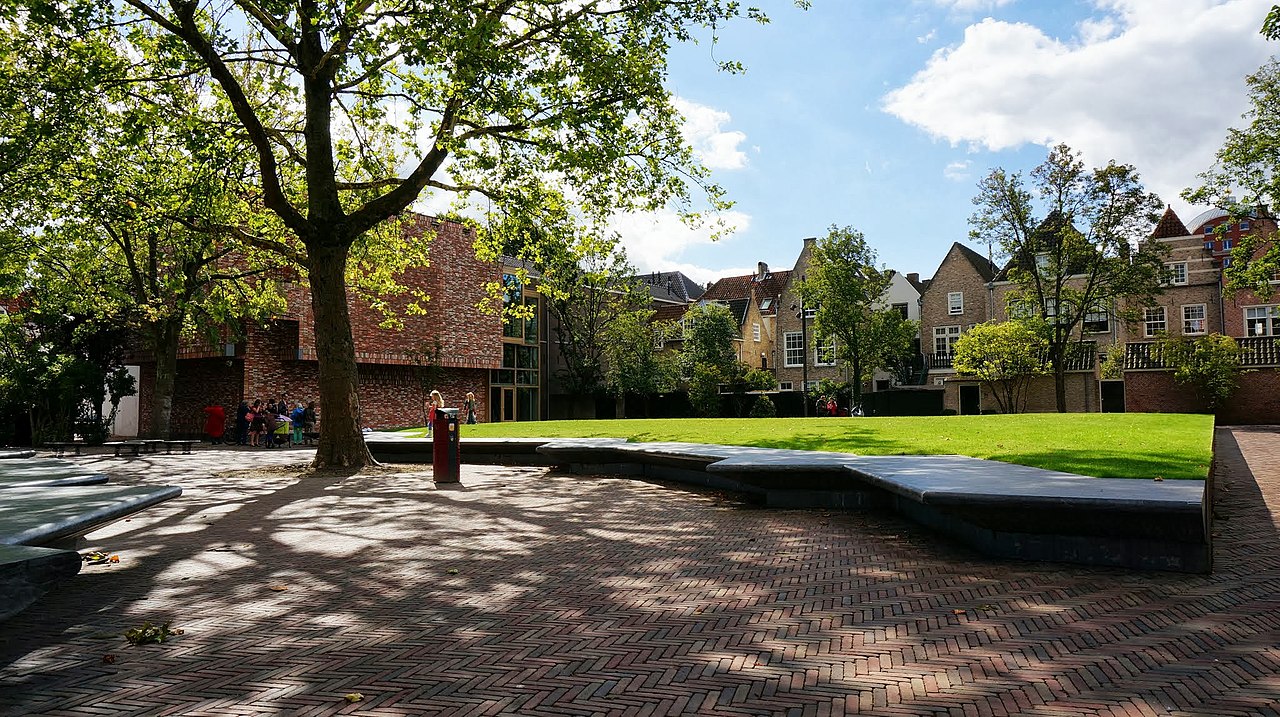


Geography and urban layout
Dordrecht occupies a position where several branches of the Rhine–Meuse river system meet. Its medieval centre sits on an island formed by river channels, and surrounding waterways have shaped transport, trade and land use for centuries. Nearby natural areas include freshwater tidal wetlands that are valued for recreation and wildlife. The city is linked by road and rail to larger nearby cities and serves as a logistic hub for river-borne cargo.
History and development
The place that became Dordrecht is first recorded in the early second millennium; a commonly cited early date is 1047, and the town received formal municipal privileges in 1220, making it one of the earliest chartered towns in the western Netherlands. Dordrecht prospered during the Middle Ages as a trading centre. It also played a role in the Dutch Revolt: assemblies in the city in 1572 supported the cause of William of Orange against the rule of Spain, and later the city hosted the important Synod of Dordrecht in the early 17th century, an event with long-standing religious and cultural consequences.
Economy and industry
Dordrecht combines port activities with light and heavy industry. The inner and outer quays handle river shipping and transshipment, and the city retains a significant marine harbour infrastructure. Major contemporary sectors include food processing, logistics, and manufacturing. Historically important metalworking survives in various forms, and the area still supports a metal industry alongside other industrial employers.
Culture, landmarks and uses
The old town contains several notable historic buildings, narrow canals and squares that attract visitors. Highlights and institutions include:
- a large medieval church and other period architecture;
- a regional history and art museum with collections that reflect the city’s maritime past;
- annual cultural events and festivals tied to river heritage;
- ports, shipyards and waterfront promenades that illustrate Dordrecht’s continuing role as a river port.
Dordrecht is often studied as an example of how river geography, medieval urban rights and later industrialisation combined to shape a medium-sized European city. Its protected historic core, nearby natural wetlands and active port make it important for heritage, ecology and commerce in the region.
History
Dordrecht received its city charter in 1220, making it the oldest city in former Holland (but not in the Netherlands). In 1421, the Saint Elizabeth flood flooded large parts of South Holland, making Dordrecht an island. The strategically valuable location of the town, which also had a stacking right, made it an important stacking market and trading centre from about 1299. Trade goods in the place were wine, wood and grain. The Hanseatic League knew how to put the trading centre of Bruges with the location of Dordrecht under political pressure successfully on several occasions.
On July 15/16, 1572, representatives of most of the cities of the Netherlands met in Dordrecht, in the building "Het Hof". There they made William of Orange their leader and declared their independence from Spain. This Dordrecht Assembly of Estates thus marked the beginning of the Dutch struggle for independence. In 1618/1619, an important religious meeting of the two Reformed churches of the Netherlands was held in Dordrecht as the Dordrecht Synod to deliberate on the Statenvertaling, the first Dutch translation of the Bible. It was opened and closed by the Dordrecht preacher Balthasar Lydius. In 1632, a synod called by the Dutch Mennonites adopted the Dordrecht Confession. In the 18th century the importance of Dordrecht decreased considerably in favour of Rotterdam.
Throughout the centuries, Dordrecht has occupied a key position in the defence of Holland. Until well into the 20th century, Dordrecht was a garrison town. Pioneers were stationed in the Benthienkazerne along the Oude Maas. During the mobilization in August 1939, crews were sent to Dordrecht to defend the island. During the German occupation, the Flußräumflottile Niederlande was stationed in Nieuwe Hafen from 1941 to 1945. Also during the Second World War, Dordrecht and its surroundings became the centre of the battles in the winter of 1944/1945. The border between liberated and occupied territory was then at Hollands Diep. In 1970, Dordrecht incorporated the previously independent village of Dubbeldam, as well as the part of the (preserved) municipality of Sliedrecht located on the island of Dordrecht.

Politics
Allocation of seats in the municipal council
Local elections 2018
%
20
10
0
18,4
12,1
10,1
9,9
9,6
9,0
7,7
6,1
6,0
11,0
gains and losses
compared to 2014
%p
8
6
4
2
0
-2
-4
-6
-8
-10
-12
-14
-16
−14,9
+4,2
+0,4
+0,3
+4,2
+0,2
+7,7
−2,7
+0,4
+0,1
Template:Election Chart/Maintenance/Color Input Error - Dark
Template:Election Chart/Maintenance/Color Input Error - Dark
Template:Election Chart/Maintenance/Color Input Error - Dark
The March 21, 2018 local elections resulted in the following distribution of seats:
| Party | Seats | |||
| 2006 | 2010 | 2014 | 2018 | |
| Beter Voor Dordt | 6 | 15 | 14 | 8 |
| 6 | 5 | 3 | 5 | |
| 4 | 3 | 4 | 4 | |
| 1 | 2 | 4 | 4 | |
| 3 | 3 | 2 | 4 | |
| 3 | 3 | 3 | 4 | |
| - — | - — | - — | 3 | |
| - — | - — | 3 | 2 | |
| Verenigde Seniors Partij | 2 | 2 | 2 | 2 |
| 12 | 6 | 4 | 2 | |
| Gewoon Dordt | - — | - — | - — | 1 |
| Dordtse Partij | - — | - — | - — | 0 |
| Blanco Lijst | - — | - — | - — | 0 |
| WEK Dordrecht | - — | - — | 0 | - — |
| Eco-Dordt | 2 | - — | - — | - — |
| Total | 39 | 39 | 39 | 39 |
Mayor
Since 13 September 2017, Wouter Kolff (VVD) is the acting mayor of the municipality. His colleagues include the aldermen Piet Sleeking (Beter Voor Dordt), Peter Heijkoop (CDA), Rik van der Linden (ChristenUnie/SGP), Marco Stam (Beter Voor Dordt), Maarten Burggraaf (VVD).
Twinning
Dordrecht is twinned with the following cities:
- Germany
 Recklinghausen, Germany, since 1974
 - United Kingdom
 Hastings, United Kingdom
 - Bulgaria
 Varna, Bulgaria
 - Cameroon
 Bamenda, Cameroon
 - Sudafrika
 Dordrecht, South Africa
Coat of arms
|
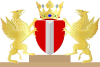
| Blasoning: "On the red shield with the white pole rests a golden crown. Shield holders are two golden griffins with silver claws." |
Questions and answers
Q: Where is Dordrecht located?
A: Dordrecht is a city in the Netherlands, in the province South Holland.
Q: When was Dordrecht founded?
A: Dordrecht was founded in 1047.
Q: When did Dordrecht get its City Rights?
A: Dordrecht got its City Rights in 1220.
Q: Was Dordrecht the first city to get City Rights in the west of the Netherlands?
A: Yes, Dordrecht was the first city in the west of the Netherlands to get City Rights.
Q: What significant event happened in Dordrecht in 1572?
A: In 1572 the Dutch Dukes under Willem van Oranien declared their independence from Spain in Dordrecht.
Q: How many inhabitants does Dordrecht have?
A: Dordrecht has about 120,000 inhabitants.
Q: What industries are prominent in Dordrecht?
A: Dordrecht has a marine harbor, metal and food industry.
Related articles
Author
AlegsaOnline.com Dordrecht — Historic River Port City in South Holland Leandro Alegsa
URL: https://en.alegsaonline.com/art/28541