
Party for Freedom (Partij voor de Vrijheid, PVV)
Dutch right-wing populist party founded and led by Geert Wilders, known for Euroscepticism, anti-Islam positions, economic liberalism, and an unusual single-member party structure.
Overview
The Party for Freedom (Dutch: Partij voor de Vrijheid, commonly abbreviated PVV) is a right-wing political movement in the Netherlands. It was established in 2006 and is led by its founder, Geert Wilders. The PVV combines elements of populism and conservative liberalism, and it is frequently described as a right-wing and anti-establishment force within Dutch politics. The party's organizational model is unusual: Wilders is its sole official member and the party operates around his leadership and parliamentary list.
Image gallery
6 Images


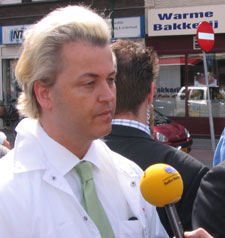
History and organization
The PVV was founded on 22 February 2006. It first entered the national legislature in the 2006 general election, winning seats in the House of Representatives (Tweede Kamer). Over subsequent elections the party's representation has fluctuated: it rose sharply in 2010, remained influential in later contests, and continued to be a significant voice on issues such as immigration and the European Union. The PVV has at times supported minority governments from outside the cabinet rather than joining formal coalitions, a tactic that underscores its role as a challenger to mainstream parties.
Ideology and policy positions
Officially and in practice, the PVV emphasizes national sovereignty, cultural assimilation, and strict immigration controls. Key policy themes include:
- Euroscepticism: the party is openly Eurosceptic and critical of the European Union, arguing for reduced EU powers and more national control over borders and lawmaking.
- Views on Islam: the PVV is widely known for its outspoken criticism of Islam and calls for measures it frames as protecting liberal democratic values.
- Economic positions: it combines a market-oriented approach with calls to cut bureaucracy and to reduce taxation, advocating policies to lower taxes for individuals and businesses.
Electoral performance and political role
The PVV's electoral fortunes have been variable but impactful. In its first election (2006) it won six seats, surged to a large parliamentary presence in 2010, and has since won between a dozen and two dozen seats in national elections. Because the party has often polled strongly on issues of immigration and national identity, it has influenced the policies and rhetoric of other Dutch parties even when it has not been part of governing coalitions.
Controversies and reception
The party's hardline rhetoric on immigration and Islam has generated extensive public debate, criticism, and legal scrutiny. Its leader and the party have been both condemned by opponents as divisive and praised by supporters who see it as defending national traditions and security. Media coverage and academic analysis frequently classify the PVV as a right-wing populist movement whose presence has reshaped political discourses in the Netherlands.
Notable facts and distinctions
Unlike most Dutch parties, the PVV has no membership base beyond its founder and does not operate as a conventional membership organization. Its combination of populist messaging, economic liberal proposals, and skeptical views of supranational institutions distinguishes it within the Dutch party system. For further reading on the party's name, leader, and parliamentary role see sources on the party's Dutch identity and institutional context: Partij voor de Vrijheid, Geert Wilders, and the Dutch legislature (House of Representatives). Other useful topics include analyses of Euroscepticism, the European Union, debates about Islam in Europe, and discussions of economic liberalism and proposals to lower taxes.
For concise introductions, party literature, critical commentaries and legislative records provide complementary perspectives: introductory profiles (right-wing positioning), party classification and broader political analyses (political party studies), and national context resources (Netherlands). Additional background and news coverage can be consulted through public archives and scholarly assessments of contemporary Dutch politics.
Questions and answers
Q: What is the Party for Freedom?
A: The Party for Freedom, Dutch: Partij voor de Vrijheid (shortened PVV), is a right-wing political party in the Netherlands.
Q: Who is the founder and leader of the Party for Freedom?
A: The founder and only member of the Party for Freedom is Geert Wilders.
Q: When was the Party for Freedom founded?
A: The Party for Freedom was founded on 22 February 2006.
Q: How many seats did the Party for Freedom win in the 2006 Dutch general election?
A: In the 2006 Dutch general election, the Party for Freedom won 6 seats in the House of Representatives with 579,490 votes.
Q: What are the political positions of the Party for Freedom?
A: The Party for Freedom is Eurosceptic, meaning they are against the European Union. They are also openly very critical of Islam. Economically, the party supports economic liberalism and wants to lower taxes. It is also a populist party.
Q: Did the Party for Freedom gain popularity recently?
A: Yes, the Party for Freedom gained a great amount of popularity in 2017, coming second in the election and winning 20 seats with 1,372,941 votes.
Q: How many seats did the Party for Freedom win in the 2021 elections?
A: In the 2021 elections, the Party for Freedom won 17 seats (-3).
Related articles
Author
AlegsaOnline.com Party for Freedom (Partij voor de Vrijheid, PVV) Leandro Alegsa
URL: https://en.alegsaonline.com/art/74854
Sources
- thesun.co.uk : "CAPTAIN PEROXIDE Who is Geert Wilders? Dutch politician and Party of Freedom leader"
- independent.co.uk : "The Netherlands' most popular party wants to ban all mosques"
- politico.eu : "Dutch party wants to outlaw mosques, Islamic schools, Koran"
- rt.com : "Dutch far-right Party for Freedom tops polls as Europe's 'populists' gain momentum"
- ioresearch.nl : "PVV stijgt door; GroenLinks grootste op links"