
African bullfrog (Pyxicephalus adspersus)
Large, robust frog of southern and eastern Africa known as the African or pixie frog; notable for deep burrowing, strong jaws, parental care and wide seasonal activity in savannas and grasslands.
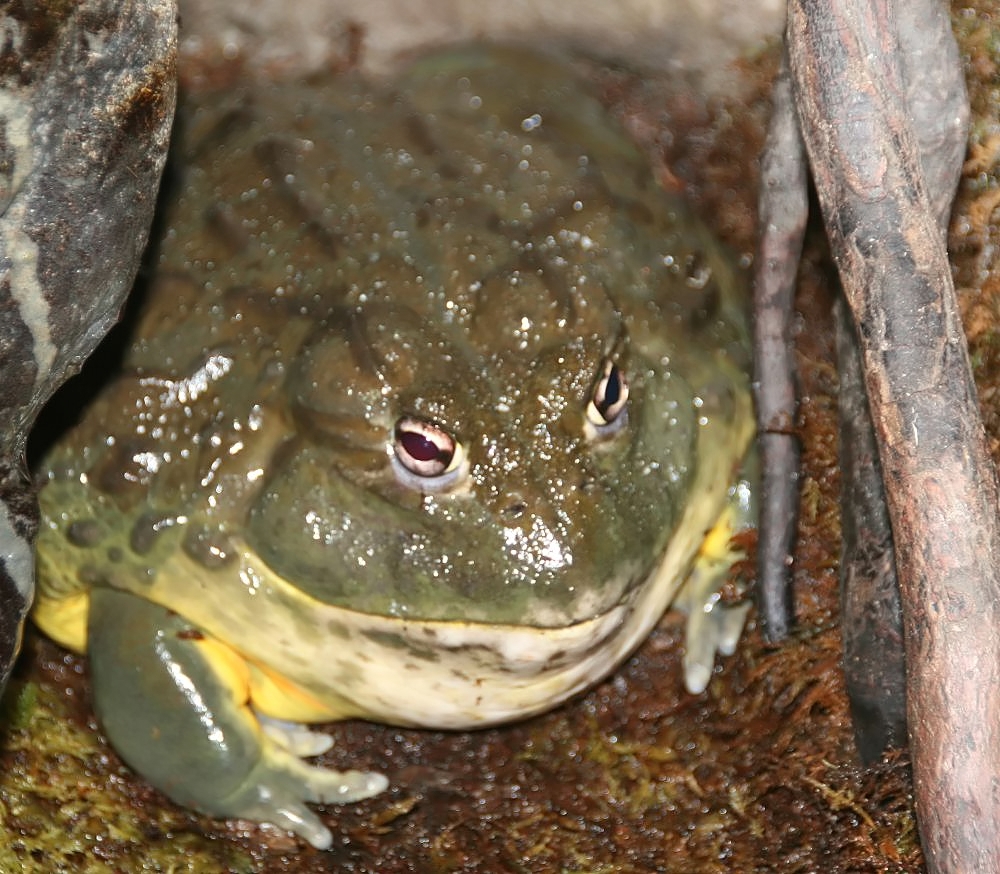
The African bullfrog, Pyxicephalus adspersus, is a large amphibian native to parts of sub-Saharan Africa. It is a distinct species of frog traditionally placed among robust burrowing taxa. Taxonomically it is treated within the broader grouping of the Ranidae lineage and referenced as a member of that family in older accounts. Colloquially it is often called the "pixie frog," a name derived from the genus name and popular usage in the pet trade (pixie frog).
Image gallery
5 Images


Physical characteristics
African bullfrogs are heavy-bodied with stocky limbs and broad heads. Adult males are markedly larger than females, a clear case of sexual dimorphism: males can develop massive bodies and powerful jaws used for subduing prey and in male-to-male interactions. Their skin is generally olive to brown and can be patterned; powerful hind legs and webbed feet aid in short bursts of swimming. They spend much time buried in soil during dry seasons and emerge to feed and breed when conditions become wet.
Range and habitat
This species occurs across a wide portion of southern and eastern Africa. Records and range descriptions include populations in:
- Angola
- Botswana
- Kenya
- Malawi
- Mozambique
- Namibia
- South Africa
- Eswatini
- Tanzania
- Zambia
- Zimbabwe
- and possibly parts of the Democratic Republic of the Congo.
Preferred environments include dry savannas and seasonally wet subtropical or tropical habitats, where they occupy shallow ponds, ephemeral pools and adjacent grassland.
Behavior, diet and life history
African bullfrogs are opportunistic carnivores, taking insects, other amphibians, small mammals and reptiles when available. They are explosive breeders in response to seasonal rains: males call from temporary pools and defend territories near breeding sites. Notable for parental care, some males guard eggs and tadpoles, protecting them from predators and, in dry periods, assisting with water access by digging channels to moister areas. Their ability to aestivate—enter a dormant state underground—allows survival through prolonged dry spells.
Conservation and human interactions
Although locally common in many parts of its range, the African bullfrog is affected by habitat alteration, pollution and capture for food or the pet trade. It plays an important ecological role as both predator and prey in savanna ecosystems. Conservation measures emphasize habitat protection, monitoring of collection, and public education about responsible keeping where they are kept as pets. For further general information consult regionally focused resources and species guides (species overview).
Related articles
Author
AlegsaOnline.com African bullfrog (Pyxicephalus adspersus) Leandro Alegsa
URL: https://en.alegsaonline.com/art/1258