
African penguin (Spheniscus demersus)
Endangered seabird of southwestern Africa, also called the jackass or black‑footed penguin. Lives in island and a few mainland colonies, feeds on small fish and squid, threatened by human impacts and habitat change.
The African penguin (Spheniscus demersus), sometimes called the jackass penguin or black‑footed penguin, is a medium‑sized seabird native to the south‑western coast of Africa. It breeds in colonies on offshore islands and a handful of mainland sites along the coast between south‑western Africa and Algoa Bay. Its black feet, a distinctive horseshoe‑shaped band on the chest and a loud, braying call that resembles a donkey have made it one of the region's most recognizable coastal birds.
Image gallery
10 Images


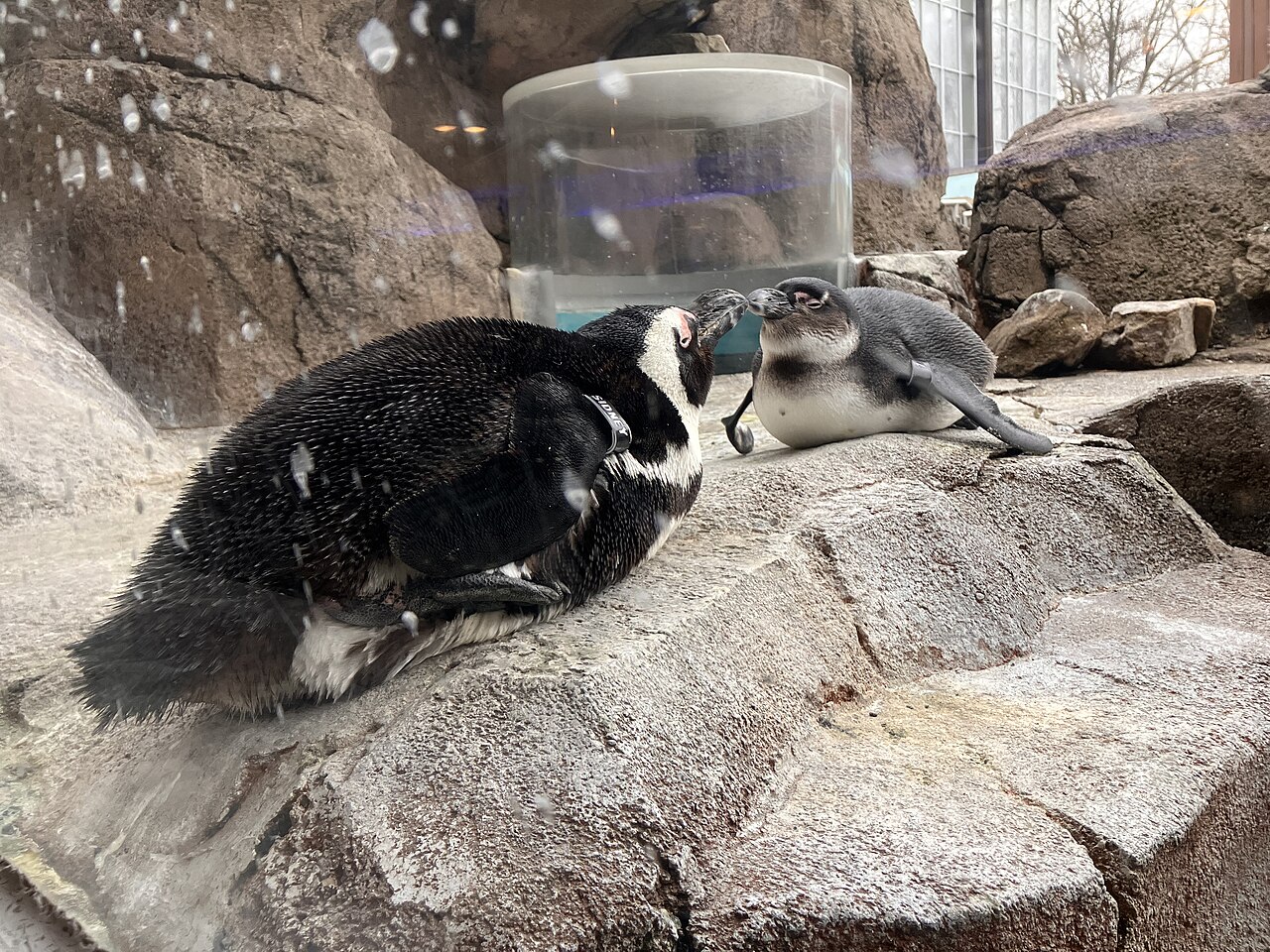

Appearance and relatives
African penguins stand to about 60–65 cm tall and can weigh up to around 3 kg at the heavier end of their natural variation. Their plumage is the familiar penguin pattern of a dark back and white front, with species‑specific black facial markings and a thin pale eyebrow stripe. They are part of the banded penguin group (genus Spheniscus) and are closely related to South American species such as the Humboldt and Magellanic penguins of southern South America, and to the equatorial Galápagos penguin, which lives in the eastern Pacific near the Galápagos Islands close to the equator.
Feeding and behaviour
African penguins are agile swimmers and forage for food in coastal waters. Their diet consists mainly of small schooling fish, but they also take squid and occasional crustaceans; common prey items include small fish, squid and crabs. Foraging trips can be short or extend offshore depending on prey availability. They are diurnal feeders, hunting in the water by pursuit diving, and often travel in groups when feeding or traveling between the sea and their nests.
Breeding and life cycle
Colonial breeders, African penguins nest in burrows, under boulders, in natural hollows or in artificial nests provided by conservation projects. Pairs usually lay one or two eggs per clutch; both parents share incubation duties, which lasts about 38 days on average. After hatching, chicks remain dependent on adults for food and protection until they fledge and enter the sea. In the wild a healthy individual may live up to around 20 years, though many face higher mortality when young.
Distribution and notable colonies
Historically confined to many islands off the coast, today the species breeds on roughly two dozen islands between Namibia and Algoa Bay near Port Elizabeth in South Africa. The largest known colony occurs at Dyer Island near Kleinbaai. In the late 20th century a few mainland colonies reappeared or were newly established, including the well‑known tourist site at Boulders Beach near Simon’s Town and a colony at Stony Point in Betty’s Bay; such mainland sites are thought to have become viable where predators are reduced or absent, although attacks by terrestrial predators have occurred, for example at Betty’s Bay. Some colonies were re‑established naturally by dispersing birds and local conservation interventions have supported nesting success at a number of sites (recolonization efforts).
Threats and conservation
African penguin populations have declined substantially in recent decades and the species is the focus of active conservation work. Major threats include reduction in prey from commercial fishing, oil spills and chronic oiling, habitat loss and alterations such as removal of guano that once provided nesting substrate, and disturbance at breeding sites. Conservation measures in use include rescue and rehabilitation of oiled birds, deployment of artificial nest boxes, protection of colonies, habitat restoration, and efforts to secure local fish stocks and manage fisheries to improve food availability.
- Key threats: overfishing, oil pollution, habitat change, introduced predators and human disturbance.
- Conservation actions: nest provision, marine protected areas, rehabilitation centers, monitoring and public education.
- Human interaction: certain sites such as Boulders Beach allow close viewing of birds, but responsible tourism and distance rules are promoted to reduce disturbance.
Because their reliance on nearshore fish and specific nesting conditions makes them vulnerable to changing marine and coastal environments, African penguins remain a priority for regional conservation planning and research. For more about their status, local colonies and conservation programs see regional resources and managed colony sites linked above.
Questions and answers
Q: What is the African penguin?
A: The African penguin is a type of penguin found on the south-western coast of Africa. It is also known as Black-footed penguin or Jackass penguin.
Q: Where does the African penguin live?
A: The African penguin lives in colonies on 24 islands between Namibia and Algoa Bay, near Port Elizabeth, South Africa. It also has two mainland colonies near Cape Town at Boulders Beach near Simon's Town and Stony Point in Betty's Bay.
Q: How large can the African penguin grow?
A: The African penguin can grow up to 65 cm tall and weigh up to 3 kg.
Q: What do African penguins eat?
A: African penguins eat fish, crabs, and squids.
Q: How long is the breeding time for African penguins?
A: The breeding time for African penguins is 38 days.
Q: What is Boulders Beach known for?
A: Boulders Beach is known as a tourist attraction for the beach, swimming, and the penguins. The penguins allow people to approach them as close as a meter (3 ft).
Q: What is the closest relative of the African penguin?
A: The closest relatives of the African penguins are the Humboldt and Magellanic penguins found in southern South America and the Galápagos Penguin found in the Pacific Ocean near the equator.
Related articles
Author
AlegsaOnline.com African penguin (Spheniscus demersus) Leandro Alegsa
URL: https://en.alegsaonline.com/art/1270
Sources
- iucnredlist.org : "Spheniscus demersus"