
Whitby, North Yorkshire — port, abbey, fossils and maritime heritage
Whitby is a coastal town in North Yorkshire known for its abbey, maritime past, jet craft, dinosaur footprints and literary links; today tourism and fishing shape its economy.
Overview
Whitby is a historic fishing port and seaside town on the coast of North Yorkshire, close to Scarborough and set within northeast England. Its population is roughly thirteen thousand residents, and it occupies a prominent position at the northwestern edge of the North York Moors National Park. The town has long combined working harbour activity with a substantial visitor industry, drawing people for scenery, geology and heritage.
Image gallery
10 Images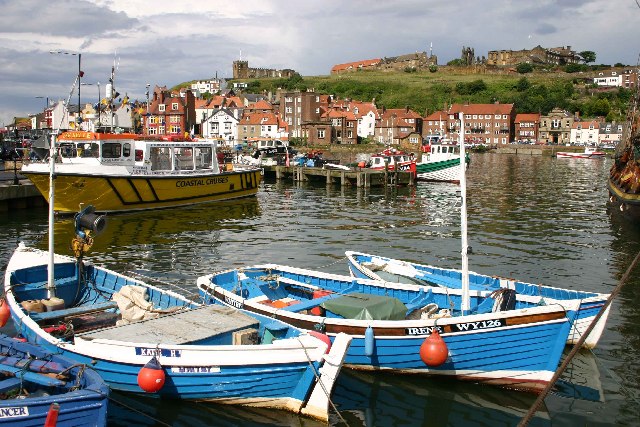


Origins and early history
The place name derives from Old Norse Witebi, commonly interpreted as the "white settlement," reflecting the town's early medieval roots. Whitby became an important monastic centre in the 7th century when a monastery was established by St Hilda; the later Benedictine foundation evolved into Whitby Abbey, a dominant landmark whose ruins sit on the East Cliff. The settlement featured in early English ecclesiastical history, including the Synod of Whitby, and grew around both religious and maritime activity through the Middle Ages.
Geology, fossils and jet
The coastline at Whitby is part of a designated heritage coast that includes dramatic cliffs and fossil-bearing strata. Visitors can see preserved dinosaur footprints exposed on the beach, and the cliffs yield locally significant fossils that attract amateur palaeontologists. Whitby is also known for the black organic mineral jet, often called Whitby jet and sometimes simply jet. Jet has been worked since the Bronze Age into beads and ornament; it experienced renewed popularity during Victorian times when it was used for mourning jewellery after being associated with Queen Victoria's period of mourning.
Maritime economy and development
Historically Whitby supported fleets involved in herring and even whaling activity; references to whaling and herring fisheries appear in accounts of the town's past. The local economy now blends a smaller commercial fishery—focused on crustaceans such as lobsters and crabs—with a large tourism sector. Since the 19th century, when seaside travel expanded across Britain, tourism has been a major source of income for Whitby and remains central to its economy today. Modern visitors combine day trips with stays in the town's guesthouses and hotels.
Landmarks, culture and literature
Whitby's skyline is dominated by the ruins of Whitby Abbey on the East Cliff and the adjacent St Mary's Church. The steep flight of steps leading from the harbour to the church and abbey is a well-known local feature. On the West Cliff a whalebone arch commemorates the town's long relationship with the sea. Whitby also figures in cultural history: the explorer Captain James Cook learned seamanship here before voyages that charted parts of New Zealand, Hawaii and Newfoundland. The town provided atmosphere and setting for part of Bram Stoker's work; Bram Stoker used Whitby as a location in his novel Dracula, and that connection is promoted in local tours and events.
Attractions, events and conservation
Whitby attracts a mixture of visitors interested in history, geology, and seaside leisure. Key attractions include the abbey ruins, harbour, coastal walks onto the moors, fossil hunting, and craft shops selling Whitby jet. The town hosts a variety of festivals and gatherings, and conservation efforts aim to protect the cliffs and shoreline while managing visitor impact.
- Historic sites: Whitby Abbey, St Mary's Church, harbour structures.
- Natural features: heritage coast, fossils and cliff-top views.
- Local economy: small-scale fishing, craft industries, and tourism.
- Cultural notes: maritime heritage, literary associations and community festivals.
Today Whitby remains a place where geological interest, maritime history and cultural traditions meet. It balances living community needs with being a destination for visitors who seek coastal scenery, historical depth and unique local crafts.
Scarborough • northeast England • dinosaur • footprints • beach • black mineral • jet • moors • Bronze Age • beads • Victorian • Queen Victoria • Middle Ages • whaling • herring • fishing • Tourism • Captain James Cook • New Zealand • Hawaii • Newfoundland • Bram Stoker • Dracula
Related articles
Author
AlegsaOnline.com Whitby, North Yorkshire — port, abbey, fossils and maritime heritage Leandro Alegsa
URL: https://en.alegsaonline.com/art/107780