
Base (geometry): definition, role in polygons and solids
In geometry, a base is a referenced side or face used for measurements and calculations. This article explains its meaning in plane figures and solids, common conventions, and how it appears in area and volume formulas.
Definition and basic idea
In plane geometry, the term base denotes a side of a polygon (or, more generally, a face of a solid) chosen as a reference for measuring heights, computing areas and describing orientation. For simple polygons such as a triangle or a quadrilateral, the base is commonly labeled b and paired with a perpendicular distance called the height or altitude. The choice of which side is called the base is often a matter of convenience: it may be the side drawn horizontally in a diagram or the side that simplifies a calculation.
Image gallery
2 Images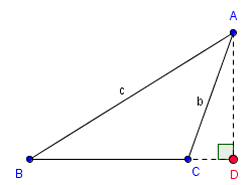
Notation, characteristics and common formulas
The base is closely linked with the concept of area. For a triangle, the area equals one half the product of the chosen base and the corresponding height: area = (1/2)·b·h. For parallelograms, rectangles and rhombi, the area is given by area = b·h. In trapezoids and other polygons that have two parallel sides, the two parallel sides are typically referred to as the bases and appear symmetrically in area formulas. Choosing a base can change which segment is measured as the height but does not change the numerical value of area when computed correctly.
Bases in three-dimensional solids
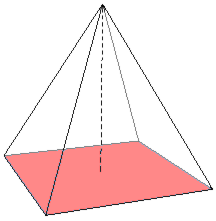
When constructing or describing solids, the word base often refers to a particular face that serves as a reference for volume, cross-sections or orientation. For example, a tetrahedron can be described by taking one triangular face as its base and measuring a perpendicular height to the opposite vertex; a cube can be described by selecting one of its six square faces (squares) as a base. More generally, prisms and cylinders are named and computed by taking a plane shape as a base and extruding it. The cylinder uses a circular base (circle) or, in oblique or more general cases, an ellipse as the generating face. A pyramid has a polygonal base — for a square pyramid the base is a rectangle or square — and triangular lateral faces meet at an apex. Volume formulas reflect the role of the base: prism and cylinder volumes equal base area times height, while pyramids and cones use one third of base area times height.
Conventions, choices and dimensions
The designation of a particular side or face as the base is partly conventional and partly functional. In many elementary problems the base is drawn horizontally to make the height a vertical segment; in analytic settings one might take a coordinate axis or a particular edge as the base. The notion extends beyond two dimensions when a face is treated as the reference for three-dimensional measurements. In advanced geometry, 'base' may also appear in compound constructions, such as when a polygonal face serves as the base of a composite solid or when a base figure is replicated to form tessellations or higher-dimensional analogues.
Practical examples and notable distinctions
- Triangle: pick any side as the base; the height is the perpendicular distance from the opposite vertex to that side.
- Parallelogram and rectangle: opposite sides are equal, so either of the parallel sides may serve as the base for area computations.
- Trapezoid: the two parallel sides are usually called the bases and appear together in the area formula.
- Prism/cylinder: the base is the congruent face that is translated along an axis; volume = base area × height.
- Pyramid/cone: the base is a single face (polygon or circle); volume = (1/3) × base area × height.
Understanding what is meant by the base in a given context simplifies many geometric arguments and calculations. The choice of base is flexible but must be paired with the corresponding perpendicular measurement (height) to apply standard area and volume formulas correctly. For further reading on plane and solid concepts see entries on geometry, triangle, pyramid and cylinder.
Related articles
Author
AlegsaOnline.com Base (geometry): definition, role in polygons and solids Leandro Alegsa
URL: https://en.alegsaonline.com/art/9193