
Triangle (basic geometry and properties)
A triangle is a three-sided polygon in plane geometry. This article explains its defining features, types, key formulas, notable centers, history and common applications.
Overview
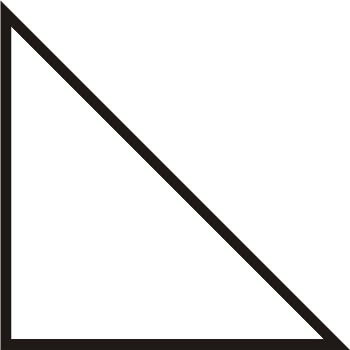
A triangle is a simple shape in two-dimensional space bounded by three straight sides and three vertices. It is the polygon with the fewest possible sides: three. A triangle with vertices A, B and C is commonly written as △ABC. The three internal angles of any triangle sum to 180° (degrees), a fundamental fact used throughout elementary geometry.
Image gallery
10 Images




Elements and basic properties
Each triangle has three sides and three vertices; the sides meet at the vertices. The triangle inequality states that the length of any one side is less than the sum of the other two sides. Important associated segments include altitudes (heights), medians, and angle bisectors. A triangle admits a unique circumcircle that passes through all three vertices and a unique incircle tangent to all three sides.
Classification
- By sides: equilateral (three equal sides), isosceles (two equal sides), scalene (all sides different) — see sides and straight sides.
- By angles: acute (all angles < 90°), right (one 90° angle), obtuse (one > 90°).
Formulas and centers
Common area formulas: 1) area = ½ × base × height; 2) Heron's formula using the semiperimeter s: area = sqrt(s(s-a)(s-b)(s-c)). Perimeter is the sum of side lengths. Key triangle centers include the centroid (intersection of medians), the circumcenter (center of circumcircle), the incenter (center of incircle), and the orthocenter (intersection of altitudes). The Euler line connects several of these centers in non-equilateral triangles.
History and significance
Triangles have been studied since antiquity; they underpin classical geometry and were central to Euclid's Elements and early trigonometry. The Pythagorean theorem, concerning right triangles, is among the best-known results and has wide-ranging consequences in mathematics and physics.
Uses and examples
Triangles are widely used in engineering and architecture because of their inherent stability — a triangular frame is rigid while quadrilaterals are not unless braced. In computer graphics and mesh construction, complex surfaces are approximated by networks of triangles. Triangulation methods are essential in surveying and navigation.
Notable facts and distinctions
A triangle is the simplest polygon and cannot be decomposed into fewer polygonal sides. Its internal angle sum of 180° distinguishes plane triangles from spherical triangles (whose angles sum to more than 180°). Many deeper results connect triangles to circles, vectors, and algebraic identities; studying triangles remains a foundation for broader geometry and applied mathematics. For further reading, consult standard geometry texts or online resources linked below.
Related topics: polygons, geometric shapes, plane geometry, Euclidean space, side classifications, line segments, angle measures, degree measure.
Related articles
Author
AlegsaOnline.com Triangle (basic geometry and properties) Leandro Alegsa
URL: https://en.alegsaonline.com/art/101442