
Dimension: Concepts, Types, and Applications in Mathematics and Physics
An accessible overview of what dimensions are, how they are defined in mathematics and physics, their historical development, and common uses from coordinates to fractals and spacetime.
Dimensions describe the independent directions, coordinates, or measurable aspects that locate and characterize objects and events. In everyday language they appear as length, width and height; in physics they also include time and other base quantities. The word is used in several related but distinct ways: as a physical measure, as a coordinate count in geometry, and as an abstract property of mathematical spaces. For introductions see perception and measurement and basic guides to physical quantities.
Image gallery
4 Images


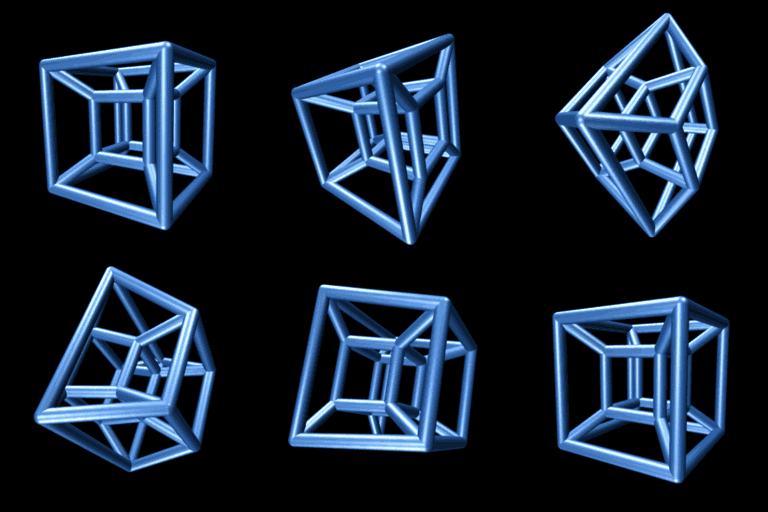
Basic mathematical meaning
In linear algebra the dimension of a vector space equals the number of vectors in any basis and gives the number of independent directions available. That notion of dimension is closely tied to coordinates: a line is 1-dimensional, a plane 2-dimensional, and ordinary space 3-dimensional. For readers new to formal ideas consult resources on vector spaces and Euclidean space. The related idea of degrees of freedom links to motion and constraints; see degrees of freedom for examples.
Variants and formal definitions
Other notions of dimension are useful in different contexts. Topological dimension classifies spaces by how neighborhoods behave, while Hausdorff and fractal dimensions measure how detail scales with magnification. The term embedding dimension describes the ambient space needed to place an object without intersections. Basic expositions are available on topology, fractal geometry, and measure theory.
Physical dimensions and units
In physics the word "dimension" often refers to fundamental measurable quantities used to express laws: length, mass, time and others form a basis for dimensional analysis. Scientists use these base quantities to check equations and convert units; concise introductions appear under dimensional analysis and the list of SI base quantities. The role of time as a fourth coordinate is central to spacetime descriptions; see special relativity and spacetime.
History and development
Ideas about dimension evolved from geometric reasoning in antiquity to formal definitions in the 19th and 20th centuries. Developments in calculus, set theory and topology allowed mathematicians to formalize different kinds of dimension. Physicists extended the idea when describing fields and spacetime; readable histories include material on historical mathematics, modern geometry, and the emergence of relativistic physics.
Uses, examples, and notable distinctions
Dimensions are practical tools. Engineers use three-dimensional coordinates for design; programmers handle dimensions when working with arrays and graphics; scientists apply additional parameters such as temperature or charge when they function like independent quantities. Distinctions to keep in mind include:
- Mathematical dimension (basis size) versus physical dimension (measured quantity) — see mathematical definitions and physical units.
- Topological versus fractal dimension — spaces can have non-integer scaling exponents; read more at fractal dimension.
- Coordinate count versus degrees of freedom — a surface embedded in 3-space has intrinsic dimension two but may be described by three coordinates in the ambient space; compare manifolds and embeddings.
For overviews, tutorials and advanced treatments consult textbooks and surveys identified at further reading.
Questions and answers
Q: What is a dimension?
A: A dimension is a way to measure, see and experience the world by using concepts such as up and down, right to left, back to front, hot and cold, how heavy and how long. It can also be defined as the degrees of freedom or the way an object can move in a specific space.
Q: How do mathematicians define Euclidean space?
A: Mathematicians define Euclidean space as being specified by three dimensions which are usually called length, width and depth.
Q: What is the number of vectors in a vector space?
A: The number of vectors in a vector space is equal to the cardinality (or number of vectors) of its basis set.
Q: How many dimensions are used to measure position?
A: Three dimensions (length, width and height) are used to measure position. In some occasions, a fourth (4D) dimension - time - may be used to show the position of an event in time and space.
Q: What does dim(V) mean?
A: Dim(V) refers to the dimension of V which is equal to the cardinality (or number of vectors) of its basis set or equal to the number of straight line directions that it has.
Q: Is there one definition that satisfies all concepts related with dimensions?
A: No, there is no single definition that can satisfy all concepts related with dimensions.
Related articles
Author
AlegsaOnline.com Dimension: Concepts, Types, and Applications in Mathematics and Physics Leandro Alegsa
URL: https://en.alegsaonline.com/art/27450