
Bean machine (Galton board or quincunx)
A mechanical demonstration device that produces a binomial/normal-shaped distribution of balls, illustrating probability, binomial coefficients and the central limit theorem.
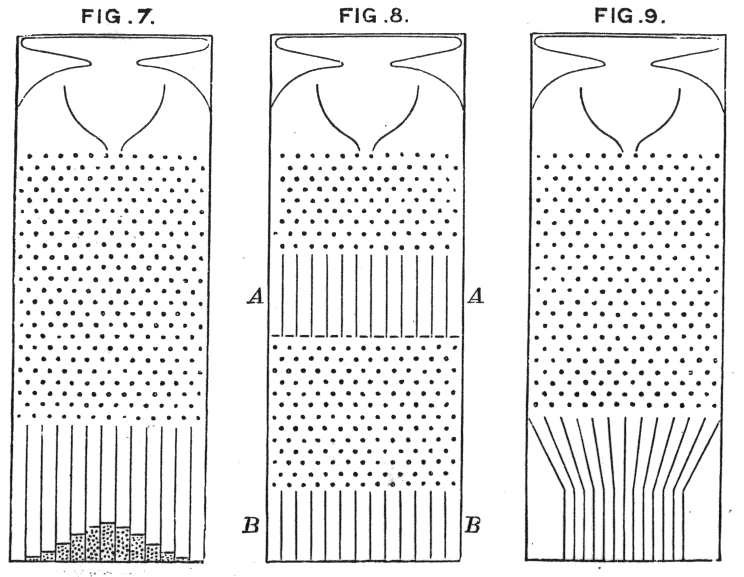
The bean machine, often called the Galton board or quincunx, is a vertical apparatus used to demonstrate how simple random processes produce a characteristic bell-shaped distribution. Small spheres or beads are released from a single point at the top and fall through a triangular array of offset pins. Each collision deflects a ball left or right so that, after many rows, the balls collect in discrete bins at the bottom. The stacked columns of balls typically form an approximate bell curve, offering a tangible illustration of how randomness aggregates into a predictable shape.
Image gallery
5 Images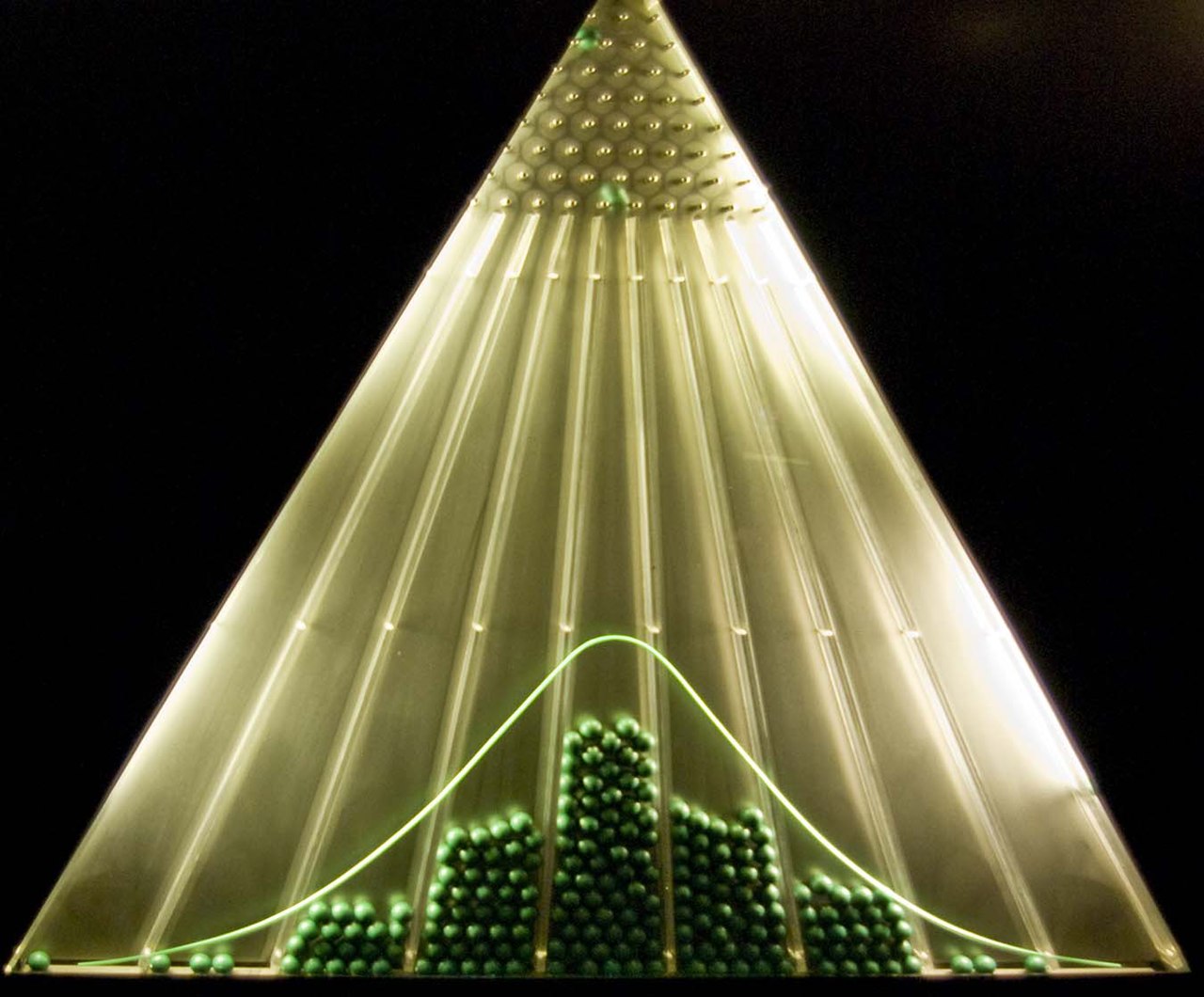


Construction and behaviour
A typical device consists of a flat board with staggered rows of pegs and a set of evenly spaced collection compartments along the base. When a ball encounters a peg it normally has two primary outcomes — deflection to the left or right — which can be treated as one step in a sequence of independent trials. The number of rows determines how many binary decisions a falling ball encounters, and the horizontal position of the bin corresponds to the total number of rightward deflections.
Mathematical principles
The path choices through the rows correspond to combinations of left/right steps. If each deflection is equally likely, the counts for balls arriving in each bin follow the binomial distribution. Overlaying a diagram of Pascal's triangle on the peg layout makes this connection visible: the entries of the triangle enumerate the distinct routes to each landing position. As the number of rows increases, the binomial distribution approaches the normal distribution through the central limit theorem, which is why the collected balls trace a bell-shaped curve.
Origins and terminology
The device was popularized in the late nineteenth century by Sir Francis Galton as a didactic model for the law of error and statistical regularity; historical descriptions and demonstrations can be found in contemporary accounts of his work. The name quincunx refers to a five-point arrangement used historically in horticulture and ornamentation, while Galton’s presentation linked the physical apparatus to themes of heredity, variation and regression toward the mean. For further historical context see Sir Francis Galton and descriptions of the original Galton machine.
Uses, variants and limitations
Bean machines are widely used in classrooms and museums to teach probability, binomial coefficients and the central limit theorem. Variants include tilted boards, nonuniform peg spacing or biased pegs to model skewed or other discrete distributions. Physical effects — friction, ball size relative to peg spacing, collisions and air resistance — cause deviations from the ideal mathematical model, so real machines are illustrative rather than exact proofs. Examples and further reading about the normal distribution and Pascal’s triangle appear in many elementary statistics texts; see also normal distribution and Pascal's triangle.
Large-scale working Galton boards appear in science museums (notably a prominent display at the Museum of Science, Boston), where they serve both as educational exhibits and as visually striking demonstrations of how order can emerge from chance.
Related articles
Author
AlegsaOnline.com Bean machine (Galton board or quincunx) Leandro Alegsa
URL: https://en.alegsaonline.com/art/9813