
Plane (mathematics)
A plane is a two-dimensional, perfectly flat surface extending without bound. It is a basic object in geometry and analytic geometry, used to model flat spaces and relations among points and lines.
Overview
In mathematics a plane is an idealized flat surface that has two independent directions and no thickness. Informally, it resembles a floor or a sheet that continues without edge; formally it is a two-dimensional Euclidean space embedded in a higher-dimensional setting or studied on its own. A plane has two degrees of freedom often described as length and width, and it contrasts with a curved surface in having zero curvature at every point. The common woodworking plane tool takes its name from this geometric notion because it can produce a level, flat face.
Image gallery
2 Images
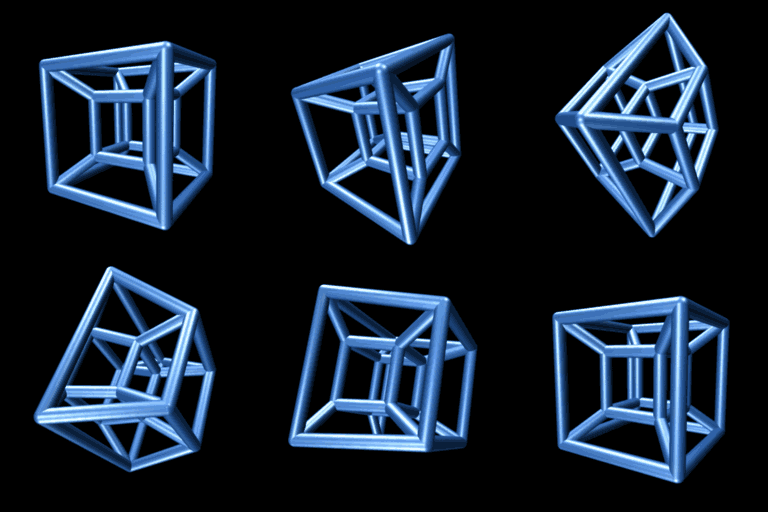
Basic properties
Key properties of a plane include: any two distinct points in the plane determine a unique straight line contained in the plane; any three points that are not collinear determine a unique plane; the plane contains an infinite collection of points and lines. In Euclidean geometry a plane has no depth and extends infinitely in all directions. It can be described by sets of points points that satisfy certain equations or relations.
Analytic and vector descriptions
In analytic geometry a plane in three-dimensional space can be given by a linear equation of the form ax + by + cz + d = 0, where a, b and c are not all zero; this is a standard way to represent a flat surface algebraically. Alternatively, a plane can be expressed parametrically as the set of points p + su + tv where p is a fixed point in space and u, v are independent direction vectors. These descriptions make planes central in linear algebra, multivariable calculus and computer graphics.
Intersections and relationships
Two distinct planes in the same three-dimensional ambient space either are parallel (no intersection), coincide (all points in common) or intersect along a single straight line. Inside a plane, lines behave according to familiar planar rules from elementary geometry, such as parallelism and angle measures. Many elementary theorems and constructions—triangles, circles, polygons—are defined as figures that lie entirely within a single plane; such shapes are often called plane figures and are typically named using capital letters placed at vertices or by a Greek letter such as a capital pi symbol.
History, contexts and distinctions
The concept of a plane goes back to early Greek geometry, where flat surfaces were treated informally, and it was formalized in Euclid's axioms. Modern mathematics studies planes in several related frameworks: the Euclidean plane (with distances and angles), affine planes (preserving parallelism but not distances), and projective planes (adding 'points at infinity' to simplify intersection laws). Each framework emphasizes different properties useful in pure mathematics, engineering and the visual sciences.
Uses and examples
Planes are used to model flat regions in physics, engineering drawings, architectural plans and geographic maps (local approximations of the Earth's surface). In computer-aided design and graphics, planes serve as clipping surfaces, reference frames and support for constructing objects. As basic building blocks in mathematics, planes underlie the study of curves, surfaces and higher-dimensional analogues and provide an approachable setting to learn about vectors, coordinates and transformations.
- Three noncollinear points determine a plane.
- Two planes intersect in a line unless they are parallel or identical.
- Planes are central in both synthetic and analytic branches of geometry.
For further foundational reading see standard geometry texts and analytic geometry references, which develop these ideas with proofs, examples and applications.
Related articles
Author
AlegsaOnline.com Plane (mathematics) Leandro Alegsa
URL: https://en.alegsaonline.com/art/77246