
Tetrahedron (triangular pyramid)
A tetrahedron is a polyhedron with four triangular faces, four vertices and six edges. This article explains its geometry, types, history, uses, and notable mathematical properties.
Overview
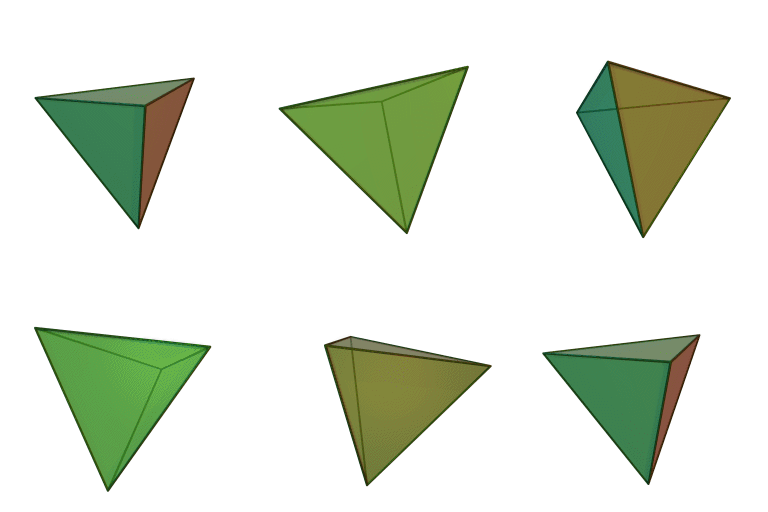
A tetrahedron, often called a triangular pyramid, is a three-dimensional solid bounded by four triangular faces. It is one of the simplest polyhedra and one of the five Platonic solids when its faces are congruent equilateral triangles. Every tetrahedron has four vertices and six edges; the network of its vertices and edges forms the complete graph on four nodes.
Image gallery
10 Images


Structure and properties
Key geometric facts about a tetrahedron include its faces (triangles), vertices (four corner points) and edges (six line segments joining pairs of vertices). A regular tetrahedron has all edges equal and all faces equilateral. Important mathematical features are:
- Euler characteristic: V − E + F = 2 (here 4 − 6 + 4 = 2).
- The regular tetrahedron is self-dual: its dual polyhedron is another tetrahedron.
- Its face angles are 60° in a regular case, and the dihedral angle between faces is arccos(1/3) ≈ 70.53°.
- The edge-vertex graph is K4, the complete graph on four vertices, useful in combinatorics and graph theory.
History and significance
Regular tetrahedra have been studied since antiquity as part of the Platonic solids, which fascinated ancient geometers and philosophers. They feature in classical geometry, algebraic studies of symmetry, and in the classification of polyhedra. The symmetry groups associated with the tetrahedron play a role in modern group theory: the rotational symmetries form a group isomorphic to A4, while including reflections gives a larger group isomorphic to S4.
Uses and examples
Tetrahedral shapes appear across science and engineering. In chemistry the tetrahedral arrangement describes the geometry of molecules such as methane, where a central atom bonds to four others at the corners of a tetrahedron. In numerical methods and computer graphics, tetrahedral meshes partition 3D domains for finite-element analysis and rendering. Architects and designers sometimes use tetrahedral modules for lightweight, stable structures. For more geometric constructions and models, see geometric resources and educational guides.
Notable distinctions and related concepts
Not every tetrahedron is regular; faces can be noncongruent triangles and the shape can be scalene. Special classes include isosceles or disphenoid tetrahedra, which have pairs of equal edges or congruent opposite faces. Practical and theoretical distinctions often concern symmetry, edge lengths, and incidence relations. For computational examples and topological applications consult software libraries or academic introductions at reference portals.
See also: triangular pyramid, Platonic solids, K4 graph, tetrahedral symmetry.
Related articles
Author
AlegsaOnline.com Tetrahedron (triangular pyramid) Leandro Alegsa
URL: https://en.alegsaonline.com/art/97244
Sources
- mathematische-basteleien.de : "Tetrahedron"