
Cube (geometry)
A cube is a regular hexahedron with six square faces and equal edge lengths; this article explains its properties, formulas, history, and common uses.
A cube is a three-dimensional solid whose faces are six congruent squares and whose edges all have the same length. In geometric terms it is a regular polyhedron with every interior angle a right angle, a property often described by reference to right angles. It can also be seen as a special case of a rectangular prism and belongs to the family of hexahedra.
Image gallery
10 Images



Basic characteristics
A cube has 6 faces, 12 edges, and 8 vertices. Each face is a square, and opposite faces are parallel. The cube is one of the five Platonic solids, meaning its faces, edges and angles are all regular and identical; its symmetry group is the octahedral group. In common language, objects shaped like a cube are described as cubic.
Metrics and formulas
Let a denote the length of an edge. The area of one square face is a^2, so the total surface area is 6a^2. The lateral surface area, often used when a top or bottom is excluded, equals 4a^2 (the area of four side faces). The volume equals a^3 because the base area a^2 multiplied by height a gives the enclosed measure. Other useful distances: the face diagonal equals a√2 and the space (body) diagonal equals a√3.
Coordinates and generalizations
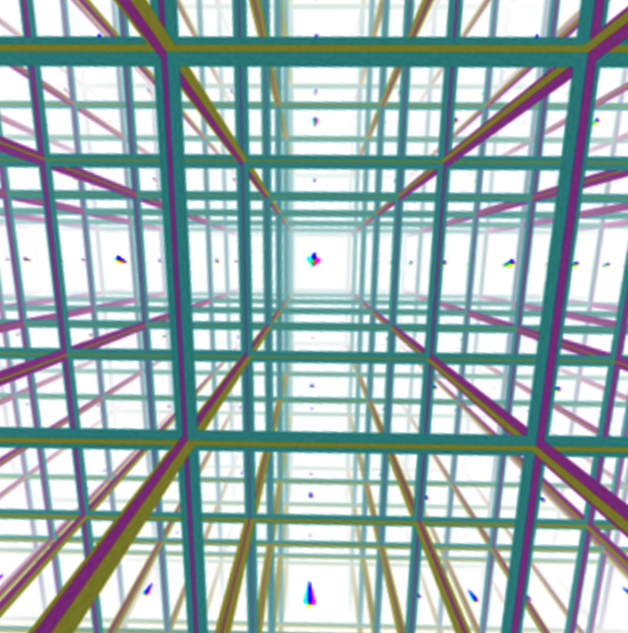
In Cartesian coordinates a standard example is the unit cube [0,1]×[0,1]×[0,1], the set of all points (x,y,z) with 0≤x,y,z≤1. The cube concept generalizes to higher dimensions as a hypercube (tesseract in four dimensions) and to scaled or skewed parallelepipeds when edge lengths or angles differ.
History, uses and examples
The cube has long appeared in mathematics, art and construction as a simple model of three-dimensional space; it was studied in classical geometry and later in solid geometry and group theory. Practically, cubes are common in manufacturing, packaging, storage and design because their regular shape packs efficiently. Puzzles and toys such as the Rubik's Cube make use of the cube's combinatorial and rotational structure.
Distinctions and notes
A cube differs from a general cuboid in that all three dimensions — sometimes described as height, width and depth — are equal. In two dimensions its analogue is the square. When studying solids, it is useful to distinguish lateral (side-only) measurements from total surface area and to recognize the cube's dual polyhedron, the octahedron, which interchanges faces and vertices.
Questions and answers
Q: What is a cube?
A: A cube is a type of polyhedron with all right angles and whose height, width and depth are all the same.
Q: What is a rectangular prism?
A: A rectangular prism is a type of hexahedron and a three-dimensional shape which has six rectangular faces.
Q: What is the surface area of a cube?
A: The surface area of a cube is equal to 6 times the length of the side squared (6l^2).
Q: What is the lateral surface area of a cube?
A: The lateral surface area of a cube is equal to 4 times the length of the side squared (4l^2).
Q: What is the volume of a cube?
A: The volume of a cube is equal to the length of the side cubed (l^3).
Q: Is a cube a complex mathematical shape?
A: No, a cube is one of the simplest mathematical shapes in space.
Q: What is something that is shaped like a cube referred to as?
A: Something that is shaped like a cube is sometimes referred to as cubic.
Related articles
Author
AlegsaOnline.com Cube (geometry) Leandro Alegsa
URL: https://en.alegsaonline.com/art/24520