
Polygon: definition, types, properties, history and uses
An accessible overview of polygons: planar definitions, components, classifications (convex, concave, simple, complex), special spherical cases, historical context, and practical uses such as tiling and computer graphics.
A polygon is a closed two-dimensional figure made by joining a finite sequence of straight line segments end to end. In elementary geometry it is commonly described as a plane figure bounded by three or more straight sides. For a concise geometric reference see two-dimensional shape and a basic description at shape definition. The most familiar examples are the triangle and the quadrilateral; together they form the family of polygons used across mathematics, art and engineering.
Image gallery
10 Images




Definitions and basic properties
Polygons are characterized by a list of vertices (corner points) and edges (the straight segments between vertices). The smallest usual polygon in flat, Euclidean geometry is the triangle; for more on planar geometry see Euclidean geometry. Each polygon has internal angles whose sum depends on the number of sides: for a simple n-sided polygon the sum equals (n−2)×180° when measured in Euclidean plane geometry; the triangle is the n=3 case — further details are available at triangle overview.
Parts, classification and notable variants
- Vertices and edges: The ordered list of vertices and connecting edges defines the polygon's shape.
- Simple vs. complex: A simple polygon has non-crossing edges; when edges cross the figure is often called self-intersecting or complex (star polygons are examples).
- Convex vs. concave: A convex polygon has all interior angles ≤180° and contains the segment between any two points inside it; concave polygons have at least one interior angle >180°.
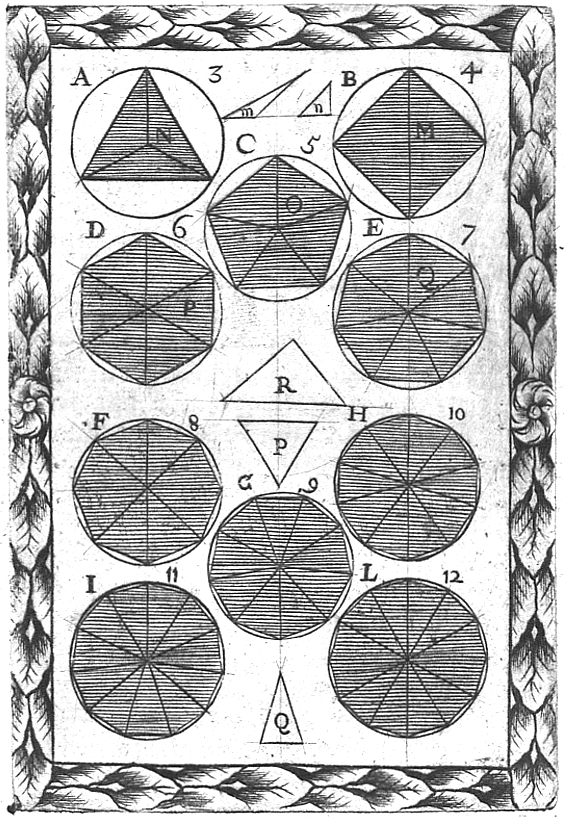
- Regular polygons: Those with all sides and angles equal (regular n-gons) play a central role in classical geometry and symmetry studies.
- Non-Euclidean and spherical cases: On curved surfaces the concept of a polygon adapts: on a sphere, for instance, one can define regions bounded by great-circle arcs and even special cases such as a digon or henagon appear in spherical geometry; see spherical geometry, digon and henagon.
History and mathematical development
The study of polygons dates back to antiquity where Greek mathematicians analyzed regular polygons, constructive methods with straightedge and compass, and the relation of polygons to circles. Over centuries the topic expanded into algebraic descriptions, tiling theory, and the classification of symmetry groups. In modern mathematics polygons serve as basic objects in planar topology, computational geometry and combinatorics.
Uses, examples and importance
Polygons appear in many practical and theoretical contexts: architectural plans and engineering often use polygonal forms; tilings and mosaics are based on polygonal tessellations; and in computer graphics and 3D modelling, complex surfaces are approximated by meshes of polygons, typically triangles, because of their numerical stability and simplicity — see computer graphics. Algorithms for polygon clipping, triangulation and point-in-polygon tests are fundamental in geographic information systems (GIS), robotics and CAD.
Distinctive facts and considerations
- Counting properties: Many combinatorial questions concern how many diagonals, ways to triangulate, or distinct forms exist for a given number of sides.
- Topology vs. geometry: From a topological standpoint, a simple polygon is equivalent to a closed disk, while geometric measurements depend on the embedding and metric used.
- Special constructions: Regular polygons with certain side counts are constructible with classical tools; others require modern methods or cannot be constructed with straightedge and compass.
- Applications to other fields: Polygons provide discrete models for curves and surfaces and are building blocks for meshes used in simulation, finite element methods and visual rendering.
Together, these aspects show why polygons are both elementary and deeply connected to many branches of mathematics, science and art. For introductory explanations and more formal treatments, consult elementary geometry resources and specialized literature on computational geometry and spherical topology.
Related articles
Author
AlegsaOnline.com Polygon: definition, types, properties, history and uses Leandro Alegsa
URL: https://en.alegsaonline.com/art/77852