
Rufous hare-wallaby (mala): appearance, range, and conservation
The rufous hare-wallaby (mala) is a small, nocturnal Australian macropod once widespread across western Australia; now confined to offshore islands and targeted by active recovery and reintroduction programs.
Overview
The rufous hare-wallaby, commonly called the mala, is a small macropod species known for its reddish fur and shy, nocturnal habits. It is classified as a vulnerable species in many conservation assessments and has become an emblem of small-mammal recovery efforts in Australia. The mala belongs to the group of small wallabies often referred to collectively as hare-wallabies because of their rabbit-like gait and relatively small size compared with larger kangaroos and wallaroos. For general context on its classification see small wallaby and its national range is within Australia.
Image gallery
3 Images

Physical characteristics and behaviour
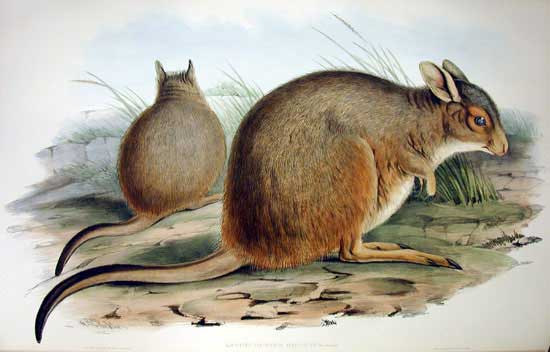
Adults are compact, with long hind legs for bounding, a long tail for balance and dense, shaggy fur that ranges from pale orange to deep rufous — the feature that gives the species its common name. The specific name hirsutus indicates a relatively hairy or shaggy coat. Malas are largely nocturnal and crepuscular, seeking shelter in vegetation or burrows during daylight. They are primarily solitary or occur in loose, temporary groups rather than forming stable social packs.
Diet consists mainly of grasses, herbs, leaves and seeds; they are typical herbivores in arid and semi-arid ecosystems and feed opportunistically on available plant matter. Their foraging behaviour and dietary choices are adapted to dry environments where food resources are patchy and seasonally variable; see general notes on herbivory and diet here.
Distribution, subspecies and historical range
Historically the mala occupied a broad swathe of central and western Australia, but populations have contracted dramatically. Today wild populations survive naturally only on predator-free islands in Shark Bay, notably Bernier and Dorre Islands. Reference to Shark Bay can be found here. A number of distinct population groups or subspecies have been recognised by mammalogists; a brief list follows:
- Lagorchestes hirsutus hirsutus — historically recorded on the mainland but now believed extinct.
- Lagorchestes hirsutus bernieri — the population on Bernier Island.
- Lagorchestes hirsutus dorreae — the population on Dorre Island.
- An unnamed desert form — once widespread in the Tanami and central deserts and now extinct in the wild but maintained in captivity and in translocated populations.
These distinctions are used in conservation planning and are summarised in taxonomic references and subspecies accounts here.
Threats, conservation actions and reintroductions
The mala declined precipitously through the twentieth century due to a combination of introduced predators (red foxes and feral cats), altered fire regimes, competition with introduced herbivores and habitat modification. To reduce extinction risk, conservationists established refuge populations on islands free of invasive predators and developed captive-breeding and translocation programs. The species has been the subject of active reintroduction efforts, including programs to return animals to parts of the Tanami Desert and other predator-managed sites; see projects in the Tanami Desert and the Northern Territory context.
Key conservation measures include:
- Predator control and exclusion fencing on mainland sites.
- Captive breeding and assurance colonies in conservation reserves here.
- Carefully planned translocations from island or captive stocks to managed release sites.
Overall conservation status and general policy notes are summarised in assessments that list the mala as a vulnerable species.
Cultural significance and notable facts
The mala has long cultural importance for Indigenous peoples of the Western Desert. It appears as a totemic animal and features in Dreaming stories and art traditions across the region. For cultural references see materials on totems, the Western Desert cultural zone and Indigenous Australian heritage here. The species was formally described in the mid-19th century by the naturalist John Gould, whose account remains an early scientific record of Australian mammals; see Gould's work here.
Further reading and resources
For additional information on identification, captive management and recovery programs consult targeted species profiles and recovery plans provided by conservation agencies and specialist organizations. General background on small macropod biology is available through summary resources on small wallaby ecology and conservation literature. Field sites and recovery projects often publish updates and practical guidance; examples include island-based stewardship in Shark Bay and mainland reintroduction case studies in the Northern Territory and Tanami.
Related articles
Author
AlegsaOnline.com Rufous hare-wallaby (mala): appearance, range, and conservation Leandro Alegsa
URL: https://en.alegsaonline.com/art/84649
Sources
- bucknell.edu : Mammal Species of the World
- iucnredlist.org : "Lagorchestes hirsutus"
- environment.gov.au : Mala Reintroduction Factsheet