
Saber-toothed cat: anatomy, evolution, and paleobiology
Extinct carnivorous mammals with enlarged upper canines that evolved repeatedly. Overview of anatomy, taxonomy, hunting hypotheses, fossil record, diversity, extinction theories and further resources.
Overview
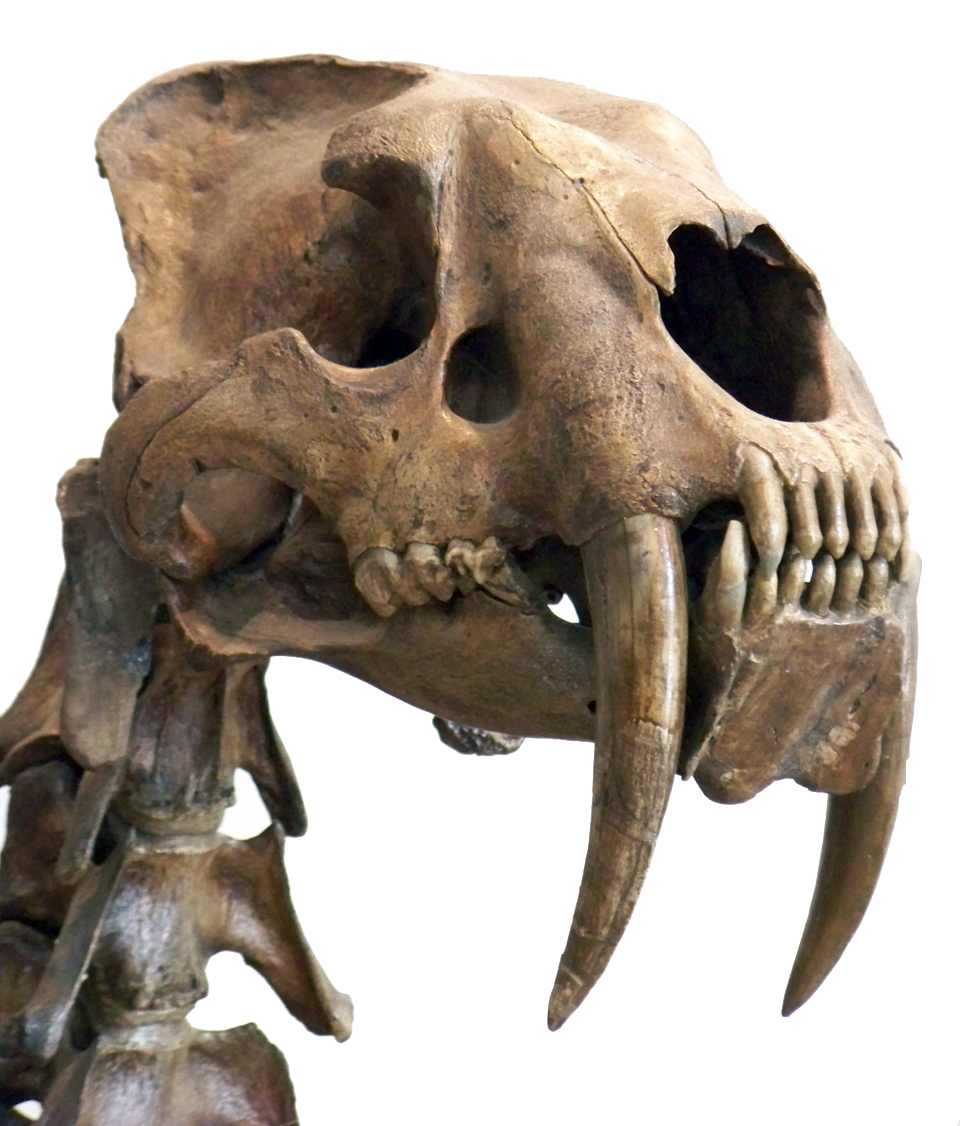
Saber-toothed cats, often called sabre-tooth or sabertooth predators, are a group of extinct carnivorous mammals recognized by their elongated upper canine teeth and adaptations for powerful bites at wide gape. The term is informal: it groups together species that convergently evolved similar dentitions and skull proportions rather than describing a single biological clade. True saber-toothed felids belong to the subfamily Machairodontinae within the family Felidae and include famous genera such as Smilodon. Other mammal groups evolved sabre-like canines independently, producing a variety of body plans and tooth shapes adapted to local prey and environments.
Image gallery
10 Images





Anatomy and adaptations
Saber-toothed species typically combined long upper canines with robust forelimbs, short powerful necks and wide skull openings for muscles that allow an extensive gape. The canines vary considerably: some are long and flattened like blades, others are shorter and conical, some bear serrated edges and others are thick and rounded. Many species show reinforced incisors and modified lower jaws to protect the elongated canines during feeding. Limb anatomy and muscle attachment sites indicate emphasis on strength for grappling large prey rather than sustained running; clavicles, scapulae and forelimb bones are often stout and heavily built compared with more cursorial predators.
Evolution and convergent origins
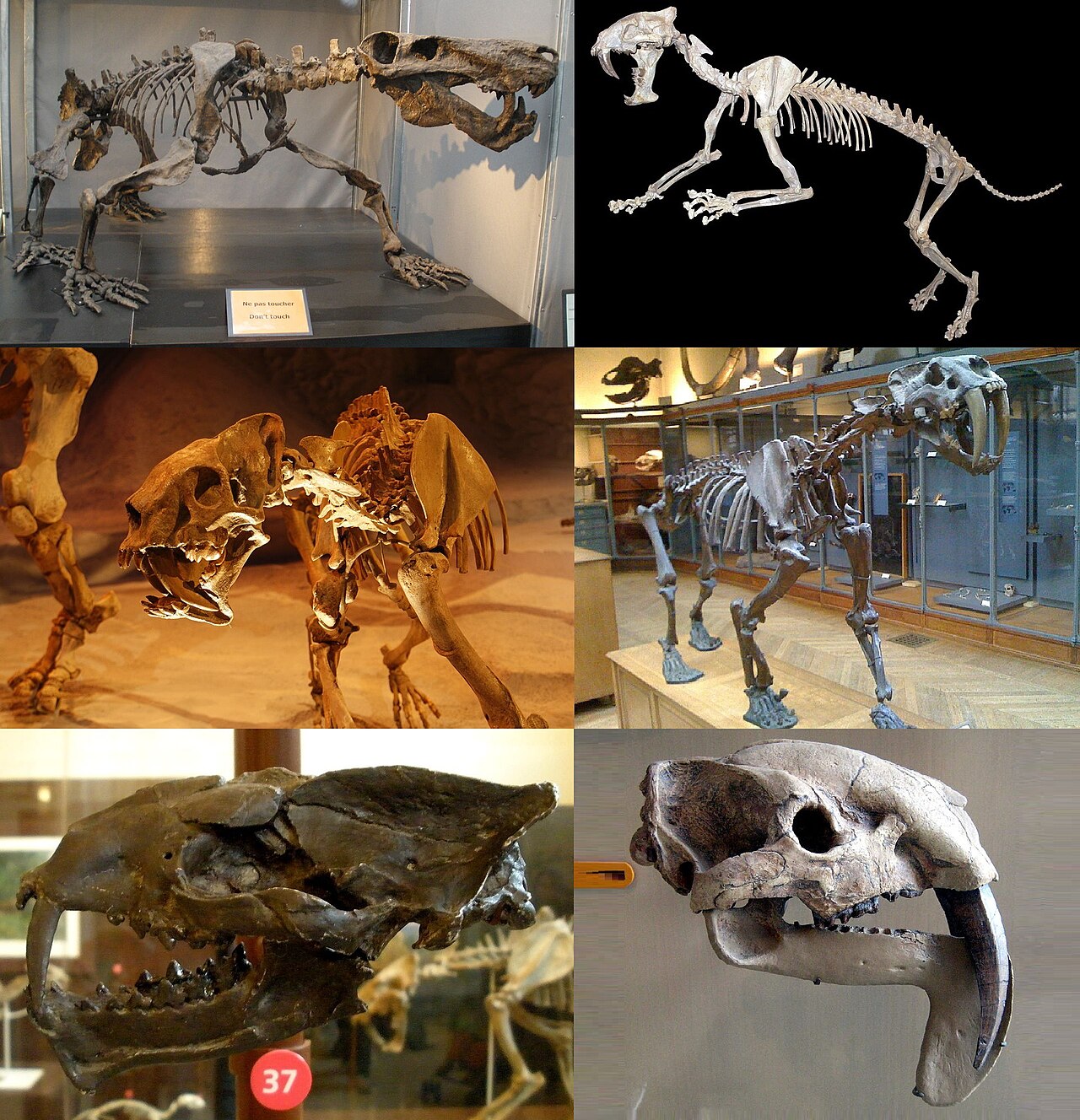
The sabre-tooth morphology evolved multiple times in mammalian history, making it a classic example of convergent evolution. Independent lineages that developed elongated canines include early creodonts in the Eocene, nimravids and barbourofelids among feliform carnivores, sparassodont metatherians in South America, and the machairodont felids (true saber-toothed cats). Each lineage adapted in parallel to ecological opportunities and prey types, producing comparable but distinct solutions to subduing large vertebrate prey.
Hunting behaviour and biomechanics
Fossil evidence and functional analysis support the hypothesis that many saber-toothed predators relied on ambush tactics. Robust forelimbs and stress-resilient pectoral regions suggest these animals used their forelimbs to seize or pin prey while delivering precise, forceful bites with the elongated canines aimed at vulnerable soft tissues such as the throat or belly. Bite force estimates and gape mechanics vary among taxa: some specialists had exceptionally deep, stabbing bites, while others may have used a slicing action. Tooth wear, healed injuries on bones and damage patterns on prey fossils contribute to reconstruction of their hunting style, but variation among species means no single model fits all saber-toothed forms.
Notable genera and groups
Representative examples illustrate the diversity of saber-toothed adaptations. The well-known Smilodon (a machairodontine) had extremely long upper canines and powerfully built forequarters. Homotherium had relatively shorter canines and more cursorial proportions. Nimravids and barbourofelids were cat-like feliforms that evolved saber teeth independently of felids. Sparassodonts such as Thylacosmilus show similar specialization in a metatherian lineage, with distinctive jaw flanges in some species. Early Eocene creodonts like Machaeroides exemplify an even earlier emergence of this morphology in a different order of carnivorous mammals.
Fossil record, distribution and taphonomy
Saber-toothed mammals are known from a wide range of fossil deposits across North and South America, Eurasia and Africa, with the most diverse records in the Neogene (Miocene to Pliocene) and some true saber-toothed felids surviving into the late Pleistocene. Fossil localities range from fluvial and lacustrine sediments to cave deposits that preserve relatively complete skeletons. Taphonomic studies, which examine how remains were buried and altered, help interpret behavior, seasonal patterns and associations with prey species found in the same deposits.
Extinction and ecological context
Extinctions of saber-toothed taxa occurred at different times and for different reasons in different regions. Broad factors often cited include climatic cooling, habitat shifts from closed woodland to more open grassland ecosystems, changes in herbivore communities, and competition with other predators. In some areas human activities may have contributed to late Pleistocene extinctions, but timing and relative importance vary among taxa. Because many saber-toothed forms specialized on large prey, reductions in available megafauna could disproportionately affect them.
Research methods and ongoing questions
Modern research on saber-toothed predators draws on comparative anatomy, biomechanical modelling, dental microwear and isotopic analyses, and study of pathology and healed injuries. These methods refine interpretations of diet, hunting techniques and social behaviour. Key unresolved questions include the degree of sociality in different taxa, the precise mechanics of killing in species with extreme canines, and the detailed causes of regional extinction events.
Cultural impact and significance
Saber-toothed cats such as Smilodon have a strong presence in popular culture and museums because of their dramatic appearance. They are frequently used as examples in discussions of convergent evolution, predator-prey relationships and the dynamics of extinction, and serve as a gateway for public interest in paleontology and evolutionary biology.
Further reading and external resources
- General review of saber-toothed predators
- Taxonomy and classification of felids and feliforms
- Convergent evolution: concepts and examples
- Creodont paleobiology and early carnivores
- Eocene epoch: climate and faunas
- Mammalian orders and higher taxonomy
- Feliformia: overview of the cat-like carnivores
- Machaeroides and other early sabertooth genera
- Nimravidae: the so-called false saber-tooths
- Basal groups in carnivore evolution
- Miocene epoch: environments and evolution
- Geologic time scales and epochs
- Sparassodonts and South American predators
- Thylacosmilus: a unique marsupial-like sabertooth
- Metatheria: marsupials and their relatives
- Marsupial comparisons and distinctions
- Pliocene fauna and climatic transitions
- Machairodontinae: true saber-toothed felids
- Felidae family overview
- Pleistocene megafauna and extinctions
- Smilodon: biology and fossil record
- Nimravides and distinctions from nimravids
- Felinae subfamily information
- Ambush predation strategies in mammals
- Woodland habitats and predator ecology
- Woodland to grassland transitions in the Neogene
- Extinction and fossilization processes
- Climate change and faunal turnovers
- Grassland expansion and ecological consequences
Questions and answers
Q: What are saber-toothed cats?
A: Saber-toothed cats, also known as sabretooth cats, were some of the best known and most popular extinct animals. They were impressive carnivores that had long canines and jaws which opened wider than modern cats.
Q: How many times did the saber-tooth style of life evolve?
A: The saber-tooth style of life evolved at least five times amongst carnivorous mammals.
Q: What is an example of a Creodont?
A: Machaeroides and Apataelurus are examples of Creodonts.
Q: What is an example of a Nimravid?
A: Hoplophoneus is an example of a Nimravid.
Q: What type of mammal was Thylacosmilus?
A: Thylacosmilus was a metatherian group of mammals.
Q: How did saber tooths kill their prey?
A: Saber tooths would hide in wait, then pounce on their prey and hang on round the neck, gripping and slashing the underside with their canine teeth to cause death by blood loss or lack of air supply.
Q: Why did they become extinct?
A: Saber tooths became extinct due to climate change as the world cooled and grassland took over from woodland in the Pliocene and Pleistocene epochs.
Related articles
Author
AlegsaOnline.com Saber-toothed cat: anatomy, evolution, and paleobiology Leandro Alegsa
URL: https://en.alegsaonline.com/art/85098
Sources
- dx.doi.org : 10.1111/1475-4983.00189